
Depression affects adult women at an estimated 6.2%, compared with 4.1% of men, according to the World Health Organization. That difference makes finding a psychiatrist for women more than a matter of preference. Good care considers not just your symptoms, but when they started, what else changed in your body and life, and which treatment fits your current stage.
What Makes Women's Psychiatric Care Different
A psychiatrist for women is a medical doctor, with an MD or DO degree, who evaluates and treats mental-health conditions with particular attention to women's needs. Psychiatric mental health nurse practitioners also provide women-focused psychiatric care, but they have a different professional credential and aren't psychiatrists. Women's mental health describes a clinical focus, not a separate license, so the provider's actual training matters.
The difference is the breadth of the evaluation. Depression, anxiety, trauma-related symptoms, and mood instability can overlap with reproductive transitions, medical conditions, medication effects, and major changes in relationships or responsibilities. A clinician shouldn't assume that every symptom is hormonal, or ignore hormones altogether.
Think of a general road map and a trail guide. The map shows the route, but a guide who knows the terrain checks whether the bridge is still passable. Similarly, a women-focused clinician looks beyond the diagnosis to factors that could change the treatment plan.
What a thoughtful first visit covers
Low mood following childbirth, low mood alongside thyroid symptoms, and low mood during perimenopause may sound similar at first. They don't automatically call for the same response, and psychiatric assessment may include coordination with primary care or obstetric care.
Expect questions about:
- Reproductive context: Menstrual timing, pregnancy, breastfeeding, contraception, and fertility treatment.
- Daily functioning: Sleep, energy, concentration, appetite, work, and caregiving.
- Personal history: Trauma, earlier episodes, previous treatment, and family psychiatric history.
- Physical health: Medical conditions, current prescriptions, supplements, and recent changes.
You don't need to arrive knowing which factor matters most. Your job is to describe what's happening; the clinician's job is to investigate without reducing your experience to a hormone level.
A useful first-visit test: Does the clinician ask how your symptoms fit into your health, reproductive stage, and daily life, rather than only checking a symptom list?
Warning Signs That Call for Booking or Urgent Care
In 2021–2022, 22.9% of U.S. women ages 18–44 reported that their mental health wasn't good for at least 14 days during the previous 30 days, according to America's Health Rankings' 2024 report. You don't have to wait until symptoms become unbearable to seek care.
Get urgent help when safety changes
Seek same-day assessment if you have thoughts of ending your life or harming someone else, can't care for yourself or a newborn, hear or see things others don't, or have racing thoughts with very little sleep for several days. These symptoms need urgent attention, particularly after childbirth.
In the United States, call or text 988 for the Suicide and Crisis Lifeline. Call 911 for immediate danger. If possible, have a trusted person stay with you and help arrange care; don't wait for a routine outpatient appointment when you can't stay safe.
Book soon when symptoms disrupt daily life
Schedule an evaluation for:
- Persistent low mood: Sadness or loss of interest most days for two weeks or more.
- Anxiety that restricts you: Panic attacks, constant worry, or avoidance that changes your routines.
- Changes in basic functioning: Sleep, appetite, or concentration that's becoming difficult to manage.
- Trauma symptoms: Intrusive memories, nightmares, or feeling constantly on guard.
- Life-stage changes: Mood swings, numbness, or distress after childbirth or during the menopause transition.
- Increasing substance use: Relying more on alcohol or other substances to cope.
If symptoms coincide with menstrual changes or menopause, ProMD Health's explanation of treatment options for low hormone levels can help you prepare questions for a medical visit. It isn't a substitute for psychiatric assessment, and suspected hormonal changes shouldn't delay urgent care.
If symptoms persist for two weeks or disrupt work, parenting, relationships, or sleep, schedule the visit. You can seek help sooner, and you don't need to prove that you're struggling enough.
Who Does What Among Psychiatrists, Therapists and Psychologists
Provider types, training and prescribing authority
| Provider | Training | Prescribes Medication | Typical Role |
|---|---|---|---|
| Psychiatrist (MD or DO) | Medical degree plus psychiatry residency | Yes | Diagnosis, medication management and therapy |
| Psychiatric nurse practitioner (PMHNP) | Graduate nursing degree with psychiatric specialty | Yes | Medication management, often with therapy referrals |
| Psychologist (PhD or PsyD) | Doctoral training in psychology | Usually no | Psychological testing and psychotherapy |
| Licensed therapist (LPC, LCSW or LMFT) | Master's-level counseling, social work or marriage and family training | No | Talk therapy, with EMDR where trained |
Medication questions usually need a prescriber. Psychiatrists and psychiatric nurse practitioners can prescribe and adjust psychiatric medication within their professional scope. Psychologists and licensed therapists generally don't prescribe, although psychologists have prescribing authority in certain jurisdictions with additional qualifications.
That distinction doesn't mean prescribers only discuss pills or therapists only listen. A psychiatric evaluation considers diagnosis, medical contributors, safety, and treatment choices; psychotherapy helps you work on patterns, relationships, emotional regulation, and coping. This explanation of what a psychiatrist does can help clarify what to expect from that appointment.
Match the professional to the task
A psychologist is often a good starting point when you need detailed psychological testing, such as an assessment to clarify overlapping symptoms or learning and cognitive concerns. A licensed therapist is well suited to ongoing psychotherapy, including structured work on anxiety, trauma, relationships, or adjustment to a life transition.
Some psychiatrists also provide psychotherapy. Therapists with specific training may offer EMDR, a structured trauma treatment, but a therapy license alone doesn't establish EMDR training.
Many women work with both a therapist and a prescriber. For example, someone with panic attacks might practice exposure-based skills in therapy while a psychiatric provider monitors medication response and side effects. With your permission, the providers can coordinate goals rather than give disconnected advice.
Check the letters after the clinician's name, then ask about their actual work. MD or DO, PMHNP-BC, PhD or PsyD, and LPC, LCSW, or LMFT identify different training pathways, not interchangeable titles.
If your goal includes medication, start with a psychiatrist or psychiatric nurse practitioner. If your main goal is ongoing talk therapy or testing, choose the professional trained for that task.
Life Stages When Women's Symptoms Shift
Symptoms can change across reproductive stages, but timing alone doesn't establish a diagnosis. The National Institute of Mental Health's guidance on women's mental health identifies the premenstrual phase, pregnancy and postpartum period, and menopause transition as important contexts for assessment.
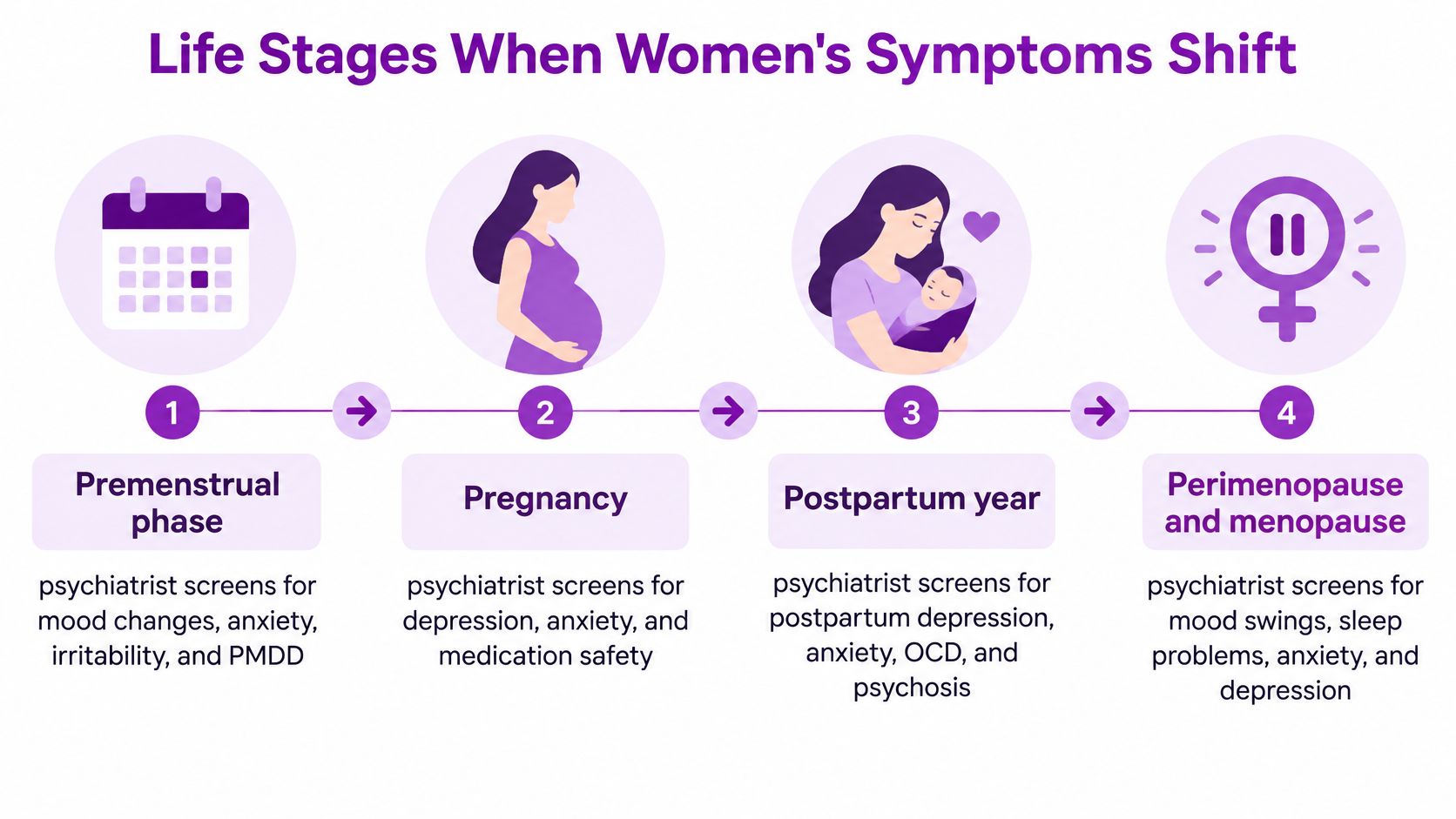
From the premenstrual phase through postpartum
Before menstruation, the clinician asks whether irritability, anxiety, depression, or emotional sensitivity appear in a recurring cycle. Symptoms that largely resolve after menstruation suggest a different pattern from depression that continues throughout the month and worsens before a period. Tracking helps distinguish premenstrual dysphoric disorder, or PMDD, from premenstrual worsening of another condition.
During pregnancy, assessment includes depression, anxiety, sleep, previous episodes, and the treatment plan. Distressing thoughts can be difficult to disclose, so describe their content, whether they feel unwanted, and whether you feel any urge to act on them.
During the postpartum year, screening extends beyond sadness to anxiety, obsessive-compulsive symptoms, bipolar relapse, and psychosis. A clinician distinguishes unwanted, frightening intrusive thoughts from intent to act, while assessing safety directly. Unusual beliefs, perceptual changes, or markedly reduced need for sleep require a different response from ordinary exhaustion.
Through perimenopause and menopause
During perimenopause and menopause, hot flashes, disrupted sleep, anxiety, and depression may occur together. A sleepless night can leave someone both physically uncomfortable and emotionally depleted, but the clinician still needs to determine whether a depressive or anxiety disorder is present.
In a 2025 qualitative study, depression was reported in 36 participants and anxiety in 34, while 32 found hormone therapy helpful and five reported benefit from antidepressants, as described in the Women's Health study. These participant accounts aren't a head-to-head treatment trial and don't show that one treatment is generally superior. They do illustrate why a clinician should consider hormonal symptoms, psychiatric history, sleep, and treatment experiences together.
For accessible background before an appointment, Momotaro Apotheca's guide to hormonal changes can help you put questions into words. Use educational material to support the conversation, not to diagnose yourself.
Bring a simple log that includes:
- Timing: Mood changes in relation to your cycle.
- Reproductive status: Pregnancy, lactation, contraception, or fertility treatment.
- Earlier episodes: Previous pregnancy-related or postpartum symptoms.
- Sleep and physical symptoms: Night waking, hot flashes, and night sweats.
- Relevant history: Trauma exposure and family mental-health history.
If you're stable enough to wait, track mood, sleep, and cycle for two months and bring the log to your visit. Don't postpone assessment to finish it.
Treatment Options and How They Work Together
Treatment options compared
| Option | Best Suited For | What It Involves | Often Paired With |
|---|---|---|---|
| Talk therapy (CBT, DBT, interpersonal therapy) | Mild to moderate depression and anxiety, skill building | Weekly or biweekly sessions with structured practice | Medication or EMDR |
| Medication (SSRIs, SNRIs, mood stabilizers) | Moderate to severe symptoms, bipolar disorder, psychosis, with medication chosen for the diagnosis | Prescriber visits, dose adjustment and monitoring | Talk therapy |
| EMDR | Trauma and PTSD memories | Structured sessions using bilateral stimulation to process memories | Talk therapy or medication |
| Combined care | Symptoms that shift across life stages | Coordinated psychiatrist and therapist plan | All options as needed |
These options aren't interchangeable. CBT, or cognitive behavioral therapy, helps you examine patterns of thinking and behavior; DBT, or dialectical behavior therapy, teaches skills such as distress tolerance and emotional regulation. Interpersonal therapy focuses on relationships, grief, and role changes, while EMDR targets distress connected to traumatic memories.
Medication selection follows the diagnosis, not how distressed someone feels. Antidepressants, mood stabilizers, and antipsychotic medicines have different purposes; an SSRI isn't a treatment for every condition listed in the table.
Make the medication decision in the right order
Before starting an antidepressant, screen for bipolar disorder if that hasn't already been done. The American College of Obstetricians and Gynecologists' perinatal assessment and treatment guidance recommends this step because unrecognized bipolar illness can be destabilized by antidepressant treatment alone.
The same guidance identifies psychotherapy as a first-line option for mild-to-moderate perinatal depression and SSRIs as first-line medication treatment for perinatal depression or anxiety. It also advises against withholding or stopping psychiatric medication solely because of pregnancy or lactation status.
That doesn't make medication automatically safe or automatically dangerous. The decision includes the specific medicine, previous response, adverse effects, pregnancy or breastfeeding circumstances, and the risks of untreated illness. Don't stop or change medication on your own after a positive pregnancy test; arrange a medication review.
For severe conditions such as bipolar or psychotic disorders, the ACOG treatment and management guideline supports continued medication management during pregnancy and postpartum, with individualized planning. Coordination between psychiatric and obstetric clinicians is especially important when several medicines or medical conditions are involved.
What individualized care looks like
Consider these different starting points:
- Recurrent depression with previous benefit: A woman who improved on an antidepressant before may discuss restarting that medicine rather than automatically choosing something unfamiliar. Previous benefit is important, but the clinician still reviews current circumstances and risks.
- Possible bipolar symptoms: A woman describing episodes of unusually high energy and reduced need for sleep needs diagnostic clarification before an antidepressant-only plan.
- Trauma-centered symptoms: A woman distressed by a traumatic event may choose EMDR with a trained therapist and keep medication changes minimal when clinically appropriate.
Monitoring should be part of the prescription, not an afterthought. A baseline symptom questionnaire, follow-up scores, side-effect review, and practical goals help the clinician judge whether treatment is working. Postpartum follow-up should be planned rather than left to the patient to arrange while exhausted.
A psychiatric medication management provider can explain what will be monitored and who to contact between visits. Ask how the plan accounts for sleep, functioning, and your own priorities, not just whether a score improves.
Ask before you leave: Which option are we choosing, and what would show it's working within four to six weeks?
That's a discussion window, not a promise of recovery. Ask separately which symptoms or side effects should trigger earlier contact.
How to Choose the Right Psychiatrist for Women
Start with clinical qualifications, then narrow the choice by experience and communication. A clinician's gender or a convenient appointment can matter, but neither replaces appropriate training for your concern.
Six criteria worth prioritizing
Training and licensure. Confirm an active Arizona license and either psychiatry board certification or an appropriate psychiatric nurse practitioner credential. Check the clinician's specific professional title so you know whether you're booking with a physician or an advanced-practice nurse.
Experience with your life stage. Ask whether the clinician regularly treats concerns like yours, such as PMDD, pregnancy-related illness, postpartum symptoms, or perimenopausal depression. Have them explain how they coordinate with an obstetrician, primary care clinician, or menopause specialist when the plan crosses specialties.
A clear medication approach. Ask how they account for reproductive plans, breastfeeding, previous medication responses, and possible bipolar symptoms. Look for an explanation of follow-up measurements, side-effect monitoring, and what happens if the initial plan doesn't help.
Access to appropriate therapy. Ask whether a recommended therapy requires specific training, especially for trauma-focused treatment such as EMDR. Clarify how a therapist and prescriber would share relevant information with your permission and who would lead each part of treatment.
Your gender preference. Wanting a woman clinician for sensitive conversations is a reasonable preference, though it doesn't guarantee a particular clinical approach. Women represented 46% of psychiatrists globally and 54% of psychiatry trainees in the World Psychiatric Association's global survey reported in 2025, according to the published survey.
Communication and trust. A first appointment should allow you to ask questions, disagree respectfully, and explain what you want treatment to change. Notice whether the clinician explains their reasoning in plain language and takes your concerns about side effects or diagnosis seriously.
Make the first call useful
At reVIBE Mental Health, we offer personalized matching based on your needs and preferences. Tell us your main concern, preferred clinician characteristics, and insurance rather than asking only for the first available opening.
Our therapy sessions are generally confidential, and information isn't disclosed without your consent except when you're at risk of harming yourself or others, or when there's suspected child or elder abuse. Ask the clinician to explain how confidentiality and care coordination apply to your circumstances.
Useful questions for the first call include:
- Clinical match: Who has experience with my particular reproductive stage and symptoms?
- Visit type: Will my initial appointment include a diagnostic evaluation, therapy, or medication assessment?
- Ongoing contact: How do I reach the care team if my symptoms change before follow-up?
Insurance, Telehealth and Costs in Arizona
Verify psychiatry and therapy coverage separately. They can involve different billing arrangements, clinicians, or benefit rules, even when both happen within the same practice. An insurance card alone doesn't confirm what a particular visit will cost.
Start with your insurer's directory, then confirm the specific clinician and service with the practice. Ask about your deductible, copay or coinsurance, referral requirements, and any authorization needed before the appointment. Keep the representative's name or reference number if you're given one.
Confirm the practical details
- Network status: Check the individual provider, not just the practice name.
- Telehealth eligibility: Confirm that the clinician is authorized to treat you where you'll physically be during the appointment, including Arizona licensure or other applicable authorization.
- Scheduling and billing: Ask whether therapy and medication visits can happen on the same day and how each will be billed.
- Your estimate: Request an estimate based on your current benefits, and compare it with any private-pay option.
Our insurance and mental-health guidance can help you prepare for benefit verification. Coverage estimates still need to reflect your own plan and the clinician you'll see.
Choose the format around the clinical need
Online visits remove travel and can suit routine follow-up when privacy, a reliable connection, and an appropriate clinical setting are available. Plan somewhere you can speak freely, not while driving or caring for others without support.
In-person appointments may suit someone who prefers face-to-face evaluation, needs closer observation after a significant change, or needs coordination with a physical examination. If laboratory work is recommended, confirm where it will be completed rather than assuming it's available at the psychiatric office.
Costs can change with coverage, clinician credentials, and private-pay arrangements. Insurance affects the price, not whether symptoms deserve attention, so choose a clinically appropriate visit and then clarify the financial details before you attend.
Book Your First Visit in the Phoenix Area
You can request an appointment without having a diagnosis. Briefly describe what you're experiencing, such as anxiety after childbirth, mood changes before periods, or depression during menopause. This helps the scheduling team match you with a provider whose training and approach fit your needs.
- Choose a format. reVIBE offers in-person and secure online therapy and medication support. Consider which setting works best for your schedule and comfort.
- Request a provider match. Tell the team whether you're seeking therapy, psychiatric care, or both, and share any preferences about your provider.
- Ask about the first visit. Confirm who you'll meet and what follow-up may involve.
- Prepare key information. Bring a medication list, notes about previous treatment responses, and any symptom log you've started. Details about your reproductive stage can help the provider understand when symptoms occur.
The location directory describes access to in-person and online care. The cost of therapy or psychiatric services varies based on insurance coverage, provider licensure, and private-pay options.
Find a reVIBE Location Near You!
reVIBE serves Scottsdale, Tempe, Chandler, Phoenix, and Paradise Valley, Arizona. To find a convenient setting, ask about in-person appointments or secure online care. Appointments are available seven days a week.
For nonurgent concerns, contact reVIBE through its website to request a personalized match. Share your symptoms, preferred format, and whether you're looking for therapy, psychiatric care, or medication management.
At reVIBE Mental Health, therapists and licensed psychiatric professionals provide therapy, psychiatric care, and medication management in person or through secure online sessions. Request a first appointment and describe the support you're seeking.