
The common advice to see a psychiatrist and get medication after trauma skips an important decision: what kind of care do you need? More treatment isn't automatically better. A useful psychiatric visit clarifies what's happening, checks safety and overlapping conditions, and determines whether medicine would help you participate in recovery.
For many people, the starting point is trauma-focused therapy, not a prescription. Psychiatry becomes especially valuable when symptoms disrupt daily life, the diagnosis isn't clear, or sleep, depression, substance use, or other illnesses complicate the picture.
Who Needs a Psychiatrist for Trauma
Who to see first for trauma
| Situation | Start with | Why |
|---|---|---|
| Single trauma and mostly able to function | Trauma-focused therapist | Processing is the first-line treatment |
| PTSD symptoms blocking sleep, work, or relationships | Psychiatrist plus therapist | Diagnosis, safety monitoring, and coordination |
| Depression, bipolar pattern, ADHD, or heavy substance use | Psychiatrist | Overlapping illness changes the plan |
| Therapy already tried and symptoms still severe | Psychiatrist for a medication review | Medicine supports therapy rather than replacing it |
| Suicidal thoughts or urgent overwhelm | Same-day psychiatric or emergency care | Safety comes before trauma processing |
| Prefers no medication and can do therapy | Therapist, psychiatrist available if needed | Preference is a valid reason to delay medicine |
A psychiatrist for trauma is a physician who evaluates trauma-related symptoms, diagnoses psychiatric conditions, and prescribes and monitors medication when appropriate. The American Psychological Association's discussion of PTSD treatment guidance describes trauma-focused psychotherapy as the usual starting point, with medication considered when therapy is unavailable, declined, insufficient, or poorly tolerated. Experiencing trauma doesn't automatically mean you have PTSD, and having PTSD doesn't automatically mean you need medication.
A psychiatric evaluation adds a medical and diagnostic perspective even when a therapist leads treatment. The clinician checks whether depression, suicidal thoughts, disturbed sleep, substance use, longstanding attention difficulties, or episodes suggestive of bipolar illness change the plan. For example, poor concentration that began after an assault calls for a different assessment than attention problems present since childhood.
Match the clinician to the problem
If you're functioning reasonably well but avoiding reminders of an upsetting event, a trauma-focused therapist may be the most direct fit. If you're missing work, barely sleeping, or struggling to stay safe, medical assessment deserves greater priority. Don't wait for a particular duration of symptoms before seeking help for serious impairment.
The urgent-care row also needs context. Suicidal thoughts warrant prompt assessment; intent, a plan, access to a means of self-harm, or inability to stay safe calls for emergency care rather than a routine appointment. If you're in immediate danger, go to an emergency department or contact emergency services.
Practical rule: Choose care around the problem that needs attention, not around an assumption that a psychiatric appointment must end with a prescription.
Legal concerns may need a separate professional. If trauma involves a potential legal claim, Nares Law Group PTSD representation from Nares Law Group LLC is a resource to review for that separate question. Legal representation doesn't replace clinical assessment, and treatment should follow your health needs rather than the needs of a claim.
Match your situation to the table before booking. You can seek an evaluation and still decide, with the clinician, that therapy without medication is the right plan.
How Trauma-Focused Psychiatry Reads the Story
Think of the traumatic event as a fire and your body's alarm as its response. A trauma-focused psychiatrist asks whether the alarm is gradually resetting or keeps ringing after the immediate danger has passed. That distinction isn't a judgment about strength, resilience, or how upsetting the event should have been.
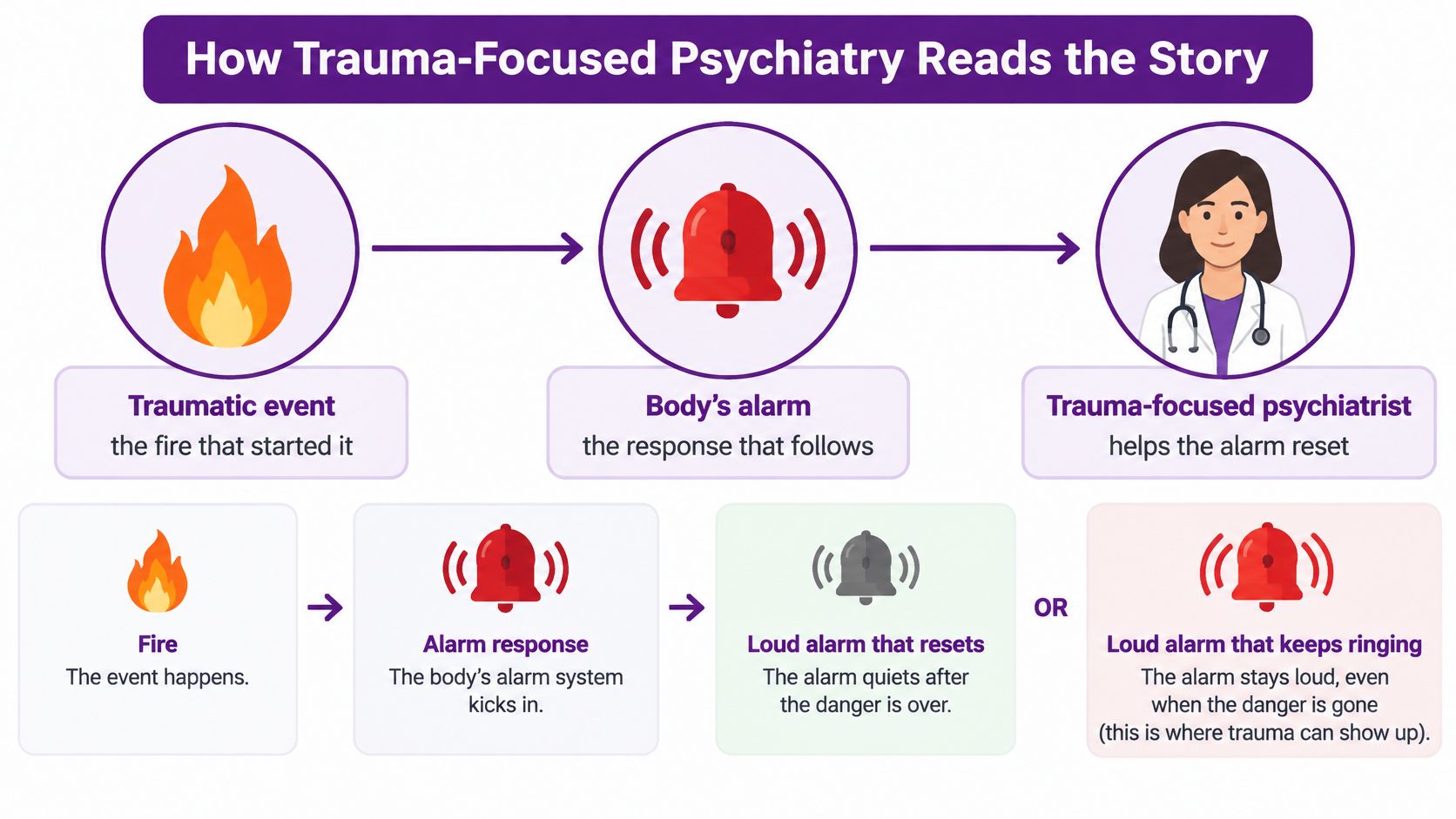
The World Health Organization reports that approximately 70% of people worldwide experience a potentially traumatic event during their lifetime, while about 5.6% of exposed individuals develop PTSD. People exposed to trauma therefore don't develop the disorder, although they may still need support.
What the alarm looks like in daily life
Say someone survives an assault and later feels panicked whenever footsteps approach from behind. The clinician records anxiety but doesn't stop there. They ask what happens in the person's body, whether the memory feels present rather than past, which situations the person avoids, and how those reactions affect everyday life.
The assessment covers distinct areas:
- Intrusion: Unwanted memories, nightmares, or flashbacks interrupt the present.
- Avoidance: The person avoids places, conversations, people, or internal reminders associated with the event.
- Mood and beliefs: Persistent guilt, detachment, shame, or beliefs that nowhere is safe affect how the person lives.
- Hyperarousal: Startling easily, scanning for danger, irritability, and difficulty sleeping keep the body on alert.
- Impairment: Symptoms interfere with work, home responsibilities, relationships, or ordinary activities.
Context changes the interpretation
The clinician also asks when the event happened, whether it happened repeatedly, and whether another person caused the harm. Someone who still faces threats needs help with present-day safety, not an assumption that every alarm is a false alarm.
History matters without requiring a detailed retelling at the outset. You can describe the category of event, when symptoms began, and what has changed without narrating every painful detail. A careful clinician explains why a question matters and gives you room to pause.
Depression, substance use, and brain injury also belong in the assessment because they can occur alongside trauma-related symptoms. The working diagnosis should explain the pattern well enough to guide care, while remaining open to revision as the clinician learns more.
The aim isn't to dismiss distress when it doesn't meet the criteria for PTSD. It's to name the problem accurately so you aren't given a treatment that targets the wrong cause.
Treatments That Come Before a Prescription
More treatment is not automatically better. For PTSD, a psychiatrist's role is often to clarify the diagnosis, assess safety and sleep, and identify other conditions that may affect care. Trauma-focused therapy is usually considered before medication, with the person's preferences and ability to participate shaping the plan.
The 2023 VA/DoD clinical practice guideline recommends individual trauma-focused psychotherapy, particularly Cognitive Processing Therapy, Prolonged Exposure, and EMDR, over medication alone. These therapies generally lead to greater symptom improvement that lasts longer. A therapy-first approach means offering an effective option with informed choice, not requiring someone to endure distress without support.
Trauma treatments and where medicine fits
| Option | Role | Time window | Evidence note |
|---|---|---|---|
| Cognitive Processing Therapy | First-line individual therapy | About three months | The National Center for PTSD reports meaningful improvement in about 57 out of 100 patients receiving CPT, PE, or EMDR after roughly three months, versus about 8 out of 100 untreated patients |
| Prolonged Exposure | First-line individual therapy | A structured course paced with the therapist | Recommended alongside CPT and EMDR as a first-line option |
| EMDR | First-line reprocessing with bilateral stimulation | A structured course based on the treatment plan | Recommended over medication alone |
| Sertraline, paroxetine, or venlafaxine | Medicine when therapy is unavailable, declined, or not enough | An approximately 8–12-week therapeutic trial, according to the VA clinician's medication guide | Strongest guideline-supported PTSD medications |
| Benzodiazepines | Generally avoid for PTSD | Not a recommended PTSD treatment course | No proven PTSD benefit and may impair therapy |
| Medicine added to therapy for every patient | Not automatic | Individualized | May suit some severe or comorbid cases, but is not consistently better for most |
What the therapies actually involve
Cognitive Processing Therapy (CPT) examines beliefs that have become stuck around blame, trust, control, and safety. A therapist might help someone consider whether failing to predict an assault means they caused it. The aim is to assess the belief, not dismiss the person's experience.
Prolonged Exposure (PE) involves revisiting trauma memories and gradually approaching avoided situations that are objectively safe. The therapist plans this work with the person. It does not mean entering genuine danger or confronting everything at once.
Eye Movement Desensitization and Reprocessing (EMDR) works with distressing memories through a structured process that includes bilateral stimulation, such as eye movements, taps, or sounds. It is more than following a moving finger: assessment, preparation, and follow-through also shape the treatment.
A guide to trauma-focused therapy for adults can help you prepare questions about choosing a method. Ask what sessions involve and how the therapist will respond if you feel overwhelmed.
When medicine changes the plan
Medication may make care more workable if depression, persistent arousal, or other symptoms make daily functioning or therapy participation difficult. Sertraline and paroxetine are SSRIs, while venlafaxine is an SNRI. A prescriber considers previous responses, side effects, other medicines, and co-occurring illness when discussing a choice.
A fair medication trial includes an appropriate starting dose, gradual adjustment, and monitoring. Symptoms can change at different speeds. Sleep, intrusive memories, mood, and arousal may not improve together, so follow-up helps determine whether the plan is working.
Benzodiazepines are not a routine PTSD treatment because they carry dependence and harm risks, have no proven PTSD benefit, and may interfere with trauma-focused care. Anyone already taking one should discuss a supervised plan with the prescriber rather than stopping abruptly.
Adding another medication should answer a specific clinical question. It should not replace checking the diagnosis, side effects, or whether the therapy fits.
Pain that makes sessions difficult can be raised with the treating clinician. An overview of non-drug options for pain relief may help prompt discussion, but it does not replace an injury assessment. During trauma processing, the psychiatric clinician also monitors sleep, substance use, suicidality, and dissociation, adjusting care when needed.
When Trauma Overlaps Injury Pain or Substances
After a crash, headaches, poor sleep, irritability, and flashbacks may have several overlapping causes. A concussion, neck pain, a sleep disorder, alcohol use, and a trauma response can occur together, with each affecting the others. A psychiatrist's role is to help clarify what may be driving symptoms and whether other medical or behavioral care is needed.
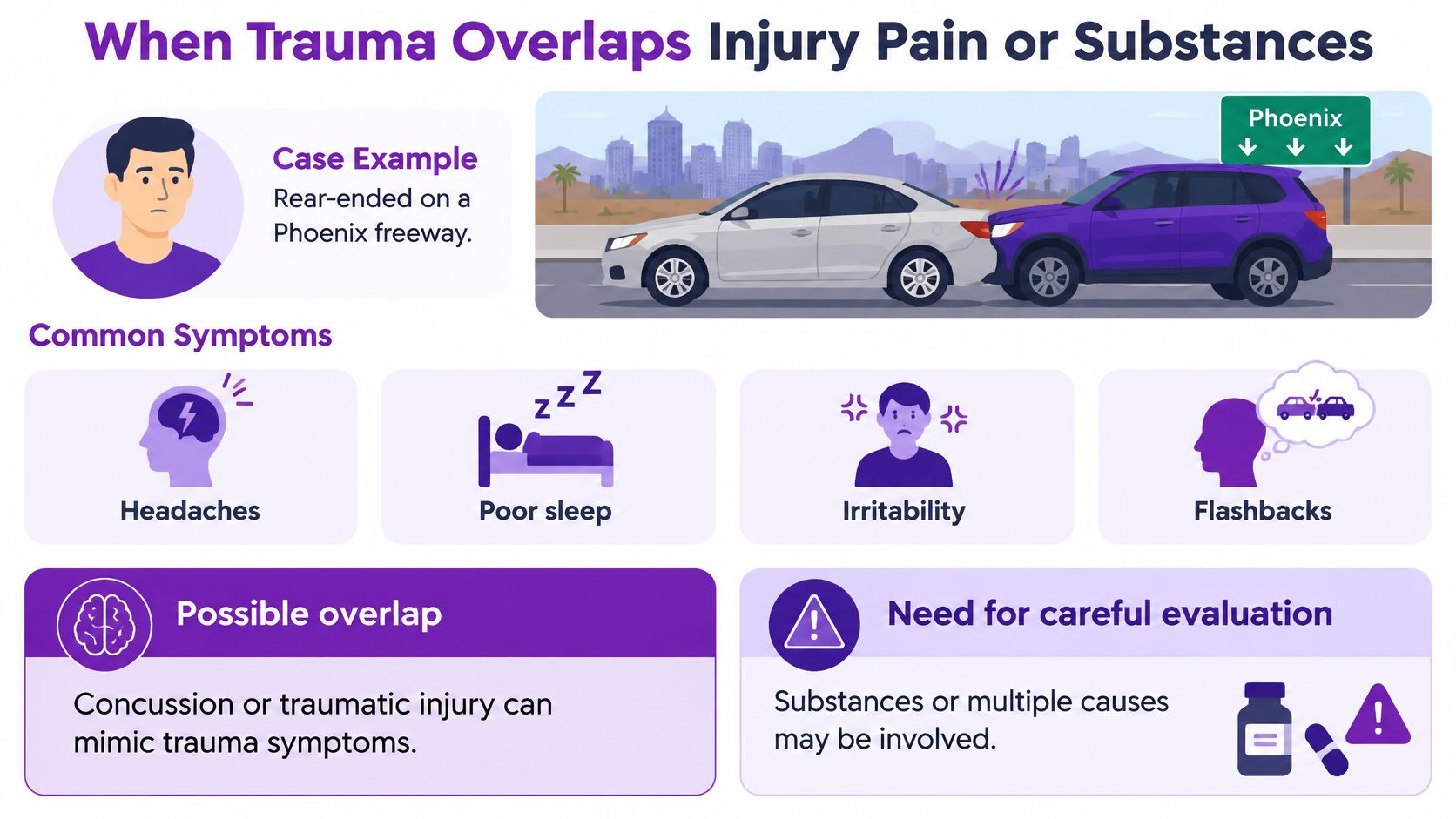
Separate the causes before adding treatment
A careful assessment asks when symptoms began, what makes them worse, and whether memory, balance, or attention changed. Cognitive screening may indicate a need for further evaluation, but it cannot identify the cause by itself.
Pain, cognitive difficulty, sedation, and seizure risk can affect medication choices and how quickly a dose is adjusted. Coordinating with neurology, primary care, pain care, rehabilitation, or addiction treatment may address the whole picture better than adding another standard PTSD medication.
Substance use also belongs in the assessment. Alcohol taken to fall asleep, cannabis used to quiet memories, or nonprescribed sedatives can affect symptoms and medication safety. An accurate, nonjudgmental discussion helps the clinician make safer decisions and shape care around the person's needs.
Keep emerging care separate from established care
A 2025 review in Frontiers in Psychiatry discusses modified dosing after brain injury and gaps in guidance for emerging treatments. It also describes a systematic review of 94 studies, reporting randomized-trial response rates of 12.5% to 80% for TMS, 17% to 67% for intravenous ketamine, and 50% to 87% for MDMA-assisted therapy.
These figures are not a head-to-head comparison or a prediction of an individual's response. The studies used different populations, treatment protocols, and definitions of response, so the ranges cannot show which option will work best for one person.
Other emerging approaches include transcranial direct-current stimulation, vagal-nerve stimulation, and photobiomodulation. Their evidence, availability, and clinical status for trauma-related conditions differ.
Before pursuing a new device or drug: Ask what is established for your symptoms, what remains experimental, and which specialist should be involved.
The first priority is stabilization and diagnostic clarity. Newer treatments warrant careful consideration, without assuming they are appropriate or promising results beyond the evidence. Physical recovery can be addressed separately through car accident rehabilitation options, while psychiatric care focuses on symptoms, safety, and treatment fit.
Questions That Vet a Trauma Psychiatrist
Start with the clinician's professional role. A psychiatrist is a physician with an MD or DO degree; a psychiatric mental health nurse practitioner, including a clinician with PMHNP-BC credentials, is a different type of psychiatric provider. Both may participate in trauma care, but the titles aren't interchangeable.
Check for an active professional license and specific experience treating PTSD. A broad claim of being trauma-informed describes an approach to care; it doesn't establish that someone provides a structured trauma treatment or routinely manages complicated trauma presentations.
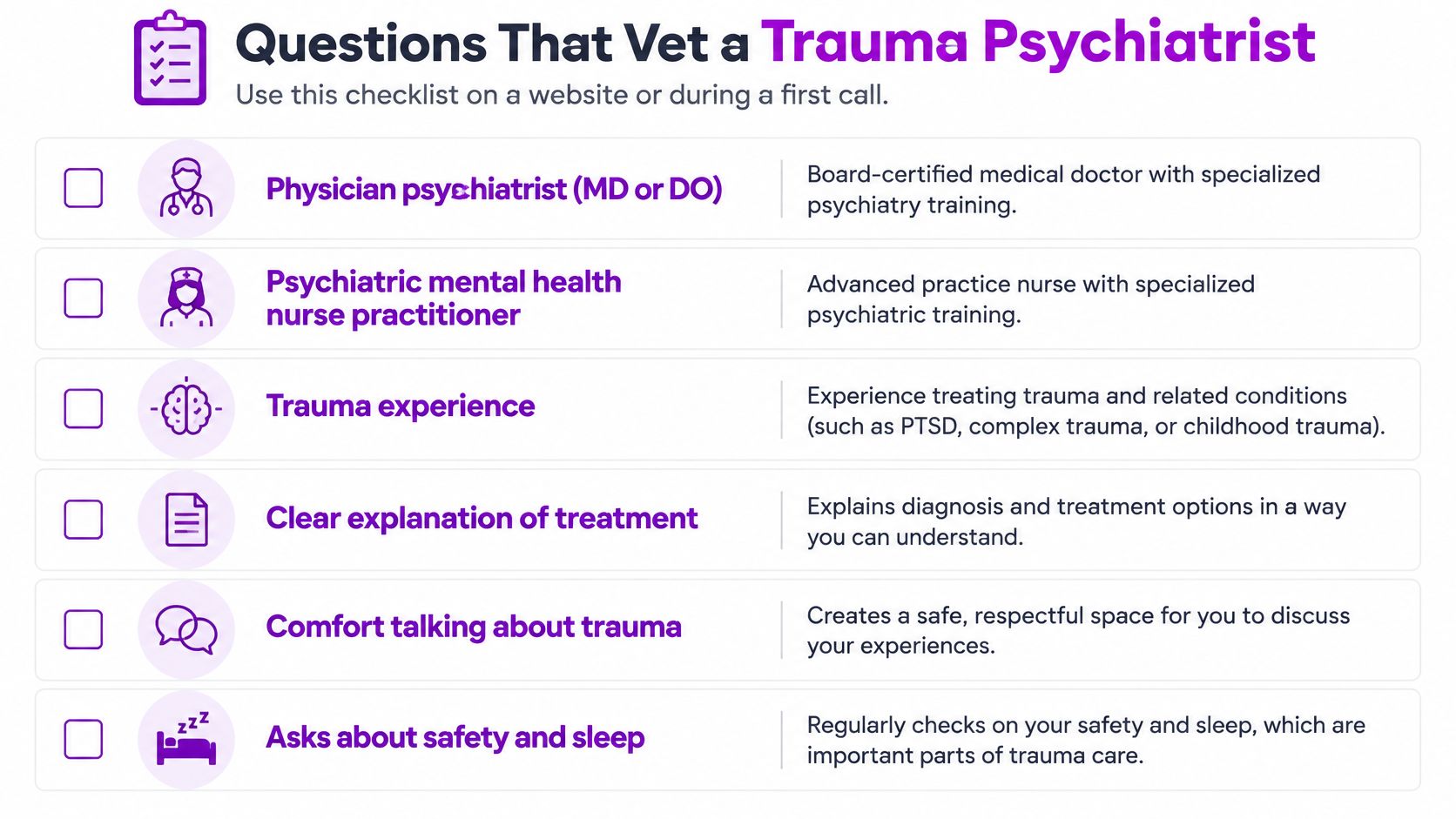
Questions for a website review or first call
- Clinical focus: Do you treat PTSD and complex trauma regularly, or mainly depression and anxiety? Ask how the clinician handles symptoms that don't fit neatly into a diagnosis.
- Therapy access: Do you recommend trauma-focused therapy, and who provides CPT, Prolonged Exposure, or EMDR? A prescriber doesn't need to deliver every therapy personally, but should know how to coordinate it.
- Medication reasoning: Which medicines do you consider first, what would each target, and how will we decide whether a trial has helped?
- Difficult symptoms: How do you assess nightmares, substance use, dissociation, and suicidal thoughts? Listen for a clear process rather than reassurance alone.
- Communication: Will you coordinate with my therapist, with my permission, and how do I contact the practice if symptoms worsen?
- Practical fit: Are visits available in person or by secure video, when is the next opening, and does the clinician participate in my insurance network?
The guide to how to find a good psychiatrist can help you organize broader questions about fit and communication. Keep the answers in writing so you can compare clinicians rather than relying on how polished a website looks.
Red flags and green flags
Be cautious about promises of a cure during an initial visit, benzodiazepines presented as the main PTSD treatment, or pressure to buy an experimental intervention before a basic assessment. Refusing to coordinate with an existing therapist without a clear reason also deserves scrutiny.
Green flags include an understandable working diagnosis, a written plan, clear safety steps, and an explanation of what would prompt a change. A clinician should be willing to say that medication isn't necessary and to discuss uncertainty without making you feel dismissed.
Comfort matters, but comfort isn't the same as never being challenged. Look for someone who explains difficult questions, respects your boundaries, and helps you make informed decisions rather than agreeing with every assumption.
What the First Visits and Coverage Involve
The opening phase of care should make the next step clearer, not require you to deliver a complete account of everything that happened. You can prepare a brief outline and tell the clinician when you need to slow down.
From scheduling to a working plan
- Scheduling and initial screening. The call or form usually covers your main symptoms, insurance, preference for in-person or video visits, and immediate safety concerns. Describe what is interfering most with daily life.
- The psychiatric evaluation. Expect questions about the trauma timeline, current symptoms, medical history, medications, substances, sleep, and risk. You don't need to force a detailed retelling to demonstrate that you're struggling.
- A working diagnosis. The clinician explains whether PTSD, another trauma-related condition, depression, brain injury, or another problem best accounts for the symptoms. A working diagnosis may change as more information becomes available.
- A treatment plan. You should leave knowing who is responsible for therapy, whether medication has a specific purpose, and what follow-up is needed. Ask the clinician to identify the symptoms you'll track.
- Early follow-up. Discuss adverse effects, changes in functioning, and safety. Don't wait for a scheduled appointment if you develop a serious reaction or feel unable to stay safe.
Our explanation of what happens during a psychiatric evaluation can help you prepare for the conversation. Bring notes if stress makes it hard to remember what you wanted to say.
Coverage and access affect the pace
Ask your insurer and the office to confirm the individual clinician's in-network status, not just whether the practice accepts insurance. Find out whether therapy and psychiatry bill separately, whether a medication requires prior authorization, and what cancellation or no-show charges apply.
Telehealth may suit evaluations and follow-ups, but some treatments and controlled-substance prescribing may require an in-person visit. Confirm that the clinician can treat you in the state where you'll physically be during the appointment, and arrange a private place for video visits.
Access can be constrained: Becker's Behavioral Health, summarizing HRSA figures, reports that U.S. mental-health professional shortage areas increased from 6,418 in 2024 to 6,807 in the latest reported period. If psychiatry isn't immediately available and you're safe to wait, a suitable therapist may be able to begin care while you remain on a waitlist.
Bring your medication list, previous diagnoses, relevant medical records, and a sentence describing your priority. A goal such as sleeping well enough to return to work gives the clinician something concrete to build the plan around.
Start Trauma Care at a reVIBE Location
Find a reVIBE Location Near You!
We currently have five locations for your convenience. The reVIBE Phoenix PV location page lists our Arizona offices and main contact number, (480) 674-9220.
reVIBE Mental Health locations
| Location | Address | Phone |
|---|---|---|
| reVIBE Mental Health – Chandler | 3377 S Price Rd, Suite 105, Chandler, AZ | (480) 674-9220 |
| reVIBE Mental Health – Phoenix Deer Valley | 2222 W Pinnacle Peak Rd, Suite 220, Phoenix, AZ | (480) 674-9220 |
| reVIBE Mental Health – Phoenix PV | 4646 E Greenway Road, Suite 100, Phoenix, AZ | (480) 674-9220 |
| reVIBE Mental Health – Scottsdale | 8700 E Via de Ventura, Suite 280, Scottsdale, AZ | (480) 674-9220 |
| reVIBE Mental Health – Tempe | 3920 S Rural Rd, Suite 112, Tempe, AZ | (480) 674-9220 |
Our practice website advertises appointments seven days a week while separately listing regular office hours Monday through Friday and Saturday and Sunday closure, so confirm Sunday availability by phone before visiting. Ask whether an offered Sunday appointment is in person or virtual.
Call with a clear starting point
We offer psychiatry and medication management alongside mental-health therapy, with therapy available in person or online. Our diverse team of therapists and licensed psychiatric care professionals has different specialties and training, and we provide personalized matching around your needs and preferences.
When you call, name trauma or PTSD as the concern and say whether you're seeking EMDR or another trauma therapy, a psychiatric evaluation, or both. Ask about insurance verification, visit format, and the next available new-patient appointment.
You don't need to decide in advance that you want medication. The useful next step is a well-matched clinician and an assessment of what would help you function and feel safer.
reVIBE Mental Health offers trauma-focused therapy, EMDR, and psychiatric care with medication management when it's appropriate. Visit reVIBE Mental Health to explore care options and request help finding a provider who fits your needs and preferences.