

You're halfway through a difficult conversation when the tone changes. One person starts speaking faster, the other paces or goes quiet, and an ordinary disagreement begins to feel dangerous. At that point, trying to prove who's right usually adds fuel. The practical goal isn't to win the argument. It's to stop the fight before the nervous system reaches its peak.
The most reliable response is early, calm, verbal intervention, followed by clear boundaries and outside support when safety or repeated patterns make home management insufficient.
Why Early Intervention Is the Best Way to Stop the Fight
A couple may begin with a small complaint about chores, money, parenting, or a missed message. Then breathing becomes shallow, voices sharpen, and one person starts interrupting. By the time someone is shouting or standing over the other person, the conversation has changed from problem-solving to threat detection.
Intervene at the first visible shift, not at the final explosion. Look for pacing, clenched hands, repeated interruptions, sudden silence, a louder or faster voice, fixed staring, or a person moving closer. These signs don't prove that violence will occur, but they tell you that ordinary reasoning may no longer work well.
Early intervention reduces the need for dramatic physical action. A low voice, more distance, and a short sentence can interrupt the cycle before either person feels trapped. Once arousal rises, explanations often sound like criticism, corrections sound like disrespect, and questions can feel like interrogation.
Practical rule: Don't try to settle the entire disagreement while either person is flooded. First create enough calm for a safe conversation to become possible.
The phrase “stop the fighting” also has a long history as a call for a temporary suspension of conflict. The Olympic Truce, first adopted at the inaugural ancient Olympic Games in 776 BC, was revived by the International Olympic Committee in 1992. The United Nations General Assembly urged member states in 1993 to observe it at future Games, and the modern truce was first observed at the 1994 Lillehammer Winter Olympics. It created a seven-day window before and after the Games for athletes, artists, families, and pilgrims to travel safely, as described in the Cambridge Dictionary entry for .
That history offers a useful relationship principle. A pause doesn't have to end the disagreement permanently. It can create a defined period in which people stop attacking, regain control, and return to the issue safely. For more structured help with recurring family patterns, family conflict resolution can address the relationship dynamics beneath repeated blowups.
A Step-by-Step Method for Verbal De-Escalation
When tension rises, your body communicates before your words do. Stand at a safe angle rather than directly face-to-face, keep your hands visible and relaxed, and avoid blocking a doorway. Your first responsibility is to reduce perceived threat, not to deliver a perfect speech.
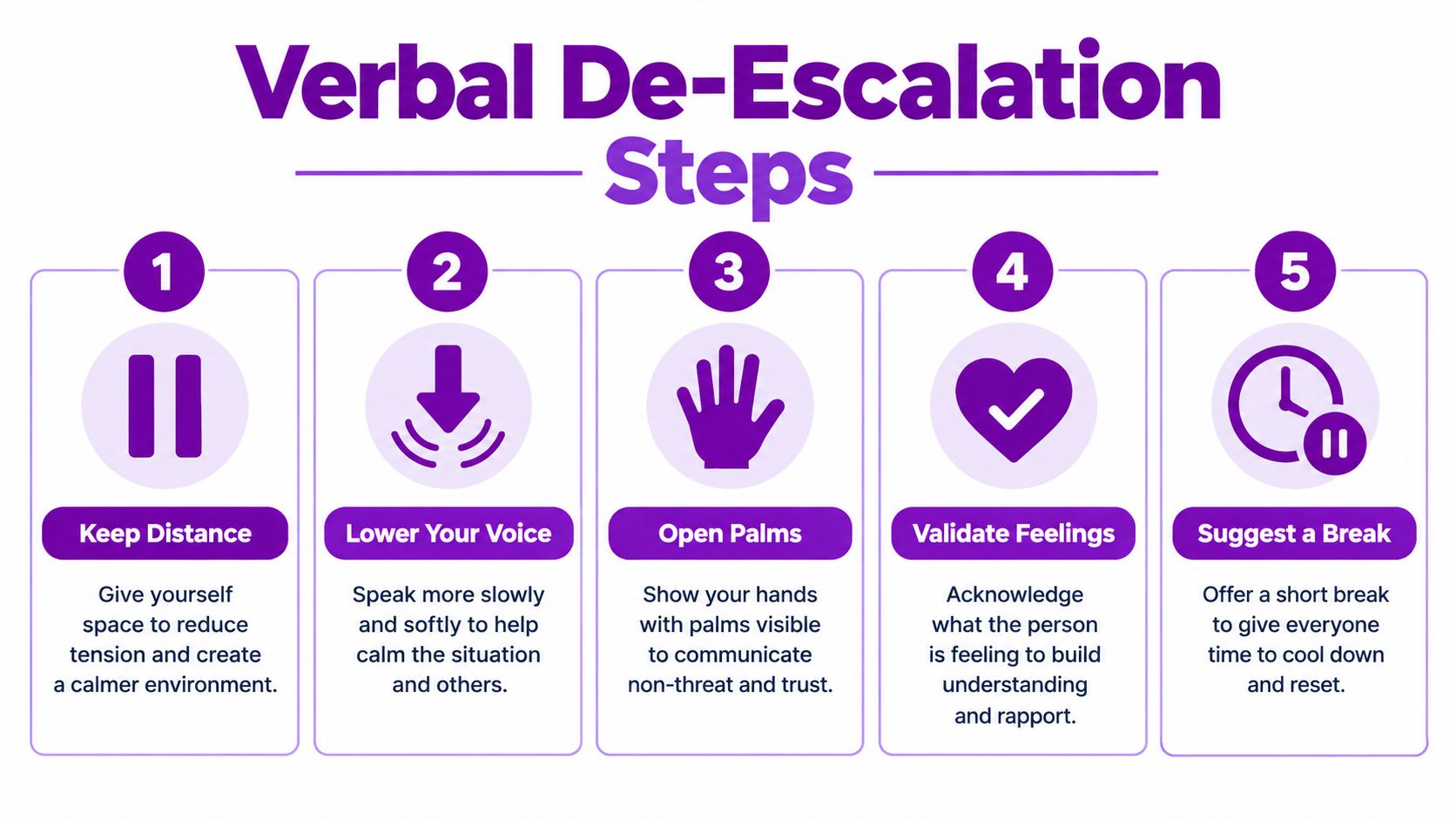
Use this sequence:
-
Create space. Move back far enough that the other person doesn't feel crowded. If children or other vulnerable people are present, guide them toward a safer area without making a sudden move toward the conflict.
-
Lower your voice and shorten your language. Speak slowly, with one idea at a time. Try, “I'm listening. I'm not going to argue while we're shouting.” A low, brief statement gives the other person less material to fight against.
-
Use non-threatening body language. Keep your palms open, shoulders down, and movements predictable. Don't point, loom, touch, or follow someone who is trying to create distance.
-
Acknowledge the feeling. Validation recognizes an emotional experience without declaring that every accusation is correct. Say, “You feel ignored,” or, “I can see that this feels overwhelming.” Avoid, “You're overreacting,” even if the complaint seems disproportionate.
-
Set one simple limit. State what you will and won't participate in: “I'll keep talking if we don't insult each other.” Don't stack several rules into a lecture.
-
Offer limited choices. Choice restores some control without turning the moment into a negotiation. Try, “Would you rather sit in the living room or take a short break outside?” Give options you can actually support.
Clinical guidance and crisis-response training consistently emphasize creating space, using a low voice, keeping language brief, adopting non-threatening posture, acknowledging feelings, setting limits, and offering limited choices. A 2026 study of acute inpatient psychiatric settings found de-escalation was successful in approximately 60% of cases, which reinforces why early recognition and rapid intervention matter (Manchester research on effective de-escalation).
The behaviors most likely to collapse the attempt are familiar: arguing, contradicting, threatening, ordering, shaming, and invading personal space. “Calm down” often sounds like an order. “You always do this” turns the immediate problem into a character attack. “You're being ridiculous” adds humiliation, which can intensify anger or cause a distressed person to shut down.
People who want a broader framework for disagreements in professional settings may also benefit from how to handle friction at work, a resource from Acheloa Wellness, Inc. For relationship-specific support, conflict resolution counseling can help couples practice these responses before the next crisis.
Communication Scripts and Time-Outs for Couples and Families
A partner says, “You never listen to me,” and the instinctive reply is, “That's not true. I listened all day.” The reply may be defensible on the facts, but it doesn't address the emotional meaning underneath the words.
A more stabilizing response is: “You feel like I'm not hearing what matters to you.” Then pause. If the person continues, use a minimal encourager such as “Okay,” “I'm with you,” or “Go on.” These small responses show attention without interrupting to prepare a rebuttal.
Reflecting statements help you listen for the total meaning, not just the most provocative sentence. You can say:
- “You're angry because you felt left alone with the decision.”
- “You're worried that this will keep happening.”
- “You want me to understand the impact, not just explain my intention.”
- “I hear that you need a clear answer, and I'm not ready to give one while we're both upset.”
None of these statements requires you to agree with every detail. They communicate that the person has been heard, which can keep the conversation open long enough to establish safety.
A predictable pause protects trust
A time-out works only when it has structure. Abruptly leaving, hanging up, or disappearing can feel like abandonment or punishment. Name the pause, give it a clear purpose, and provide a return point.
Try this script:
“I want to continue this conversation, but I'm too activated to do it safely. I'm taking a break now. I'll check back at 7:30, and we can decide whether to talk for fifteen minutes or get help.”
The exact duration should be realistic and mutually understood. During the break, don't rehearse accusations, send hostile messages, drink to numb the reaction, or recruit relatives to take sides. Use the time to lower stimulation, breathe more slowly, walk in a safe place, or write down the one issue you need to address.
A teenager who shuts down may need fewer words, not more pressure. A parent might say, “You don't have to explain everything right now. I need to know you're safe. You can talk with me here, or we can sit in silence and try again later.” If the teenager is at risk of harming themselves or someone else, safety assessment and emergency support take priority over preserving privacy.
For couples who repeat the same cycle, couples therapy communication skills can turn these scripts into practiced habits. The trade-off is that communication skills won't make an unsafe person safe, and they can't replace emergency intervention when threats, weapons, or physical violence are present.
When to Step Back and Seek Professional Support
Some conflicts are painful but repairable. People can disagree, take responsibility, listen, and return to the subject without intimidation. Other encounters involve a pattern of fear, coercion, threats, property damage, stalking, physical assault, weapons, or one person preventing the other from leaving. Those situations require a different decision rule.
Don't step physically between people when weapons, multiple aggressors, domestic violence, or serious injury risk is present. Move yourself and vulnerable people toward safety if you can do so without increasing danger, and contact emergency services or trained local support. Trying to restrain someone without the appropriate training can injure everyone and may escalate the threat.
Evidence for de-escalation training is limited and uneven, with results varying by setting and training quality. Reviews describe situations in which early de-escalation may halt escalation in about two-thirds of cases, while another study found no relevant impact from some staff training on violent incidents in forensic wards (review of de-escalation techniques). The practical conclusion isn't that people should stop learning these skills. It's that no universal script can guarantee safety in every context.
Signs that home strategies aren't enough
Seek professional assessment when:
- Conflict is repetitive and worsening. The same rupture returns despite apologies, boundaries, and attempts to change.
- Someone lives in fear. A person changes routines, hides communication, or avoids ordinary topics to prevent retaliation.
- Trauma symptoms drive reactions. Flashbacks, hypervigilance, dissociation, nightmares, or intense responses to reminders can make present conflict feel like past danger.
- Daily functioning is declining. Sleep, work, parenting, eating, or medication adherence becomes difficult.
- A person loses control repeatedly. Threats, aggression, impulsive behavior, or severe withdrawal call for more than communication advice.
A therapist can identify whether the primary need is individual trauma treatment, couples work, family therapy, or a higher level of crisis care. Psychiatric support may also be appropriate when severe anxiety, depression, trauma symptoms, or other mental health concerns interfere with regulation. External resources such as couples therapy in Kelowna can illustrate what specialized relationship support looks like, even for readers comparing care models in different regions.

A pause is not successful if it merely postpones the next threat. It succeeds when people become safer, regain choice, and receive the level of support the underlying problem requires.
How reVIBE Mental Health Helps You Regain Your Balance
Chronic fights rarely come from communication alone. Anxiety, depression, grief, trauma, burnout, relationship patterns, and difficulty regulating emotion can all shape how people interpret ordinary events. A useful care plan addresses those drivers rather than asking a distressed person to memorize better phrases while remaining overwhelmed.
reVIBE Mental Health offers an integrated path through talk therapy, psychiatry with medication management, and EMDR. EMDR is supported by a substantial research base for PTSD. The U.S. Department of Veterans Affairs reports that a moderate-grade review of 10 randomized controlled trials found reduced PTSD symptoms and loss of PTSD diagnosis, with treatment typically delivered over about 3 months (VA information on EMDR for PTSD). The VA also says the 2023 VA/DoD PTSD guideline recommends Prolonged Exposure, Cognitive Processing Therapy, and EMDR as the most effective PTSD treatments (VA overview of PTSD therapies).
Independent academic literature reports support from more than 30 published randomized controlled trials involving adults and children with PTSD, and notes that most international clinical practice guidelines recommend EMDR as a first-line PTSD treatment (Journal of Traumatic Stress review). A 2025 U.S. military health evidence brief reports that the 2023 VA/DoD guideline gives EMDR a Strong For recommendation, while noting that NICE recommends considering EMDR for people with non-combat trauma who prefer it and the APA suggests EMDR for PTSD (EMDR PTSD evidence brief).
For Arizona residents, reVIBE provides welcoming spaces designed to feel more like home than a clinic, appointments seven days a week, in-person and secure online sessions, and help with insurance verification. Its five locations are:
-
reVIBE Mental Health, Chandler
3377 S Price Rd, Suite 105, Chandler, AZ -
reVIBE Mental Health, Phoenix Deer Valley
2222 W Pinnacle Peak Rd, Suite 220, Phoenix, AZ -
reVIBE Mental Health, Phoenix PV
4646 E Greenway Road, Suite 100, Phoenix, AZ -
reVIBE Mental Health, Scottsdale
8700 E Via de Ventura, Suite 280, Scottsdale, AZ -
reVIBE Mental Health, Tempe
3920 S Rural Rd, Suite 112, Tempe, AZ
Call (480) 674-9220 to ask about availability, insurance, and the right starting point for your needs.
If recurring conflict, trauma reactions, anxiety, or relationship strain keep pushing conversations toward crisis, reVIBE Mental Health offers talk therapy, EMDR, psychiatry, and medication management to help you regain stability. Visit reVIBE Mental Health to find a convenient Arizona location or request support for yourself, your partner, or your family.