

Emotionally focused couples therapy (EFT) is a short-term, structured, attachment-based couples therapy that relieves distress by reshaping how partners respond to each other's emotions and bonding signals. A 2024 meta-analysis of 20 studies involving 332 couples found medium-to-large effects, including d = .93 from before to after treatment, d = .86 at follow-up, and about 70% of couples symptom-free at treatment's end (EBSCO's overview of the evidence).
You may be reading this after another argument that began with something ordinary, such as a late work night, a forgotten chore, or a question that received no answer. One partner wanted reassurance, the other felt criticized, and both ended the conversation feeling less safe and more alone. EFT helps couples understand that repeating conflict often reflects a painful interaction pattern, not a defective partner.
When the Same Fight Keeps Coming Back
Maya and Jordan have been together for years, and the argument about Jordan's late work nights has barely changed. Maya has asked him to come home earlier for six years. Jordan has explained that work is demanding, promised to communicate better, and then stayed late again.
One evening, Maya serves dinner and notices the time. Jordan walks through the door tired, still holding his phone.
“You said you'd be home for dinner,” she says.
Jordan starts to explain, but Maya interrupts. She asks whether work matters more than the family and says she can't rely on him. Jordan's shoulders tighten. He looks down at his phone, gives shorter answers, and eventually retreats into silence. Maya follows him with more questions. Jordan withdraws further. When they finally separate for the night, Maya feels rejected and Jordan feels like nothing he says will be good enough.
The topic is dinner. The emotional pattern is larger.
The cycle beneath the topic
Therapists often call this repeating pattern the negative cycle. One partner protests disconnection through criticism, pursuit, or repeated questions. The other experiences the protest as blame and protects themselves by withdrawing, becoming defensive, or going quiet. The first partner then sees the withdrawal as proof that they don't matter and intensifies the protest.
The same choreography can appear around money, sex, chores, in-laws, parenting, or social plans. The subject changes, but the emotional sequence remains familiar:
- Pursuit: “Why won't you talk to me?”
- Withdrawal: “I can't do this right now.”
- Escalation: “You never show up for me.”
- Distance: Both partners leave the exchange feeling unsafe.
Learning couples therapy communication skills can help with timing and clarity, but EFT looks beneath communication technique. It asks what each partner is protecting, fearing, and longing for during the exchange.
What EFT treats
EFT doesn't choose a winner in the argument. It helps partners see the cycle as the shared problem, then reshapes the emotional responses that keep the cycle alive. The approach was developed in the mid-1980s by Susan M. Johnson and Leslie S. Greenberg, and the first manual for emotionally focused couples therapy was published in 1988 (historical and clinical overview).
The therapist helps Maya move from “You never care” toward the more vulnerable fear, “When you go quiet, I feel unimportant and afraid I'm losing you.” Jordan learns to move from silence toward an honest response, such as, “I shut down because I feel I've disappointed you, but I don't want you to face that fear alone.”
The rest of EFT becomes easier to understand when you recognize your own loop. The model maps the cycle, identifies the attachment injury underneath it, and creates new moments in which partners reach and respond differently.
The Heart of Emotionally Focused Couples Therapy
A couple can care intensely for each other and still feel alone in the same argument. One partner reaches for reassurance, the other withdraws to avoid criticism, and both leave the exchange convinced that the relationship is unsafe. EFT explains this pattern through attachment rather than assigning one partner the role of the problem.
Attachment theory begins with a basic human need for dependable emotional connection. John Bowlby described attachment as a system that helps people seek protection and closeness. Sue Johnson and Leslie Greenberg applied this understanding to adult romantic relationships, framing romantic love as an attachment bond rather than only a strong feeling or preference for companionship.
Under threat, the nervous system can ask a direct question: “Are you there for me?” A request for reassurance is not automatically codependence or neediness. After rejection, betrayal, loss, or prolonged distance, it may express a normal need for emotional accessibility.
A safe base and a safe haven
A secure partner can provide both a safe base and a safe haven. A safe base supports work, exploration, parenting, social connection, and other challenges. A safe haven is the person you turn toward when life hurts.
Attachment injuries make this bond feel unreliable. An attachment injury may involve a remembered moment of abandonment, betrayal, rejection, or failed support that still shapes how a partner interprets closeness. Couples exploring attachment issues in relationships often recognize the same question beneath their recurring conflict: “Will you be there when I need you?”
Jordan's late arrival may mean more to Maya than missed dinner. She may hear, “Our time does not matter to you.” Maya's criticism may mean more to Jordan than a complaint. He may hear, “I am failing again, and closeness will bring more shame.” The argument becomes a protest or retreat around the attachment injury.
A useful question: During the argument, are you fighting about the event, or about what it seems to say about your place in each other's lives?
How EFT differs from other approaches
Cognitive-behavioral couples therapy often focuses on thoughts, behaviors, and practical interaction changes. Gottman-informed work commonly addresses relationship skills, conflict patterns, friendship, and shared meaning. Psychodynamic couples therapy may examine unconscious expectations, developmental history, and the emotional meanings partners bring into the relationship.
EFT places emotion and attachment security at the center of change. The therapist helps partners identify the cycle, reach the vulnerable feelings beneath anger or silence, and create safer responses. Support is strongest for EFT's core model and structured couples work, while evidence is thinner for how consistently it applies outside North American outpatient samples.
The Three Stages and Nine Steps of EFT
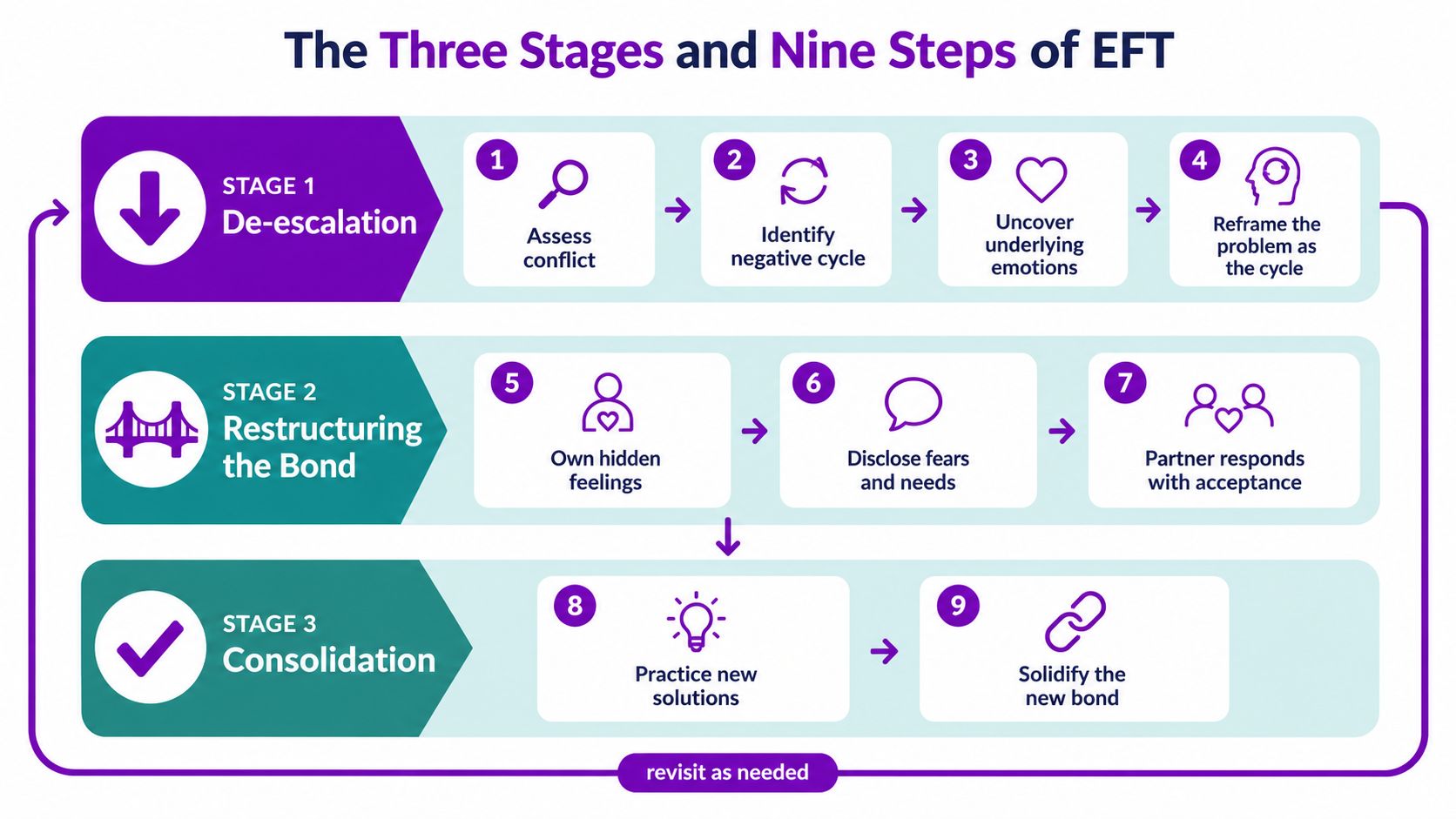
EFT organizes treatment into three stages and nine steps. The stages aren't a rigid script. A therapist may revisit earlier work when a new injury emerges, but the map keeps sessions focused on emotional transformation rather than endless discussion of the latest disagreement (APA process description).
Stage 1 de-escalates the cycle
The first stage includes Steps 1 through 4:
- Assess the relationship. The therapist learns the couple's history, current distress, major injuries, and recurring conflicts.
- Identify the negative cycle. Partners track what each person does, feels, and expects when disconnection begins.
- Uncover underlying emotions. The therapist helps each partner move beyond secondary reactions, such as anger or defensiveness, toward fear, loneliness, shame, sadness, or longing.
- Reframe the problem as the cycle. Instead of “Maya is too demanding” or “Jordan is uncaring,” the couple begins to see a loop that traps both people.
The emotional change is a reduction in blame. Partners don't necessarily stop feeling upset, but they gain enough distance from the cycle to recognize that each person is responding to perceived danger.
Stage 2 restructures the bond
Stage 2 includes Steps 5 through 7. Partners identify and own the vulnerable feelings hidden beneath their positions, deepen those feelings in the session, and express attachment needs directly. The other partner then practices responding with acceptance, emotional presence, and engagement.
A complaint such as “You never talk to me” may become, “When you pull away, I panic and need to know I still matter to you.” A silent partner may say, “I go quiet because I feel like I've failed, and I'm afraid you'll give up on me.”
These conversations are called enactments because the partners speak directly to each other rather than only describing the problem to the therapist. New solutions emerge from new emotional responses. A practical agreement about calling when late becomes more meaningful when it carries reassurance and reliability.
Stage 3 consolidates the new pattern
Stage 3 covers Steps 8 and 9. The couple revisits old pain, integrates new understanding, practices the changed cycle, and strengthens a more secure bond. Partners learn to recognize early signs of disconnection and turn toward each other before the old pattern gains momentum.
The outcome isn't a relationship without conflict. It's a relationship in which conflict no longer automatically produces pursuit, retreat, shame, or emotional abandonment.
The Moments That Change Everything in a Session
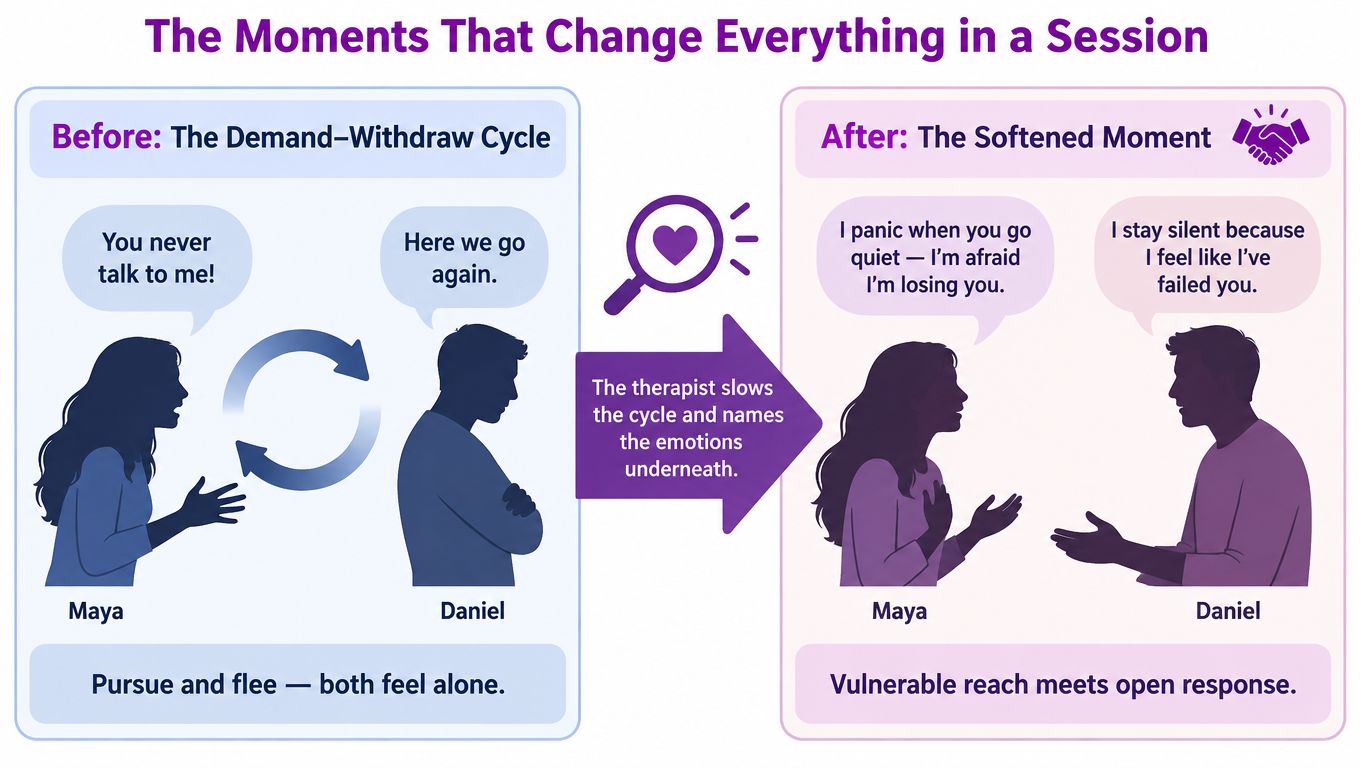
Maya and Daniel sit several feet apart after another demand-withdraw argument. Maya says Daniel never talks to her. Daniel looks toward the floor and says, “Here we go again.” His voice is flat, but his hands are tense.
The therapist doesn't ask them to decide who started the fight. Instead, the therapist slows the sequence down.
“Maya, when Daniel goes quiet, what happens inside you before the anger arrives?”
Maya pauses. Her face changes. “I feel panic. I start thinking I'm alone in this relationship, and I push harder because I don't know how else to reach him.”
The therapist turns to Daniel. “When Maya reaches harder, what happens inside you?”
Daniel initially shrugs. With support, he says, “I feel like I've failed her. I'm afraid that if I speak, I'll make it worse, so I disappear.”
Withdrawer reengagement
The therapist helps Daniel stay emotionally present instead of hiding behind silence. Daniel looks at Maya and says, “I go quiet because I feel ashamed. I'm not trying to punish you. I'm scared you'll see me as someone who can't make you happy.”
This is withdrawer reengagement. The withdrawing partner begins to step back into the relationship, name the internal experience, and risk an emotionally available response. The shift may appear in a steadier gaze, a fuller answer, or a willingness to remain in the conversation.
Blamer softening
The therapist then helps Maya stay with the fear beneath the criticism.
“Can you tell Daniel what you need without telling him what's wrong with him?”
Maya's shoulders lower. She says, “When you disappear, I feel unimportant. I'm afraid I can't reach you. I need you to show me that I still matter.”
This is blamer softening. The pursuing or criticizing partner moves from accusation toward vulnerable attachment language. The partner isn't surrendering a legitimate concern. She's expressing the emotional need in a form Daniel can respond to.
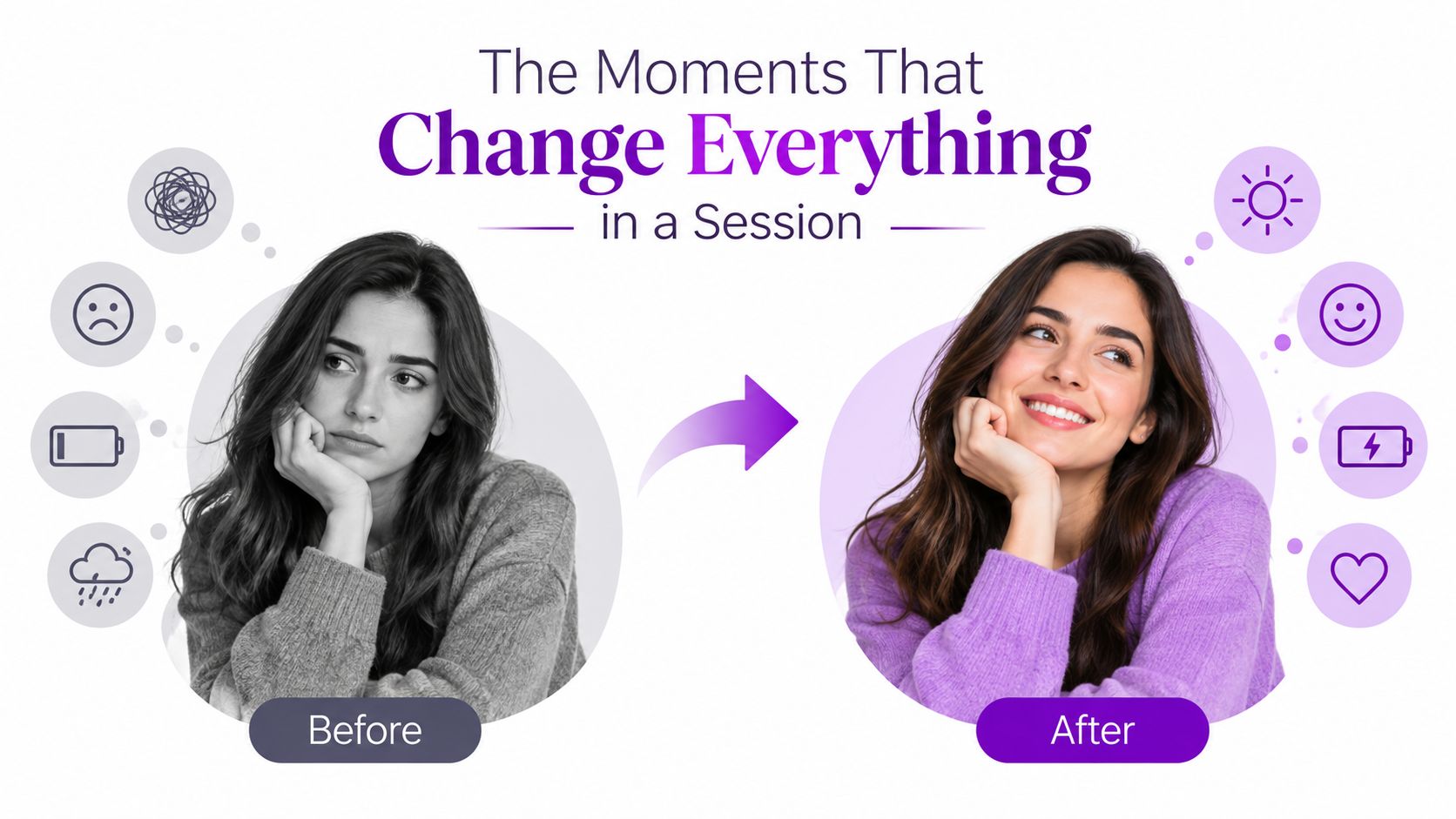
These moments matter because they change the couple's emotional choreography. One partner reaches with less attack, and the other responds with less retreat. The therapist helps them notice the difference and repeat it until connection becomes more accessible during stress.
What the Research Actually Says About Couples Therapy
EFT has a substantial research base, but responsible interpretation requires more than repeating a success claim. A 2024 meta-analysis of 20 studies involving 332 couples found a pretest-to-posttest effect of d = .93, a pretest-to-follow-up effect of d = .86, and an effect of d = .44 when EFT was compared with viable alternative couple interventions. The analysis also reported that about 70% of couples were symptom-free at treatment's end, and that stronger therapist fidelity to the model was associated with stronger gains (2024 meta-analysis summary).
Other reviews point in the same direction while adding complexity. A systematic review covering the previous 19 years reported a very large improvement in marital satisfaction, with Hedges' g = 2.09, sustained at follow-up. Another meta-analysis reported post-treatment effects of g = 0.73 for EFCT and g = 0.66 at 6-month follow-up, while finding that gains weren't maintained after 12 months in the studied sample (systematic review and meta-analysis).
EFT outcome evidence at a glance
| Study Type | Recovery Rate | Improvement Rate | Sample Notes |
|---|---|---|---|
| 2024 meta-analysis | About 70% symptom-free at treatment end | Medium-to-large change, d = .93 after treatment | 20 studies and 332 couples |
| 2024 comparison analysis | Not stated as a recovery percentage | EFT effect of d = .44 compared with viable alternatives | Therapist fidelity was associated with stronger gains |
| Systematic review | Not stated as a recovery percentage | Hedges' g = 2.09 for marital satisfaction | Improvement was sustained at follow-up |
| Comparative meta-analysis | Not stated as a recovery percentage | g = .73 after treatment and g = .66 at 6 months | Gains weren't maintained after 12 months in the studied sample |
Where confidence should be calibrated
Much of the strongest evidence comes from North American outpatient research and structured treatment studies. A 2025 analysis noted only two Chinese outcome studies and found that their results were inconsistent with North American findings, while a naturalistic 2025 study reported small-to-moderate effects in routine practice (cultural and naturalistic evidence review).
That doesn't make EFT ineffective outside its original research settings. It means culture, language, therapist preparation, health-system access, couple characteristics, and treatment fidelity can affect results. Research on individual symptoms is also developing. A 2025 PubMed-indexed study reported increased intimacy and reduced shame, while broader literature links EFT with changes in depression, PTSD-related distress, and relational problems, but a 2026 systematic review found only modest overall support for several couple-therapy models because studies often involve small samples and limited independent replications (PubMed-indexed study).
What Happens Inside a Typical EFT Session
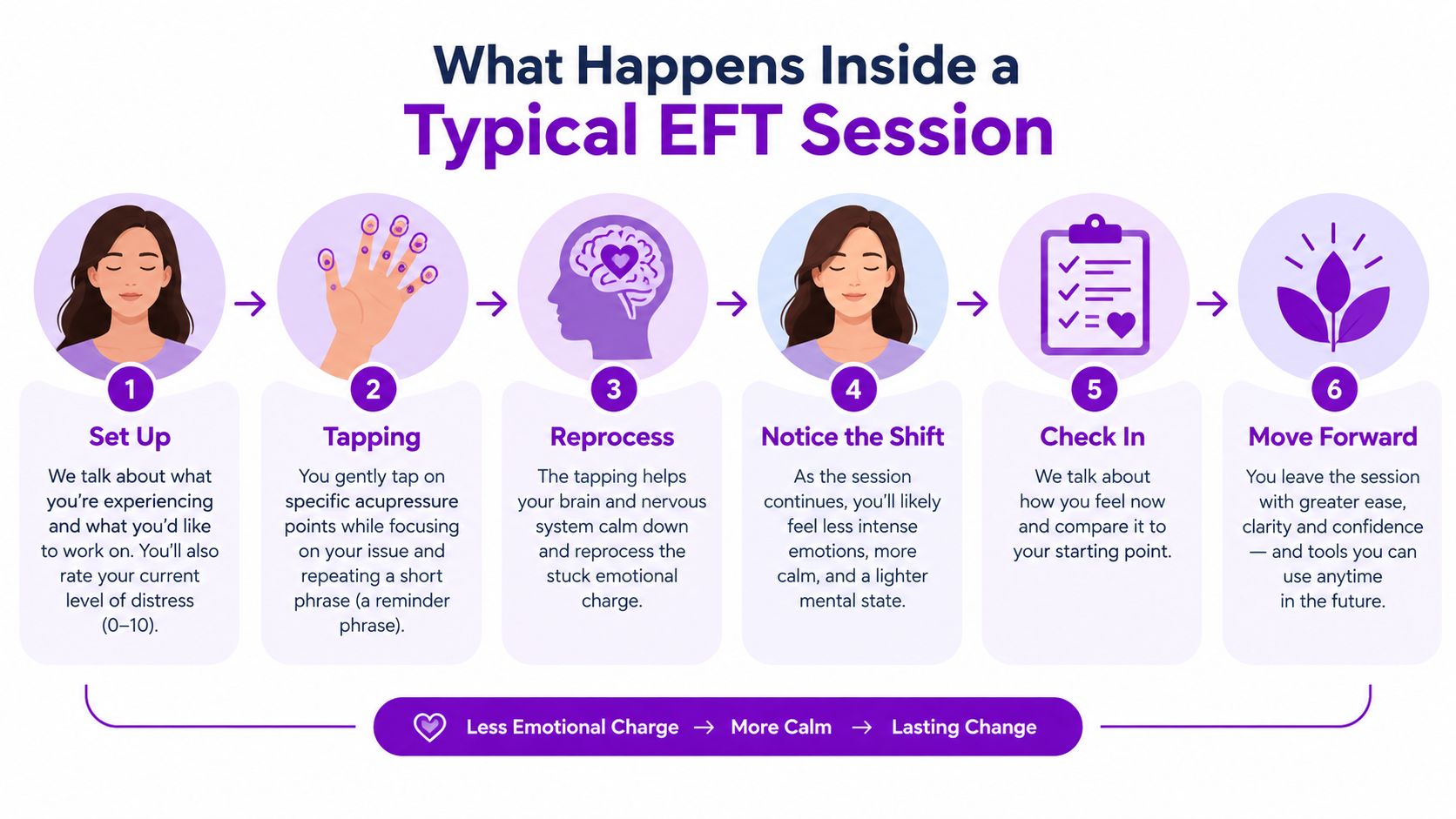
A typical session starts with a brief emotional and relational check-in. You might describe a recent argument, a moment of closeness, or an event that activated the familiar cycle. The therapist listens for where the couple is in the cycle, then updates the map rather than treating the new incident as an isolated problem.
The therapist may ask what each partner felt in the body, what meaning they made of the other's behavior, and what they did next. The focus moves from the visible reaction, such as anger or silence, toward the attachment emotion underneath it.
The session arc
- Check in. You describe what has happened since the previous meeting.
- Track the cycle. The therapist slows down a recent exchange and identifies the sequence.
- Find the vulnerable emotion. You explore fear, loneliness, shame, hurt, or longing.
- Create an enactment. One partner speaks directly to the other in a slower, more specific way.
- Support a response. The other partner practices staying present and responding with care.
- Consolidate the shift. The therapist helps you notice what changed and how to carry it into daily life.
EFT sessions are often described as lasting 60 to 90 minutes in clinical practice, though the exact format depends on the provider. Between sessions, a therapist may suggest a daily check-in or a small connection ritual, not as a test of compliance but as a way to practice turning toward each other.
The therapist isn't a referee or mediator. They don't just divide speaking time or decide whose account is correct. Their job is to guide the emotional process, protect the conversation from escalation, and help partners create a new experience of reaching and responding.
Is EFT the Right Fit for Your Relationship
EFT may fit couples who keep returning to the same conflict, feel emotionally disconnected, or experience a pursue-and-withdraw pattern. It can also provide a framework for repairing a bond after infidelity, betrayal, repeated rejection, or an attachment injury that still shapes present-day reactions.
The approach may be less appropriate as a stand-alone treatment when domestic violence is ongoing, active substance dependence is disrupting safety, a partner has unmanaged serious mental illness, or one or both partners are still deciding whether they want to remain together. Those situations may require safety planning, individual treatment, psychiatric care, addiction support, or discernment-focused work before relationship repair can proceed.
Questions to ask before choosing a therapist
- Shared participation: Are both partners willing to attend and participate, even if one person is more hesitant?
- Training: Has the clinician completed training through an accredited EFT training institute?
- Model fidelity: Does the therapist practice EFT as a structured model, rather than borrowing attachment language loosely?
- Safety: Can both partners speak freely without fear of retaliation outside therapy?
- Goals: Are you seeking repair and a more secure bond, rather than only a verdict about who is right?
- Fit: Does the therapist slow the cycle down, remain balanced, and help both partners access their emotional experience?
A first consultation should give you space to describe the recurring pattern and ask how the therapist would conceptualize it. You don't need to disclose every painful detail immediately, but you should leave with a clearer sense of the clinician's training, approach, boundaries, and plan for assessing safety.
Use your early sessions to evaluate fit. You should feel challenged to be honest, but not shamed. The therapist should be able to name each partner's position in the cycle without reducing either person to a label. For practical help defining what you want from treatment, review these couples therapy goals.
In the Phoenix metro area, reVIBE Mental Health offers couples therapy in Scottsdale, Chandler, and Tempe, with therapists trained in Emotionally Focused Therapy. The practice also provides talk therapy, EMDR, psychiatry, and medication management through in-person and secure online appointments, with help navigating insurance and provider matching. Visit reVIBE Mental Health to ask about couples therapy and whether an EFT-informed clinician fits your relationship needs.
Find a reVIBE Location Near You!
We currently have five locations for your convenience. (480) 674-9220
reVIBE Mental Health – Chandler
3377 S Price Rd, Suite 105, Chandler, AZ
reVIBE Mental Health – Phoenix Deer Valley
2222 W Pinnacle Peak Rd, Suite 220, Phoenix, AZ
reVIBE Mental Health – Phoenix PV
4646 E Greenway Road, Suite 100, Phoenix, AZ
reVIBE Mental Health – Scottsdale
8700 E Via de Ventura, Suite 280, Scottsdale, AZ
reVIBE Mental Health – Tempe
3920 S Rural Rd, Suite 112, Tempe, AZ