

Yes, in short, a licensed therapist can diagnose mental health conditions like anxiety, depression, and PTSD.
Professionals like Licensed Professional Counselors (LPCs), Licensed Marriage and Family Therapists (LMFTs), and Licensed Clinical Social Workers (LCSWs) have the advanced training and state-conferred authority to formally identify these conditions. This diagnosis isn't just a label; it’s the cornerstone of a truly effective treatment plan.
Understanding Who Can Provide a Diagnosis
When you’re looking for mental health support, one of the first questions you might have is who can actually give you a formal diagnosis. While many people in the helping professions offer incredible support, the authority to diagnose is reserved for those with specific advanced degrees and state licensure. These credentials are a big deal—they ensure the person you're trusting has met rigorous standards of expertise and care.
Think of a diagnosis as a roadmap for your mental health journey. It’s a crucial first step that helps your provider understand the specific challenges you're facing. From there, they can choose the right evidence-based therapies to guide you toward healing and recovery.
The Professionals Qualified to Diagnose
So, who are these qualified professionals? Several types of mental health experts are trained to assess symptoms and provide a diagnosis. The flowchart below breaks down the key players in mental healthcare, from those who can prescribe medication to those who focus primarily on therapy.
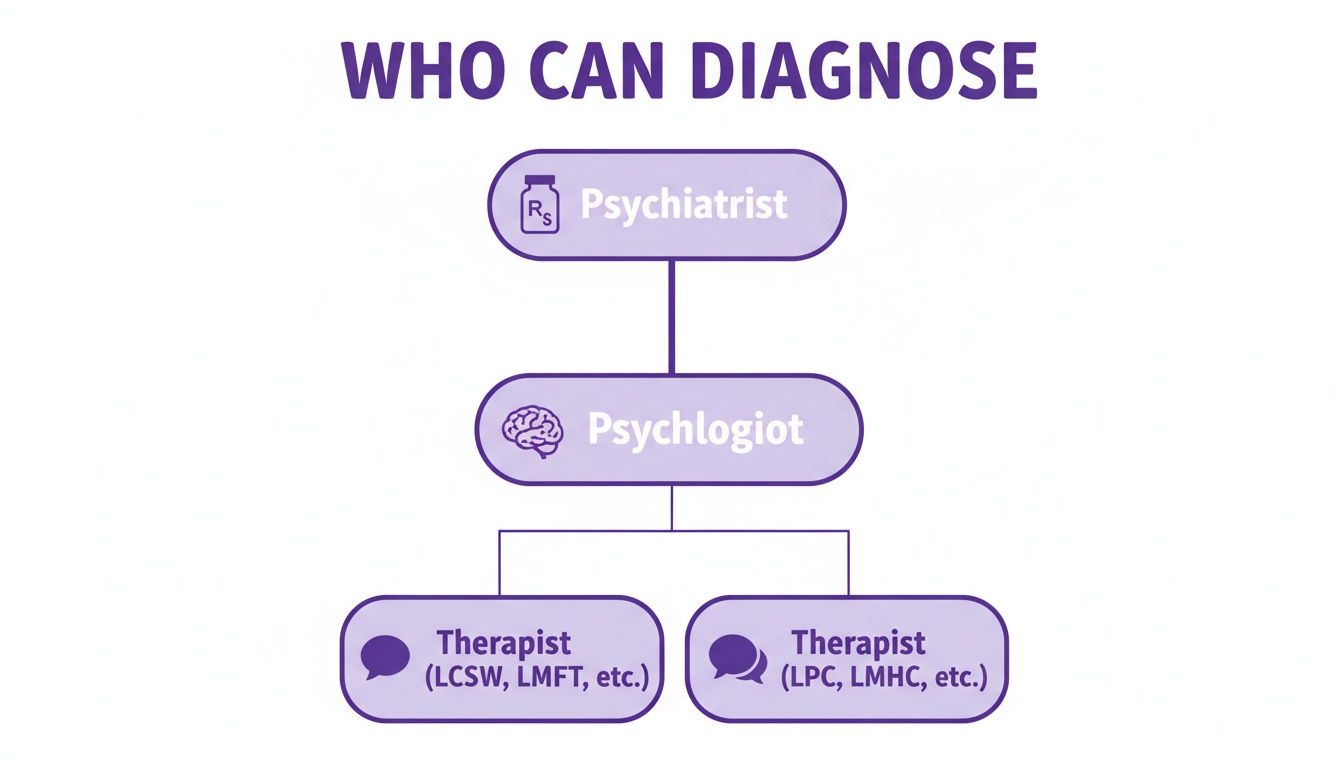
As you can see, different professionals have overlapping but distinct roles. To make it even clearer, let's compare their core functions side-by-side.
Who Can Diagnose Mental Health Conditions
| Professional Title | Can They Diagnose? | Can They Prescribe Medication? | Primary Focus |
|---|---|---|---|
| Psychiatrist (MD/DO) | Yes | Yes | Medication management, diagnosis, and sometimes therapy. |
| Psychologist (PhD/PsyD) | Yes | No (with few exceptions) | Psychological testing, assessment, diagnosis, and therapy. |
| Licensed Therapist (LCSW, LMFT, LPC/LMHC) | Yes | No | Talk therapy, counseling, and diagnosis. |
This table highlights the unique contributions of each professional. While psychiatrists often focus on the biological and neurological aspects of mental health (especially medication), therapists and psychologists zero in on behavioral, emotional, and cognitive patterns through talk therapy.
Understanding these roles empowers you to find the right expert for your specific needs. At reVIBE Mental Health, our integrated team includes both therapists and psychiatric professionals, ensuring you receive comprehensive, well-rounded care. Whether you’re near our offices in Chandler, Scottsdale, or another Phoenix-area location, we can connect you with the right provider to start your journey.
How a Diagnosis Becomes Your Roadmap to Healing
It’s easy to think of a mental health diagnosis as a permanent, scary label. But in reality, it’s the exact opposite. It’s the starting point. When a therapist provides a diagnosis, they’re not putting you in a box; they’re handing you a map to find your way out.
The whole process is designed to create a personalized, effective treatment plan that actually guides you toward feeling better.
Think about it this way: if you have a nagging cough and a fever, your doctor doesn’t just guess what’s wrong. They listen to your lungs, maybe run a few tests, and identify the specific issue—like bronchitis—so they can prescribe the right medicine. A mental health diagnosis works the same way. It gives you and your therapist a shared understanding of what's happening.

From Diagnosis to a Personalized Plan
A proper diagnosis is the blueprint for your therapy. For instance, if a therapist identifies the specific thought patterns and avoidance behaviors of social anxiety, they can recommend a proven, evidence-based approach like Cognitive Behavioral Therapy (CBT). This makes sure your sessions are targeted and effective right from the start.
This isn’t just a nice-to-have; it's the standard of care. In fact, research shows that nearly 100% of surveyed psychologists in the U.S. regularly make diagnoses as part of their work. They are constantly assessing for conditions like anxiety, depression, and trauma to provide the best possible care. You can discover more insights from this study about therapist diagnostic practices.
Without that initial clarity, therapy can sometimes feel a bit aimless. A diagnosis brings focus, allowing you to set clear goals and use strategies known to work for the challenges you're facing.
A diagnosis isn’t about putting you in a box. It’s about giving you the right tools to build your way out of one. It provides clarity and direction, turning abstract feelings of distress into a concrete plan for feeling better.
The DSM-5: A Standard Guide for Consistent Care
To make sure everyone is on the same page, therapists use a standardized guidebook called the Diagnostic and Statistical Manual of Mental Disorders, now in its fifth edition (DSM-5). It's not some rigid, intimidating rulebook. Instead, it’s a carefully developed resource that lays out clear, consistent criteria for identifying mental health conditions.
The DSM-5 helps clinicians all over the country speak the same professional language. It means a diagnosis of Major Depressive Disorder in Arizona is based on the same criteria as one in New York. This consistency is crucial for several reasons:
- Creating Effective Treatment Plans: It connects specific symptoms to the therapies that have been proven to help most.
- Facilitating Communication: It allows different providers on your care team—like a therapist and a psychiatrist—to communicate clearly.
- Securing Insurance Coverage: Most insurance companies require a formal DSM-5 diagnosis to cover the cost of treatment.
At reVIBE Mental Health, this thoughtful, compassionate diagnostic process is the foundation of everything we do. Our integrated team uses this roadmap to design a unique path to recovery, one that honors your individual experiences while drawing on proven therapeutic methods. It’s the first step toward getting the targeted support you truly deserve.
What to Expect During Your Diagnostic Assessment
Walking into your first therapy session can feel a bit nerve-wracking, especially when you’re not sure what’s going to happen. The phrase "diagnostic assessment" probably sounds more intimidating than it actually is—conjuring up images of a cold, clinical exam. But in reality, it’s just a guided conversation. It’s not an interrogation.
This first meeting is all about creating a safe space for you to share your story. Your therapist's main job is simply to listen and understand what you're going through, from your point of view. Think of it as laying the groundwork for a trusting relationship, which is the cornerstone of any successful therapy.
The Initial Conversation
The assessment usually kicks off with what’s called an intake interview. Your therapist will ask open-ended questions to get a sense of your life and the specific challenges that brought you in. This is a team effort; you are the expert on your own life.
You'll likely chat about a few key areas:
- Your current symptoms: What have you been feeling lately? How long have these feelings been around?
- Your personal history: This can include your family background, major life events, and relationship patterns.
- Your medical history: They’ll ask about any physical health issues, medications you’re taking, or previous mental health care.
- Your daily life: You'll talk about your work or school, your social life, and the ways you typically cope with stress.
Looking at the big picture helps the therapist see you as a whole person, not just a set of symptoms. It’s crucial for making sure any potential diagnosis truly fits the full context of your life.
Gathering Information with Standardized Tools
On top of the conversation, your therapist might use some standardized questionnaires or checklists. Don't worry, these aren't tests you can pass or fail. They are simply tools to help measure your symptoms in a consistent and objective way, comparing them to established diagnostic criteria.
For instance, you might fill out a short survey asking you to rate how often you've felt anxious or down over the past couple of weeks. This kind of information adds valuable data that complements the personal story you share. It’s a key piece of how a therapist can diagnose mental health conditions accurately.
A diagnostic assessment is really a partnership. It blends your lived experience with the therapist's clinical expertise to create a clear, shared understanding of what's going on and how to move forward. The goal is always to make you feel heard, validated, and hopeful.
Find a reVIBE Location Near You!
We currently have five locations for your convenience. (480) 674-9220
reVIBE Mental Health – Chandler
3377 S Price Rd, Suite 105, Chandler, AZ
reVIBE Mental Health – Phoenix Deer Valley
2222 W Pinnacle Peak Rd, Suite 220, Phoenix, AZ
reVIBE Mental Health – Phoenix PV
4646 E Greenway Road, Suite 100, Phoenix, AZ
reVIBE Mental Health – Scottsdale
8700 E Via de Ventura, Suite 280, Scottsdale, AZ
reVIBE Mental Health – Tempe
3920 S Rural Rd, Suite 112, Tempe, AZ
If you want to dig a little deeper into this process, check out our guide that explains in more detail what happens during a psychiatric evaluation. This initial meeting is your first step toward getting clarity and the personalized care you deserve.
Therapist vs. Psychiatrist: Understanding the Difference
Many people use the terms "therapist" and "psychiatrist" interchangeably, but their roles in mental healthcare are actually quite different. Both are qualified to diagnose mental health conditions, absolutely. Where they diverge is in their approach to treatment and the tools they have at their disposal.
Getting clear on this distinction is the first step toward finding the right kind of support for you.
Think of it like this: a therapist is like a physical therapist for your mind. They work with you to build emotional strength, heal from psychological wounds, and change unhelpful patterns through targeted exercises—in this case, talk therapy and other therapeutic techniques. Their main focus is on your thoughts, behaviors, and relationships.
On the other hand, a psychiatrist is a medical doctor who specializes in the brain's biology and chemistry. As medical doctors (MDs or DOs), they are licensed to prescribe medication that can help manage the biological roots of many mental health conditions.

Different Tools for the Same Goal
So, while both professionals can identify the problem, how they help you solve it is what sets them apart. A therapist's toolkit is filled with evidence-based psychotherapy, whereas a psychiatrist's primary tool is medication management.
- A Therapist's Focus: Using talk therapy approaches (like CBT or EMDR) to help you develop coping skills, process tough emotions, and make lasting behavioral changes.
- A Psychiatrist's Focus: Prescribing and managing medication to help regulate brain chemistry, which can significantly reduce symptoms of conditions like depression, anxiety, or bipolar disorder.
These roles aren't an either/or situation. In fact, they often work in tandem for the best results. For a deeper dive into the nuances, check out our guide on the differences between a therapist vs psychologist vs counselor.
The Power of Integrated Care
Often, the most powerful and effective treatment comes from an integrated approach where therapists and psychiatric professionals work together on your behalf. This collaborative model ensures you’re getting well-rounded care that addresses both the emotional and biological sides of your mental health.
For example, someone experiencing severe depression might see a psychiatrist for medication to help stabilize their mood and lift the fog. At the same time, they would work with a therapist to explore the root causes of their depression and build long-term strategies for managing it.
This collaborative model is the core of our philosophy at reVIBE Mental Health. Our integrated teams across Chandler, Phoenix, Scottsdale, and Tempe communicate and work together to create a single, personalized treatment plan just for you. This means you get the benefit of both therapy and expert medication management—if needed—all coordinated under one roof.
Why State Licensing Is Your Assurance of Quality Care
When you’re seeking answers about your mental health, trust is everything. How do you know the person you're opening up to is actually qualified to provide a diagnosis? The answer is state licensing—a system specifically designed to be your guarantee of quality, safety, and expertise.
Think of a license as a therapist's professional seal of approval. It’s far more than just a piece of paper on the wall; it’s tangible proof that they’ve met incredibly high standards before they are legally permitted to practice. This framework is in place to protect you by ensuring the care you receive is grounded in proven, professional competency.

The Rigorous Path to Licensure
Before a therapist can ever diagnose a condition, they must dedicate years to education, hands-on training, and direct supervision. State boards, like the Arizona Board of Behavioral Health Examiners, set these demanding requirements to make sure every licensed professional is truly prepared for the job.
The journey to becoming a licensed therapist involves several critical steps:
- Advanced Education: At a minimum, they must earn a master’s or doctoral degree in a mental health field like counseling, social work, or psychology.
- Supervised Clinical Experience: After getting their degree, they have to complete thousands of hours of client-facing work under the watchful eye of an experienced, licensed professional. This is where they bridge the gap between textbook knowledge and real-world application.
- Comprehensive Examinations: To finish, they must pass a tough national licensing exam that tests everything from clinical knowledge to ethical judgment.
Only after checking all these boxes can a therapist earn a title like Licensed Professional Counselor (LPC) or Licensed Clinical Social Worker (LCSW).
State licensing is your built-in quality control. It confirms that your therapist has not only the knowledge to diagnose but also the supervised experience and ethical grounding to do so responsibly and effectively.
A National Standard for Diagnosis
This demanding process isn't just an Arizona thing; it’s a standard upheld across the country. Regulatory frameworks worldwide confirm that licensed therapists are qualified to diagnose mental health conditions. In the US, where reVIBE operates across Scottsdale, Tempe, Chandler, and Phoenix, our professionals must hold an advanced degree, complete years of supervised practice, and pass their exams—all of which allows them to diagnose using the DSM-5. You can learn more about these global regulatory standards for mental health professionals.
This system creates a consistent, reliable benchmark for quality. When you choose a licensed provider at any reVIBE Mental Health location, you can feel confident they have the credentials and expertise needed to provide an accurate diagnosis and help guide you toward healing.
How a Diagnosis Unlocks Treatment and Insurance Benefits
Getting a formal diagnosis is about so much more than just putting a name to what you've been feeling. It's a critical step that opens the door to effective, structured treatment and, just as importantly, helps you access financial support through insurance. It takes the abstract sense of distress you’re experiencing and turns it into a clear, actionable path toward getting better.
Think of it as the architectural blueprint for your recovery. A diagnosis gives your therapist a solid framework to build a treatment plan based on proven, evidence-based methods that are right for you. This clarity helps ensure your sessions are focused and that your progress can be tracked right from the start.
Paving the Way for Effective Treatment
For a therapist, a diagnosis acts like a compass, pointing them toward the most effective strategies for your specific situation. For instance, if you're diagnosed with Panic Disorder, your therapist will know to use specific, proven techniques for managing panic attacks. But a diagnosis of Major Depressive Disorder would steer them toward different approaches, like behavioral activation or exploring medication.
You can learn more about how a comprehensive plan might include both therapy and other interventions in our guide on medication management for depression. This targeted approach takes the guesswork out of therapy, making sure your time, effort, and emotional energy are all invested in what’s most likely to bring relief and lasting change.
The Key to Insurance Coverage
Beyond shaping your treatment plan, a formal diagnosis is almost always required for insurance coverage. Health insurance providers rely on a standardized system of codes. When a therapist diagnoses a condition, they assign it a specific code from the DSM-5.
This diagnostic code is the language insurance companies speak. It’s what they use to confirm that your therapy is medically necessary. Without that code, they generally won't approve or reimburse your sessions, which would leave you paying for the full cost yourself.
Once a diagnosis is on record, navigating the world of medical billing for mental health is what allows claims to be processed so you can use your benefits. It might seem like a bureaucratic hoop to jump through, but this system is what makes professional mental healthcare affordable and accessible for millions. It’s a validation that your mental health is a legitimate, essential part of your overall well-being.
Finding Clarity and Support on Your Mental Health Journey
Figuring out that a therapist can diagnose you is a great first step. But the real journey toward feeling better begins when you decide to act on that knowledge.
Getting a diagnosis isn't about getting a label slapped on you. It's about getting clarity—a clear, professional understanding of what's going on so you can finally move forward with a plan that actually works for you. This insight is empowering. It gives you the confidence to find the right kind of support, knowing your path is guided by expertise, not guesswork.
This is exactly where having a compassionate, integrated team comes in. When therapists and psychiatric professionals work together, they build a complete circle of support around you, guiding you from that initial assessment to lasting recovery. It’s a holistic approach that makes sure every part of your well-being is considered, seamlessly blending talk therapy with medication management if and when it's needed.
Taking the Next Step with Confidence
Taking that next step can feel like a huge leap, but it’s really just a series of small, manageable actions. Each one gets you a little closer to finding your balance again.
Here’s what that might look like:
- Schedule an Initial Consultation: It often starts with a simple phone call. You get to connect with a professional, share a bit of your story, and hear how they can help.
- Verify Your Insurance: Getting a handle on your benefits beforehand takes the financial stress and mystery out of the equation, making it easier to commit to care.
- Learn More About Your Options: A little research into the different kinds of therapy and support out there can help you find a provider and an approach that truly resonates with you.
Think of a diagnosis not as a final destination, but as the starting line. It’s the roadmap that helps you and your care team navigate toward the most effective strategies for healing and growth.
An Integrated Team That Meets You Where You Are
The most critical part of this whole process is finding a team that makes you feel heard, valued, and safe. A welcoming, non-judgmental space is where real progress happens because it allows you to be open and vulnerable. At reVIBE Mental Health, we've designed our spaces to feel more like a comfortable home than a clinic, helping you feel at ease from the moment you walk in.
Our integrated teams in Chandler, Phoenix, Scottsdale, and Tempe collaborate to build a plan that fits your life. With appointments available seven days a week, both in-person and online, we make it much easier to get the consistent care you deserve. We're here to build a long-term partnership with you—one that helps you regain your balance and find your strength.
Your journey to feeling better starts with a single step. The team at reVIBE Mental Health is here to support you with compassionate, expert care tailored to your needs. Visit us at https://revibementalhealth.com to schedule a consultation today.