

You've searched “couples therapy near me that takes insurance,” opened directory after directory, and found providers who either don't accept your plan or won't say whether couples sessions qualify. Then someone tells you that one partner may need a diagnosis before the insurer will pay. That confusion isn't your fault. Couples therapy sits in an awkward place between relationship care and the medical model used by health insurance.
The practical answer is to verify the billing pathway before you book, ask exactly how the provider submits claims, and consider both local offices and secure telehealth. Arizona couples also have an important protection: covered behavioral health telehealth services must receive payment at the same level as equivalent in-person services under state law.
Why Finding Covered Couples Counseling Is Uniquely Hard
You may find a therapist who treats constant arguments, emotional distance, or trust problems, then learn that the practice cannot bill your plan for a couples session. The insurance directory may list family therapy, the representative may search another category, and the therapist's office may use different billing language. The care can be similar while the labels do not match.
The coding system creates much of this confusion. The United States still has no separate CPT code for couple therapy, as a 2022 review of couple therapy and healthcare systems explains. Providers commonly bill these sessions under family therapy, but insurers may apply different rules to that category.
Why relationship distress alone may not activate coverage
Health insurance generally pays for care it considers medically necessary. Relationship distress alone may not qualify, even when conflict causes significant suffering. The plan may require the session to support treatment for a diagnosable mental health condition affecting one partner.
That requirement explains why couples with similar concerns can receive different answers. One practice may offer relationship counseling only on a self-pay basis. Another may submit a family-therapy claim connected to an identified patient's treatment plan. Coverage depends on the plan's terms, the provider's credentials, the diagnosis requirement, and the office's billing policy.
Practical rule: Treat “we accept your insurance” as a starting point. Confirm that the practice can bill your specific couples session under your plan.
Search by more than “marriage counseling.” Use family therapy, outpatient behavioral health, and relationship-focused therapy when reviewing directories and practice websites. Then ask whether the office has billed sessions involving both partners under your insurance plan and whether one partner must be the identified patient.
Arizona couples should also ask about virtual care. State telehealth parity protections require covered behavioral health telehealth services to receive payment at the same level as equivalent in-person services. That protection does not erase diagnosis or network rules, but it can expand your provider options when local offices cannot offer a workable billing route.
Verifying Your Specific Behavioral Health Benefits
Before you spend time comparing therapist bios, identify what your plan covers. The insurance company's provider directory may show a clinician as in-network without explaining whether family therapy is included or whether both partners can participate in a claim.
Use this script with the member services representative:
“I'm looking for outpatient behavioral health care involving me and my partner. Does my plan cover family therapy when the patient is present? Are relationship-focused sessions covered when tied to treatment for a diagnosed mental health condition? Is the provider required to be in-network, and what out-of-network reimbursement is available?”
A verification checklist that produces useful answers
Ask about the benefit category. Request information about outpatient behavioral health, family therapy, and psychotherapy benefits. Don't rely on the representative's response to the phrase “couples counseling” alone.
Clarify the patient requirement. Ask whether one partner must be the identified patient and whether the session must support that person's treatment plan. Independent insurance guidance on couples therapy coverage notes that many plans don't cover couples therapy as standalone relationship counseling, but coverage may apply when one partner has a diagnosis and the session is treated as therapy for that condition.
Get your cost-sharing details. Confirm whether your deductible applies, then ask for the behavioral health copay or coinsurance. Request the answer in writing through the member portal if possible.
Check network status at the practice level. A therapist may accept the insurer's brand but not your employer's specific plan. Ask the office to verify the exact plan name and network.
Ask about out-of-network care. Find out whether you can submit claims yourself, what documentation is required, and whether reimbursement is available after the deductible.
Record the call. Write down the representative's name, the date, the reference number, and the wording used to describe your benefits. Verification isn't a guarantee, but documentation gives you something concrete to use if the claim is later questioned.
For a practical walkthrough, use this guide to verify insurance coverage for therapy. Ask the therapist's billing coordinator to verify the same facts before your first appointment. Two independent confirmations are safer than trusting a directory label.
Understanding Diagnosis Requirements and Billing Codes
You may find a therapist who offers couples sessions, only to learn that insurance requires one partner to be the identified patient. Who is receiving medically necessary treatment? That answer determines how the claim is filed. In self-pay relationship counseling, the relationship can be the focus. With insurance, the claim often identifies one partner whose diagnosed condition is being treated with the other partner's participation.
The diagnosis belongs in the identified patient's record, and the session must connect clinically to that person's treatment plan. Ask the therapist to explain the arrangement before you consent. You and your partner should know whose record receives the claim, what service and billing code will be submitted, and what information the insurer may review.
How family-therapy billing fits the situation
U.S. billing does not use a dedicated CPT code specifically for every form of couple therapy. Practices may therefore use a family-therapy code when the service fits the payer's rules, the clinician's scope, and the treatment plan. Ask the billing coordinator to explain the selected code and its purpose in plain language before the first session.
Do not ask a therapist to invent a diagnosis so the insurer will pay. Ask whether either partner has an existing or clinically appropriate condition being treated, and whether joint sessions support that care. If the insurer will not cover the arrangement, compare self-pay, an employee assistance benefit, and other payment options.
Judge the care, not only the claim
Billing compliance does not establish clinical quality. A meta-analysis of non-randomized couples therapy studies reported positive pre-to-post effects for both relationship and individual outcomes, including Hedge's g = 0.522 for relationship outcomes and Hedge's g = 0.587 for individual outcomes. These results support asking how the therapist will define progress, measure change, and adjust treatment.
The claims process can also raise concerns about whether a therapist diagnoses you. Review this explanation of whether a therapist diagnoses you before your consultation, then ask directly what diagnosis, if any, will appear in the record and how couples participation will be documented. A clear answer is part of informed consent, not an administrative favor.
Choosing Between Local In-Person and Telehealth Sessions
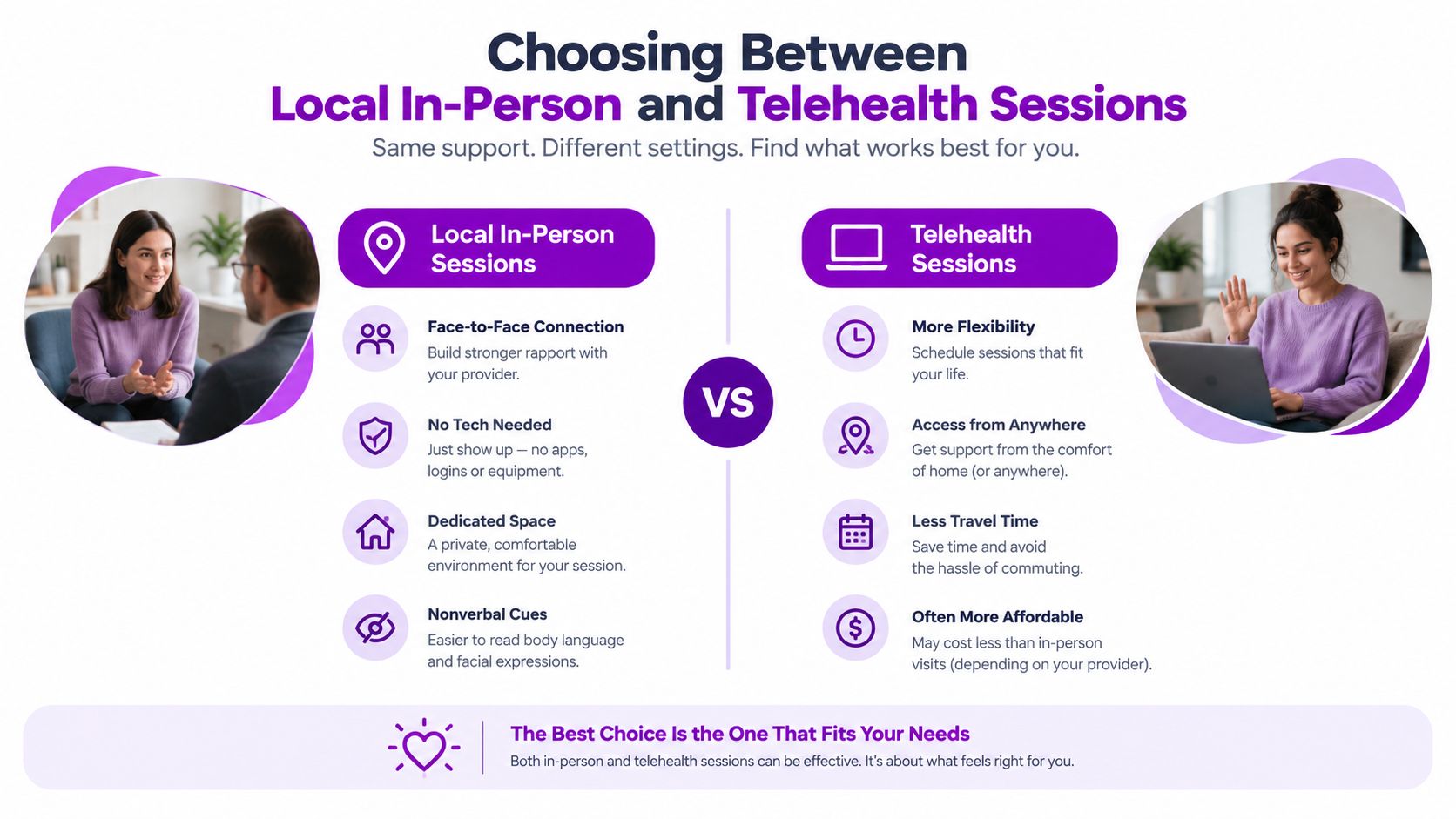
The right format is the one that lets both partners participate consistently and safely. An office visit gives you a neutral setting away from household routines. Telehealth removes travel and can make it easier for partners with demanding schedules, mobility constraints, or different locations to attend together.
| Consideration | In-person therapy | Telehealth therapy |
|---|---|---|
| Setting | A dedicated clinical space separates therapy from home conflict. | A private room at home can make attendance easier. |
| Logistics | Both partners must coordinate travel and arrival. | There's no commute, but both partners need reliable privacy and technology. |
| Privacy | The office controls the physical environment. | You must prevent interruptions, overheard conversations, and unsafe participation. |
| Continuity | Sessions remain tied to a nearby location. | Virtual access can help maintain care when travel or scheduling changes. |
Arizona law gives telehealth an important insurance safeguard. When a health plan covers telehealth, it must cover a service if the service would have been covered in person, and it must pay at the same level for equivalent services. For behavioral health and substance use disorder services, the same payment rule applies even when the service is delivered by audio only, according to Arizona's telehealth parity statute.
That law doesn't force every plan to cover a service it excludes. It protects the payment relationship when the service is covered and equivalent. Confirm eligibility with your insurer and ask the practice whether your appointment will be billed as behavioral health or family therapy.
If you choose virtual care, use a private room, headphones when appropriate, and a backup plan if the connection fails. For more information about the online option, review online counseling services that take insurance.
Critical Questions to Ask During the Initial Consultation
The first consultation should answer two separate questions: Can this practice bill my plan for the care we need, and can this therapist work effectively with both of us? Don't accept a vague answer such as “we take most insurance.” Ask for specifics.
Start with billing:
- “Is my exact plan in-network?” Give the office the full plan name, not only the insurer's brand.
- “How do you bill sessions attended by both partners?” Ask whether the claim is submitted under family therapy and whose record is used.
- “Does one partner need to be the identified patient?” The provider should explain the clinical and administrative implications.
- “What diagnosis or medical-necessity requirements apply?” The office shouldn't promise coverage without reviewing those rules.
- “Will you verify benefits before the first appointment?” Ask what the verification includes and whether you'll receive an estimate of your responsibility.
- “What happens after a denial?” Find out whether the practice corrects claim errors, provides paperwork, or expects you to manage the appeal.
- “Could any portion become self-pay?” This matters if the session runs longer than the plan allows or falls outside the covered benefit.
Then test the therapeutic fit. Ask how the therapist handles conflict in the room, whether both partners receive equal attention, and which couples approaches inform the work. A good clinician can describe how sessions may address communication patterns, emotional safety, trust repair, or individual symptoms without taking sides.
Ask for a concrete first-session plan: What will you assess, what information will you need, and how will we know whether therapy is helping?
Pay attention to the response. If the office is transparent about claims, diagnosis requirements, privacy, and clinical goals, you have a workable basis for informed consent. If staff avoid direct answers or guarantee payment without verifying your plan, keep searching.
Streamlining Your Search with Integrated Local Practices
The most efficient search combines four checks: benefit verification, provider network status, billing mechanics, and therapeutic fit. Complete them in that order. There's little value in finding a therapist you both like if the practice can't submit the service under your plan, and there's no reason to choose a convenient office that can't explain who will be listed as the patient.
An integrated practice can reduce the handoffs between insurer, directory, therapist, and billing office. A team that handles intake and provider matching may help you identify a clinician based on your goals, preferred format, location, and insurance questions rather than leaving you to repeat the same story to every provider.
For Phoenix-area couples, reVIBE Mental Health offers in-person and secure online care across its local offices. The practice accepts most major insurance plans and provides verification guidance, but you should still confirm your specific benefits and the planned billing arrangement before treatment begins.
Find a reVIBE location near you
reVIBE currently has five locations for convenience. Call (480) 674-9220 to discuss availability and insurance questions.
reVIBE Mental Health, Chandler
3377 S Price Rd, Suite 105, Chandler, AZreVIBE Mental Health, Phoenix Deer Valley
2222 W Pinnacle Peak Rd, Suite 220, Phoenix, AZreVIBE Mental Health, Phoenix PV
4646 E Greenway Road, Suite 100, Phoenix, AZreVIBE Mental Health, Scottsdale
8700 E Via de Ventura, Suite 280, Scottsdale, AZreVIBE Mental Health, Tempe
3920 S Rural Rd, Suite 112, Tempe, AZ
Before calling, have your insurance card, plan name, preferred appointment format, and a short description of what brought you to therapy. Ask the intake team to explain whether care is available in person, through telehealth, or both. Then request a benefits check and written confirmation of your expected responsibility.
If you're searching for couples therapy near me that takes insurance, don't let an unclear directory result end the process. Call practices that understand behavioral health billing, verify the exact plan, and choose the provider who can offer both administrative clarity and a clinically appropriate plan.
reVIBE Mental Health offers couples and family counseling through in-person offices in Chandler, Phoenix, Scottsdale, and Tempe, along with secure online sessions and insurance verification guidance. Visit reVIBE Mental Health or call (480) 674-9220 to discuss your coverage, location, and next available appointment.