
Finding family counseling in Scottsdale is more accessible than ever, with 4,615 marriage and family therapists statewide and a Maricopa County ratio of 9.66 therapists per 100,000 residents. Flexible in-person and telehealth options can widen your choices, but the right match still depends on licensure, insurance, availability, and the issues your family wants to address.
Maybe the search started after another difficult evening. One child refused to finish homework, siblings argued over the television, and the adults ended the night exhausted rather than connected. Nobody is necessarily “the problem,” yet the household feels stuck in the same cycle.
When Family Life Feels Overwhelming
A Scottsdale family might notice the pattern gradually. A teenager becomes more withdrawn, a parent responds with stricter rules, the other parent disagrees, and the tension spreads through the home. By the time everyone sits down to talk, each person is defending a position instead of hearing what the others need.
Arizona's need for mental-health support has been substantial. In February 2021, 40.8% of adults in Arizona reported symptoms of anxiety or depression, while 27.4% were unable to get needed counseling or therapy, according to NAMI's Arizona fact sheet. Those figures describe adults, not family counseling specifically, but they help explain why anxiety, depression, parenting strain, and relationship conflict can collide inside the same household.

Families also face practical uncertainty. A directory may show several therapists, yet leave unanswered questions about wait times, insurance verification, issue-specific matching, fees, and short-notice appointments. More listings don't automatically create easier access when parents still have to compare each detail while managing a crisis at home.
Practical rule: Don't wait for every family member to agree that the situation is serious. A consultation can clarify whether the next step should involve the whole family, a parent and child, couples work, individual therapy, or coordinated care.
Family counseling can help with repetitive arguments, parent-child strain, blended-family tension, and major transitions. Families looking for an approach that places children within their broader relationships may also find this resource on holistic family therapy for kids useful. For conflict that keeps resurfacing, family conflict resolution can provide another way to think about structured support.
Understanding What Family Counseling Is
Family counseling treats relationships as part of the clinical picture. A household works like an ecosystem. When one person experiences anxiety, trauma, depression, or behavioral changes, everyone else often adjusts. Those responses may help in the short term, yet they can also create fixed roles, misunderstandings, and repeating conflict.
A family therapist does not need to find one person at fault. Instead, the therapist watches how relatives communicate, withdraw, pursue, criticize, protect, and repair. The focus might be a parent-child relationship, sibling conflict, co-parenting, a blended family, or the household as a whole.
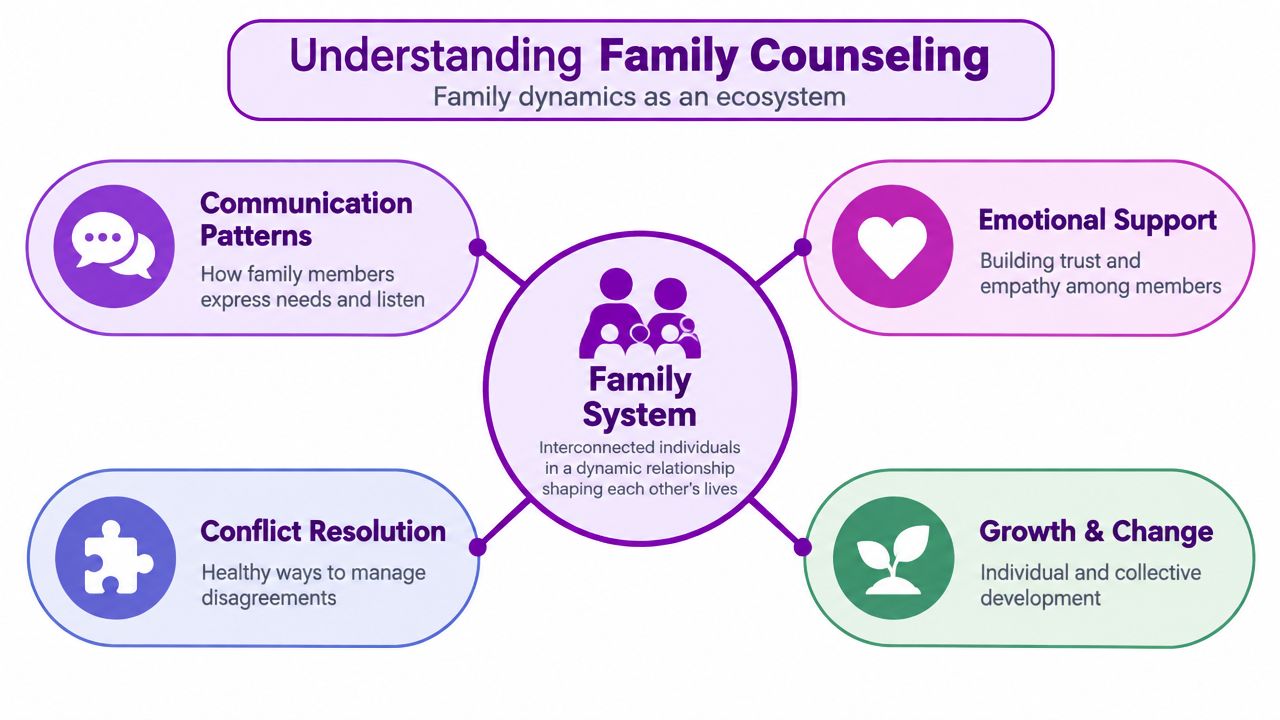
What happens inside the family system
A therapist might help a parent replace repeated commands with clearer requests, teach a teenager to express distress before shutting down, or guide partners through disagreement without involving their children. Sessions may include everyone, or only the people most directly involved at a given stage.
Family counseling also has research support. A major review of systemic family therapy found it as effective as other psychosocial interventions, and sometimes more effective for infant mental health and externalizing behavior problems. Across the reviewed meta-analyses, the average treated family did better than more than 71% of comparison families, with effects remaining at six to twelve months' follow-up (Wiley review).
This evidence does not promise a quick, identical result for every household. It supports a practical expectation: therapy that addresses interaction patterns alongside individual symptoms can help families develop skills that remain useful outside sessions.
What family counseling isn't
It is not a courtroom where a therapist rules on who is right. It is not always a group meeting with every relative present, and it should not replace psychiatric care when someone needs evaluation or medication management. An initial assessment can clarify whether the appropriate plan involves family counseling, individual therapy, psychiatric support, or a combination of services.
What to Expect in Your Counseling Journey
Starting therapy becomes less intimidating when you treat the first contact as an information-gathering conversation rather than a commitment for life. Explain what has been happening, who is affected, what you've tried, and what you hope will change. Ask how the therapist works with families and whether the provider has experience with your specific concern.
The first conversation
The initial consultation is also your chance to evaluate fit. Notice whether the therapist listens without taking sides, explains confidentiality clearly, and speaks in language your family can understand. Ask who should attend the first appointment, how the therapist handles private information, and what happens if one family member refuses to participate.
Once care begins, the therapist may meet with the whole family, a parent and child, caregivers alone, or individuals for part of the process. That structure can change as the work develops. A child may need a private space to speak, while parents may need coaching on how to respond at home.
The work between appointments
Expect conversation, guided observation, and practical exercises. Your therapist may identify a recurring conflict cycle, slow down a heated exchange, practice reflective listening, or role-play a difficult parenting conversation. The purpose isn't to perform perfectly. It's to notice what happens in real time and rehearse a different response.
A useful treatment plan separates relationship goals from symptom goals. For example, a family might work on reducing hostile arguments while a teenager receives individual treatment for anxiety. If trauma, psychiatric symptoms, or safety concerns are present, coordinated care may be more appropriate than family sessions alone.
Progress rarely follows a straight line. Look for concrete signs such as faster repairs after disagreements, more direct requests, fewer people being pulled into adult conflicts, or greater willingness to attend sessions. Your therapist should help define what progress means for your household and adjust the plan when the original approach isn't working.
How to Choose the Right Therapist in Scottsdale
Scottsdale families have access to a meaningful regional provider base, but a large pool still requires careful comparison. A University of Arizona workforce report identified 4,615 marriage and family therapists statewide, with 8.19 marriage and family therapists per 100,000 residents across Arizona and 9.66 per 100,000 in Maricopa County (University of Arizona workforce report). The same report listed 4,628 counselors statewide, showing that family counseling sits within a broader behavioral-health network.
Start with credentials and scope
Arizona marriage and family therapist applicants must complete at least 3,200 hours of supervised marriage and family therapy experience over no less than 24 months and complete the approved national licensing examination, according to the Arizona Board of Behavioral Health Examiners rules. Counselor licensure requires a master's or higher degree with 60 semester credit hours or 90 quarter credit hours, plus at least 24 months of post-master's supervised work, including 1,600 hours of direct client contact and 100 hours of clinical supervision (Arizona statute).
Ask which license the clinician holds, what populations they serve, and whether they routinely work with children, teens, couples, blended families, trauma, or parenting concerns. A provider's general availability doesn't tell you whether the provider is appropriate for your situation.
Compare fit, format, and access
Use the first call to compare practical factors:
- Issue match: Can the practice match your family with someone familiar with anxiety, school refusal, trauma, co-parenting, or behavioral changes?
- Session format: Would your family speak more openly in an office, through telehealth, or with a hybrid arrangement?
- Scheduling: Are evening or weekend appointments available when all necessary participants can attend?
- Clinical coordination: Can the provider explain when family counseling should be combined with individual therapy, EMDR, or psychiatry?
- Communication style: Does the therapist remain neutral while still offering clear direction?

You can also review a local option through the Scottsdale therapist page, then ask direct questions before scheduling. Comfort matters, but so does clarity. A warm therapist who can't meet your family's needs or availability may not be the right practical fit.
Navigating Insurance and Booking Details
Administrative friction can stop a family from beginning care. Handle the details in a fixed order so you don't spend multiple calls repeating the same information.
Verify coverage before choosing a time
Call the insurer and ask whether family counseling, rather than only individual therapy, is covered. Confirm the participating clinician or group, your out-of-pocket responsibility, whether a referral or authorization is required, and how telehealth claims are handled. Ask the practice to verify benefits too, but remember that an eligibility check isn't a guarantee of payment.
For a focused checklist, use this guide to verify insurance coverage. Save the name of the representative, the date of the call, and any reference information the insurer provides. If coverage is unclear, ask the practice about private-pay pricing, superbills, or other payment procedures before the first session.
Ask about the queue, not just the calendar
A practice may offer consultations while the earliest recurring appointment is much later. Ask:
- How soon can a new family complete an intake?
- Is there a cancellation list?
- Can the practice match by age, issue, language, and preferred format?
- Can all required family members attend the same appointment?
- What happens if an urgent concern appears between sessions?
Arizona law requires parity for audio-visual telehealth, meaning insurers must reimburse comparable telehealth services at the same or an equivalent rate as in-person services, subject to the applicable rules and plan terms (Arizona telehealth law overview). That can make online sessions a meaningful option for families managing school, work, transportation, or conflicting schedules.
If you're comparing independent scheduling tools or another provider's intake process, a resource such as book session with Velma may help you understand how an online booking flow works. The important point is to choose a process that gives you clear answers about availability, cost, and clinical fit.
Why Choose reVIBE Mental Health for Family Counseling
A family may need more than one kind of support. Relationship counseling can address communication and conflict, while individual therapy, EMDR, or psychiatry may address trauma, anxiety, depression, or medication needs. An integrated practice can make that coordination easier when the family agrees that separate but connected care is appropriate.
reVIBE Mental Health offers talk therapy, EMDR, and psychiatry with medication management, with care plans shaped around individual symptoms and family relationships. The practice provides in-person and secure online sessions, appointments available seven days a week, and guidance with insurance verification. These features address the access questions families often can't answer from a simple directory listing.

One practice, several Phoenix metro locations
reVIBE Mental Health lists five Arizona locations and one contact number, (480) 674-9220:
- Chandler: 3377 S Price Rd, Suite 105, Chandler, AZ
- Phoenix Deer Valley: 2222 W Pinnacle Peak Rd, Suite 220, Phoenix, AZ
- Phoenix PV: 4646 E Greenway Road, Suite 100, Phoenix, AZ
- Scottsdale: 8700 E Via de Ventura, Suite 280, Scottsdale, AZ
- Tempe: 3920 S Rural Rd, Suite 112, Tempe, AZ
The Scottsdale office gives local families an in-person option, while telehealth can reduce travel and help include family members who can't easily reach the office. Location alone shouldn't determine the decision, but a distributed practice can be useful when schedules, school routes, or caregiver responsibilities change.
The right question isn't whether one model works for everyone. Ask whether the practice can identify your family's main concern, match you with an appropriate clinician, explain coverage, and coordinate additional care when family sessions aren't enough by themselves.
Taking the Next Step Toward Family Wellness
Seeking counseling doesn't mean your family has failed. It means the current pattern is costing more energy than the household can keep supplying, and everyone deserves support in changing it. A therapist can help turn vague distress into specific goals, such as improving parent-child conversations, managing blended-family expectations, repairing trust, or supporting a teen while adults address their own stress.
Start with the facts that matter most. Identify the people affected, describe the situations that repeat, and decide whether you need whole-family sessions, parent coaching, couples work, individual treatment, or a combination. Then verify licensure, ask about issue-specific matching, confirm insurance details, and request a realistic estimate for the first available intake.
Arizona's workforce data show that Scottsdale benefits from the wider Maricopa County provider base, but access still depends on scheduling, modality, coverage, and fit. A flexible appointment doesn't help if the clinician lacks experience with your concern, and a strong clinical match isn't practical if the family can't attend consistently.
Bring those questions to the first call:
- Who needs support: Include children, teens, caregivers, or partners affected by the problem.
- What needs to change: Describe the recurring argument, withdrawal, anxiety, or transition in observable terms.
- Which care may be needed: Ask how family therapy fits with individual counseling, EMDR, or psychiatry.
- How care will work: Confirm session format, confidentiality, attendance expectations, insurance, and cancellation policies.
- What progress will look like: Agree on signs that the plan is helping and when it should be reviewed.
You don't have to wait until the household reaches a breaking point. Take one practical step today, write down your questions, and contact a qualified Scottsdale provider for a conversation about fit.
reVIBE Mental Health offers family counseling alongside talk therapy, EMDR, and psychiatry with medication management, through in-person and secure online appointments available seven days a week. Visit reVIBE Mental Health to explore family-focused support, review the Scottsdale location, and start a conversation about matching your household with the right care.