

Deciding to look for a Scottsdale therapist can feel like a big step, but you're making this choice in one of the best places for mental wellness. Think of this guide as your roadmap—a friendly tour through your options to help you find the right support for your unique journey.
Why Scottsdale Is a Hub for Mental Health and Wellness

Life in Scottsdale is vibrant and full of opportunity, but let's be honest—it also comes with its own unique set of pressures. Between demanding careers, complex social circles, and family responsibilities, it’s all too easy to feel stretched thin. If you’re feeling overwhelmed, anxious, or just not quite yourself, you are definitely not alone.
Choosing therapy is a powerful, proactive step toward getting your balance back and building real resilience. It’s an investment in yourself, giving you a dedicated space to process challenges, learn new coping skills, and move toward a more fulfilling life.
You Have Options—A Lot of Them
Scottsdale has really become a central point for mental health services in the greater Phoenix area. A quick search on platforms like Psychology Today shows over 1,000 verified therapists here, making it one of the most concentrated markets for therapy in the Southwest.
This concentration speaks to a real need. In fact, 93% of these professionals list anxiety as a primary focus, and 84% specialize in depression—two of the biggest concerns for adults navigating the area's often high-stress lifestyle. The sheer number of specialists means you have an excellent chance of finding someone who truly gets you and your goals.
"Therapy is not about 'fixing' something that is broken. It's about cultivating the inner resources you already have to navigate life's challenges with greater strength and self-awareness."
Getting to the Root of the Problem
Sometimes, the things we struggle with daily—like persistent anxiety, feeling emotionally numb, or getting easily triggered—are tied to experiences from our past that we haven't fully processed. Chronic trauma, which can happen after long-term exposure to distressing situations, can actually reshape how our nervous system responds to the world.
That’s why effective therapy does more than just help you manage the symptoms; it helps you address what's causing them in the first place.
Specialized approaches are key to finding deep, lasting healing. For example, some techniques are designed to help your brain reprocess difficult memories, which can bring a profound sense of relief. You can learn more about how EMDR therapy works in our detailed guide, a type of targeted care you can find with a qualified Scottsdale therapist.
Finding the Right Therapy in Scottsdale at a Glance
Navigating the world of therapy can feel a bit overwhelming at first. To help, here’s a quick look at some common feelings and the specialized therapeutic approaches that can make a real difference.
| If You Are Feeling… | Specialized Therapy That Can Help | What It Focuses On |
|---|---|---|
| Stuck on past traumatic events, having flashbacks, or feeling "on edge." | EMDR (Eye Movement Desensitization and Reprocessing) | Reprocessing traumatic memories to reduce their emotional impact and help your brain heal. |
| Overwhelmed by anxiety, depression, or mood swings that disrupt daily life. | Psychiatry & Medication Management | Medical evaluation and prescription of medication to help stabilize mood and brain chemistry, often alongside talk therapy. |
| Constantly arguing with your partner or feeling disconnected from them. | Couples Counseling | Improving communication, resolving conflicts, and rebuilding intimacy and connection in your relationship. |
| Stressed by family dynamics, or if your child/teen is struggling. | Child & Teen Therapy | Providing a safe space for young people to work through behavioral issues, anxiety, depression, and family changes. |
| Preoccupied with food, weight, and body image in a way that feels out of control. | Eating Disorder Support | Addressing the underlying emotional triggers of disordered eating and building a healthier relationship with food and your body. |
This table is just a starting point. The best approach for you will be based on your individual story and goals, which is something a good therapist will help you figure out.
At reVIBE Mental Health, our integrated team understands the complexities of modern life. Our Scottsdale office is a welcoming, non-judgmental space where you can feel heard and empowered. Our collaborative approach—combining talk therapy, EMDR, and psychiatry—ensures your care is both comprehensive and personal. We're here to help you find your strength, starting today.
Exploring Therapy Options Beyond Just Talking
When you picture therapy, what comes to mind? For most of us, it’s the classic image of someone talking on a couch. And while that kind of talk therapy is a cornerstone of mental health, it’s not the whole story. The field has evolved, and today’s toolkit is filled with specialized approaches designed to get to the root of an issue, not just manage the symptoms.
If you’re looking for a Scottsdale therapist, knowing what’s out there can make all the difference in finding what actually works for you. It’s about finding the right key for the right lock. Here at reVIBE Mental Health, two of the most powerful options we offer are EMDR therapy and psychiatry with medication management.
Reprocessing Difficult Memories with EMDR
Ever feel like a past event is still happening right now? Sometimes, deeply distressing memories don't get filed away properly in the brain. They stay "stuck," and a completely normal, everyday situation can trigger the same intense emotions and physical reactions as the original event. It’s like the past is constantly crashing into your present, which is especially common with trauma.
That’s where EMDR comes in. Standing for Eye Movement Desensitization and Reprocessing, EMDR is a highly structured therapy that helps the brain finally process these stuck memories correctly.
Imagine your brain is a library and a traumatic memory is a book that got shoved onto the wrong shelf in a moment of chaos. It’s out of place, keeps falling out, and messes up the whole system.
An EMDR therapist is like a skilled librarian. Through a process called bilateral stimulation (like following a light or a sound back and forth), they gently guide your brain to pull out that misplaced "book," process what's inside, and file it away where it belongs—in your long-term memory.
The memory doesn’t just vanish. Instead, its emotional charge is neutralized. It becomes a part of your story, not something that dictates your daily life. The results can be profound. Some studies show that up to 90% of single-trauma victims no longer have PTSD after only three EMDR sessions.
The Role of Psychiatry and Medication Management
While therapy is fantastic for building coping skills and processing life experiences, some mental health challenges have a biological component. Conditions like depression, anxiety, or bipolar disorder often involve imbalances in brain chemistry. In the same way you’d see a doctor for a physical ailment, a psychiatrist can address the physiological side of your mental health.
Psychiatry is a medical specialty focused entirely on mental health. As a medical doctor, a psychiatrist can:
- Diagnose complex mental health conditions.
- Prescribe and carefully manage medication.
- Offer integrated care that combines medical treatment with therapy.
Medication isn’t a quick fix or a "magic pill." Think of it more as a tool for building a stable foundation. It can help regulate your mood and quiet the overwhelming static of your symptoms, giving you the clarity and energy to do the deeper work in therapy. It’s not about changing who you are—it’s about turning down the noise so you can hear yourself again.
Often, the combination of therapy and medication is more effective than either one on its own. At reVIBE, our Scottsdale therapists and psychiatric team work together closely, ensuring your care is coordinated and complete. This all-in-one approach means every part of your well-being—emotional, psychological, and biological—is supported under one roof, paving a smoother path toward feeling better.
Specialized Support for Individuals and Families

Mental health is rarely a solo journey. Our well-being is deeply connected to the people closest to us, and the challenges we face almost always ripple outward, touching our partners, children, and the entire family dynamic. This is why truly effective support often needs to look beyond just the individual and address the relationships that shape our lives.
At reVIBE Mental Health, we understand this from the ground up. We offer specialized support for every member of the family, whether it's couples feeling disconnected or parents looking for help for their kids. Finding a Scottsdale therapist who gets these complex connections is the key to creating positive change that actually lasts for everyone involved.
Rebuilding Connection with Couples Counseling
So many couples wait until their relationship is at a breaking point to seek help. But couples counseling isn’t just a last-ditch effort; it's a space to proactively strengthen your foundation, fix communication gaps, and deepen your bond before small cracks turn into major fractures.
Think of it like tending a garden. If you don't regularly weed, water, and care for it, misunderstandings and resentment can quickly take over. Couples counseling gives you the tools to tend to that garden together.
Our therapists can help you and your partner:
- Translate Needs: Learn how to ask for what you need in a way your partner can actually hear, and finally understand what they’re trying to tell you.
- Break Cycles: Pinpoint and stop those frustrating, repetitive arguments that feel like you're stuck on a loop.
- Rebuild Trust: Create an emotionally safe space where you can heal from past hurts and re-establish a secure bond.
This process is about so much more than just managing conflict. It’s about rediscovering the friendship and intimacy that brought you together in the first place.
Supporting the Next Generation with Child and Teen Therapy
Being a parent is incredible, but it can also be incredibly challenging. When your child or teen is struggling, it’s easy to feel overwhelmed and isolated. The good news is, you don’t have to figure it all out alone. Our child and adolescent specialists create a safe, supportive space for young people to work through their feelings and build resilience.
For younger kids who don’t yet have the words for their big emotions, our therapists often use play therapy. Play is the natural language of childhood. Through specific games and activities, children can act out their fears, make sense of difficult experiences, and learn new coping skills in a way that feels completely natural to them. It’s how they tell their story.
For teenagers, therapy provides a confidential outlet to talk about pressures they may not feel comfortable sharing with anyone else—from school stress and friendships to anxiety and self-esteem.
A therapist acts as a neutral guide, helping teens develop self-awareness and communication skills that will serve them for a lifetime, all while keeping parents in the loop.
Compassionate Support for Eating Disorders
Eating disorders are complex mental health conditions that require a highly specialized and compassionate touch. They are never about vanity or a simple choice; they are serious issues often rooted in deep anxiety, trauma, or a need to feel in control. Our approach to eating disorder support is built on empathy and proven, evidence-based care.
We focus on helping individuals untangle their self-worth from their body image and eating habits. The real goal is to get to the underlying emotional triggers—the "why" behind the behavior. By fostering a healthier relationship with both food and their body, we help clients reclaim their lives.
Our Scottsdale team works together to provide a full circle of support, making sure individuals and their families feel understood, not judged, every step of the way.
How to Choose the Right Scottsdale Therapist for You
Finding the right support is a deeply personal journey, and here’s the most important thing to know: your connection with your therapist matters more than anything else. This relationship, what we call the therapeutic alliance, is the single biggest predictor of success in therapy—more than any specific technique or fancy degree.
Think of it like finding a guide for a tough hike. You need someone you trust, who gets your pace, and who you feel comfortable with while navigating tricky spots. Choosing a Scottsdale therapist isn't just about matching symptoms to a resume; it's about finding that genuine human connection where you feel seen, heard, and completely accepted. That’s where the real work begins.
First, Clarify Your Goals
Before you even start Googling, it’s incredibly helpful to pause and reflect. You don't need a perfect roadmap, but having a general sense of your destination will make the search so much easier. It's like plugging a city into your GPS before you start a road trip—even a broad direction helps.
Take a minute to ask yourself a few things:
- What’s bringing me to therapy right now? Is it a sudden life change, a nagging feeling of anxiety, a struggle in a relationship, or just a desire to understand yourself better?
- If things were better in six months, what would that look like? Try to picture it. What’s different? How do you feel?
- What kind of person do I want to talk to? Do you work best with someone who is direct and gives you action steps, or someone who is more gentle and exploratory? Does their gender, age, or background matter to you?
Thinking through these points helps you walk into those first conversations knowing what you’re looking for, making it easier to find a therapist who is on the same page from day one.
Questions to Ask a Potential Therapist
Most therapists offer a free, quick consultation call. This isn't just for them to assess you; it’s your chance to interview them. It’s a two-way street. Your main goal here is to get a feel for their personality and style to see if it clicks with yours.
Here are a few essential questions to have in your back pocket:
- Could you tell me a little about your approach to therapy? This gives you a peek into their philosophy. Do they use structured methods like Cognitive Behavioral Therapy (CBT), or are they more focused on exploring past experiences? If you're curious about the different professional titles, our guide on therapist vs. a psychologist vs. a counselor can be a big help.
- What’s your experience working with issues like mine? It’s perfectly okay to ask if they’ve helped others navigate anxiety, trauma, or whatever you’re bringing to the table. It can give you a real sense of confidence.
- What should I expect in our first few sessions? This helps you understand their process and sets realistic expectations for how things will get started.
A crucial tip: The answers to these questions are often less important than how you feel talking to them. Do you feel a sense of ease and understanding? Or do you feel rushed and unheard? Trust your gut.
The reVIBE Matching Process
We get it. Poring over profiles and making endless calls can feel like trying to find a needle in a haystack. That's why at reVIBE Mental Health, we’ve built our entire process around making that perfect match. We take the guesswork out of it by personally considering your needs, goals, and personality to pair you with the ideal therapist on our team.
When you reach out to our Scottsdale office, our care coordinator will actually listen to your story. From there, they’ll connect you with a provider who not only has the right clinical skills but, just as importantly, the right relational style for you. It’s a personalized touch designed to help you start your journey with confidence.
As you do your research, you'll also notice that online presence plays a role. Understanding the importance of Google reviews for local businesses can offer some insight into what other people's experiences have been like. Our goal is to make that first, critical step as simple and reassuring as possible.
Navigating Insurance and Scheduling Your First Session
Let’s be honest, the practical side of starting therapy—like figuring out insurance and scheduling—can feel like a huge hurdle. It's often the last thing you want to deal with when you're already feeling overwhelmed. At reVIBE, we get it. Our whole approach is built around making these steps as painless as possible so you can focus on what actually matters: your well-being.
First up, insurance. It’s a common source of confusion, and the jargon alone can make your head spin. You’ll hear two words thrown around a lot: deductible and copay.
Think of your deductible as the amount you need to cover yourself before your insurance plan starts chipping in. A copay, on the other hand, is the flat fee you pay for a session after you've met that deductible.
Making Insurance Work for You
Trying to decipher what your specific plan covers can feel like a full-time job. You don't have to do it alone. When you call us, our team will handle the benefits verification for you. That just means we’ll contact your insurance company directly to get a clear picture of your mental health coverage, so there are no surprise costs down the road.
We're in-network with most major insurance providers, which simplifies things quite a bit. This includes:
- Aetna
- Blue Cross Blue Shield (BCBS)
- Cigna
- United Healthcare / Optum
This isn't a complete list, and benefits can differ even within the same provider. The absolute best first step is to give our office a call at (480) 674-9220. Our care coordinators are experts at this and can walk you through the specifics of your plan.
This flowchart breaks down the process of finding the right therapist, from setting your goals to making sure it’s a good fit.
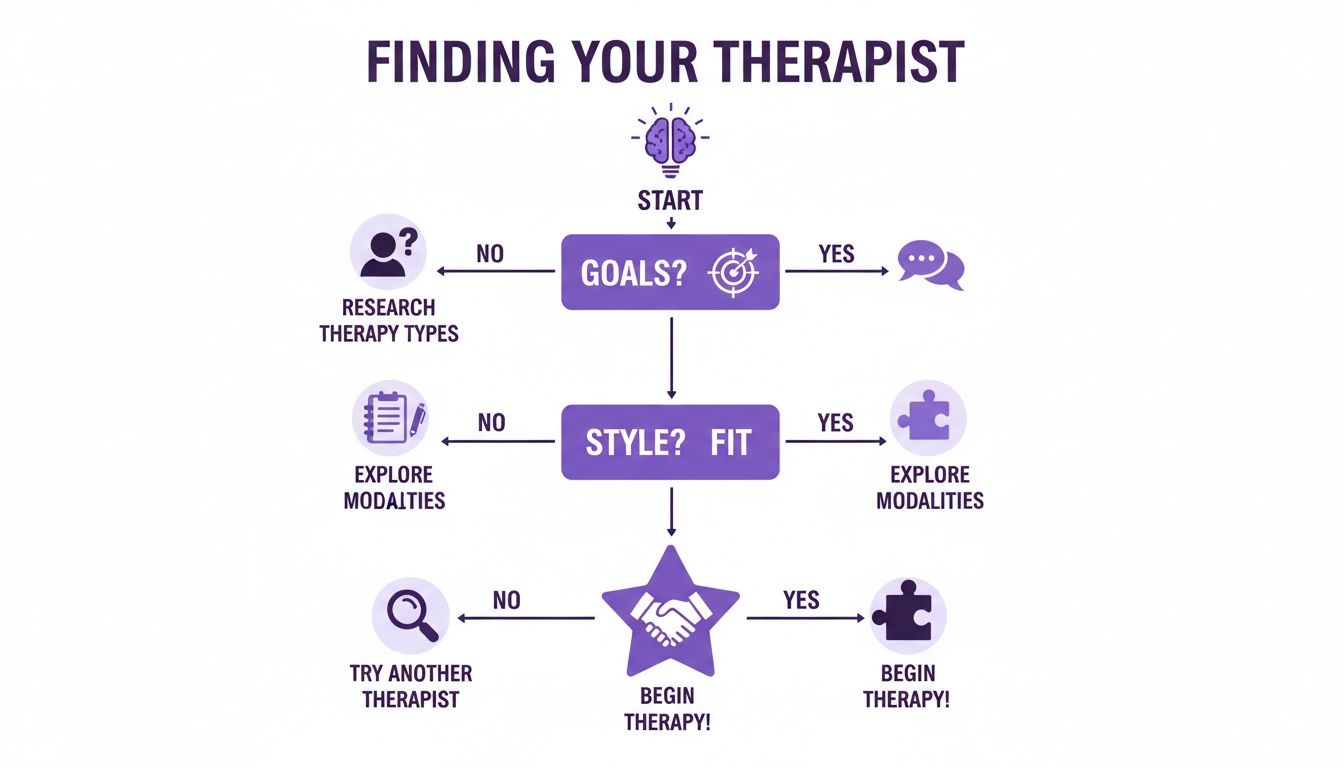
As you can see, finding the right Scottsdale therapist is all about matching your needs with their approach and, most importantly, feeling a real connection.
Scheduling That Fits Your Life
Therapy should fit into your life, not force you to rearrange it. We know life in Scottsdale is busy, and finding an hour for yourself is hard enough. That's why we’ve built our scheduling to be as flexible as possible.
We offer appointments seven days a week, with plenty of evening and weekend slots available. You can find a time that works for you, whether it's during a lunch break, after the kids are in bed, or on a Saturday morning.
"The best time to start therapy is when you realize you need it. Logistics shouldn't be the barrier that stops you from taking that first brave step toward feeling better."
You also get to choose how you connect with your therapist. We offer both in-person appointments and secure online therapy sessions. Some people thrive on face-to-face interaction, while others love the convenience of logging in from home. The choice is completely yours.
If you’re ready to book but feeling a little nervous, it can help to know what to expect. Check out our guide on how to prepare for your first therapy session to ease your mind.
With five convenient locations across the Valley, great care is never far away.
What to Expect at Your First reVIBE Appointment

It’s completely normal to feel a little bit of everything before your first therapy session—a mix of hope, maybe some nerves, and a whole lot of uncertainty. We get it. Taking this first step is a huge sign of strength, and our entire goal is to make the process feel comfortable and clear from the moment you reach out.
Your first appointment isn't some high-pressure test. Think of it more like a conversation, a chance for you and your therapist to get to know one another and see if it’s a good fit. This initial meeting is all about establishing a safe, confidential space where you can start to share your story, but only at a pace that feels right for you.
A Welcoming and Non-Clinical Environment
The first thing people usually comment on when they walk into our offices is the atmosphere. We’ve worked hard to design our spaces to feel more like a comfortable, modern living room than a sterile doctor's office. It’s all about creating a calm, inviting environment where you can actually relax and feel grounded.
This non-clinical vibe is a core part of who we are. We believe real healing happens when you feel safe, seen, and respected, and your physical surroundings play a surprisingly big role in that. From the comfy chairs to the calming decor, every detail is there to help you settle in for the important work ahead.
The Collaborative Intake Process
That first session is often called an "intake," but honestly, we see it as the beginning of a partnership. Your therapist will gently guide the conversation with open-ended questions to get a sense of what brought you here.
You can expect to touch on a few key areas:
- Your Story: This is your time to talk about your current struggles, your background, and anything else that’s on your mind.
- Your Goals: What do you hope to get out of therapy? Your therapist will want to know what a better future looks like to you.
- Logistics and Questions: We'll also cover the practical stuff, like confidentiality and how often you'll meet, and answer any questions you have about how it all works.
"The first session is less about finding solutions and more about building a foundation. It's about establishing trust and ensuring you feel genuinely heard and understood, perhaps for the first time."
Setting the Stage for Your Journey
By the time your first appointment wraps up, you and your Scottsdale therapist should have a clearer idea of how you can move forward together. We’ll end by outlining some potential next steps, so you leave not just feeling heard, but with a real sense of direction and hope for what’s possible.
Taking that brave next step is easier than you think. With five convenient locations including Scottsdale, Chandler, Tempe, and Phoenix, quality mental health care is always within reach. Call us to find the office nearest you and schedule your first, confidential appointment.
A Few Common Questions About Finding a Therapist in Scottsdale
Starting therapy is a big step, and it's totally normal to have questions before you begin. Getting some clear answers can make the whole process feel less intimidating and help you walk into that first session with confidence. Here are a few of the things we hear most often from people searching for a Scottsdale therapist.
How Long Does Therapy Usually Last?
This is probably the most common question we get, and the honest answer is: it's completely up to you and what you want to achieve. There's no magic number or standard timeline. Some people come to therapy to tackle a specific, short-term challenge—maybe navigating a career change or grieving a loss—and might feel they have the tools they need after just a few months.
Others view therapy as an ongoing space for personal growth and self-exploration, making it a longer-term part of their self-care routine. At reVIBE, your therapist works with you to map out a plan. The key is that it's flexible, and you'll constantly check in on your progress together to make sure the pace and duration always feel right for you.
Is Online Therapy as Effective as In-Person Therapy?
Yes, absolutely. A huge amount of research has confirmed that for many common concerns like anxiety and depression, online therapy (sometimes called telehealth) is just as effective as meeting in person. What really matters most for success isn't the room you're in, but the strength of the connection you build with your therapist—and that connection can be just as powerful and genuine through a screen.
The biggest benefit of online therapy is the convenience. It lets you get the support you need from a space where you feel comfortable and safe, without having to fight traffic. We offer both in-person sessions at our five Valley locations and online therapy, so you can choose whatever fits your life best.
What Is the Difference Between a Therapist and a Psychiatrist?
It's easy to get these two mixed up! Think of them as two different but complementary specialists on your mental health team.
A therapist, who might be a Licensed Professional Counselor (LPC) or a Licensed Clinical Social Worker (LCSW), focuses on "talk therapy." They are experts in helping you process your experiences, build practical coping skills, and work through the thought patterns and behaviors that are holding you back.
A psychiatrist is a medical doctor (MD) who specializes in mental health. Because of their medical training, they can diagnose conditions and are licensed to prescribe and manage medication. While some do provide therapy, their primary role often involves the biological side of mental wellness.
Here at reVIBE, our therapists and psychiatric team work side-by-side. This means if you could benefit from both therapy and medication, your care is coordinated and seamless, giving you the best of both worlds.
Find a reVIBE Location Near You!
We currently have five locations for your convenience. (480) 674-9220
reVIBE Mental Health – Scottsdale
8700 E Via de Ventura, Suite 280, Scottsdale, AZ
reVIBE Mental Health – Chandler
3377 S Price Rd, Suite 105, Chandler, AZ
reVIBE Mental Health – Phoenix Deer Valley
2222 W Pinnacle Peak Rd, Suite 220, Phoenix, AZ
reVIBE Mental Health – Phoenix PV
4646 E Greenway Road, Suite 100, Phoenix, AZ
reVIBE Mental Health – Tempe
3920 S Rural Rd, Suite 112, Tempe, AZ
Ready to get the support you deserve? The team at reVIBE Mental Health is here to help you get matched with the right provider and start your journey toward feeling better. Book your appointment online or call us today!