
The first move in quieting a racing mind at night isn't to fight the thoughts, but to understand why they show up in the first place. Once you get a handle on that, you can start using some surprisingly simple strategies—like setting aside a specific time to worry earlier in the evening or creating a relaxing bedtime ritual—to signal to your brain that it’s time to power down.
Why Your Brain Goes Into Overdrive at Bedtime
It’s an experience most of us know all too well. The moment your head hits the pillow, your brain suddenly kicks into high gear, replaying conversations, second-guessing decisions, and worrying about tomorrow. It’s incredibly frustrating.
All day long, you’re busy. You’re juggling tasks, putting out fires, and constantly processing new information. When you finally lie down, all that external noise disappears. Your brain, free from its usual distractions, suddenly has a wide-open space to fill, and it often does so with every unresolved issue it can find.
This isn't a sign of weakness; it's just how our minds work. Without emails to answer or kids to get ready for school, anxieties from the day—or even from years ago—can rush in to fill the silence. This mental loop is often called rumination, a frustrating cycle where you chew on the same negative thoughts over and over again.
The Science Behind Nighttime Worries
Think of it this way: during the day, the logical, problem-solving parts of your brain are in the driver's seat. But at night, as you try to unwind, the brain's emotional centers can take over. This shift in control can blow minor concerns way out of proportion, making them feel like massive, unsolvable crises.
Your brain is essentially trying to "close the tabs" left open from the day. The problem is, it’s doing this when you’re tired and least equipped to think rationally. This creates a vicious cycle:
- A worry pops into your head.
- That worry triggers an anxiety response, releasing stress hormones like cortisol.
- These hormones make you feel more awake and alert.
- Now you’re wide awake, with even more time to worry.
This cycle of rumination is a core target of many therapeutic approaches. By learning to identify and restructure these thought patterns, you can effectively break the loop and quiet your mind for sleep.
Just understanding this pattern is a huge first step toward taking back your nights. Techniques from Cognitive Behavioral Therapy (CBT) are particularly powerful for this. You can learn more about what is Cognitive Behavioral Therapy in our detailed guide, which breaks down how this approach helps you reframe those automatic negative thoughts that keep you up.
If you’re in Chandler, Phoenix, Scottsdale, or Tempe, the compassionate team at reVIBE Mental Health is here to give you the practical tools you need to find peace and quiet at bedtime.
Actionable Techniques to Reclaim Your Thoughts
Instead of letting anxious thoughts run the show, you can learn how to intercept and manage them. The goal isn’t to force your mind to go blank—an impossible task that just creates more stress. It’s about learning to engage with your thoughts differently.
These are the same practical, cognitive strategies we teach in therapy to help people break free from the worry cycle. These aren't abstract theories; they're real tools you can start using tonight. You have more control than you think, and it starts with a few intentional actions well before your head even hits the pillow.
Schedule Dedicated "Worry Time"
One of the most powerful things you can do is give your worries a designated time and place to exist. This technique, which we call "Worry Time," is surprisingly simple. You just set aside a specific window—say, 15-20 minutes in the early evening—to consciously and deliberately think about whatever is on your mind.
During this time, grab a notebook and write down everything that's causing you stress. Get it all out, from big-picture fears to small, nagging to-do list items. When the timer goes off, you close the notebook and make a deal with yourself to put those worries aside until tomorrow's session.
This approach works because it validates your brain's need to process things without letting it hijack your sleep. If a worry pops up later as you're trying to fall asleep, you can gently tell yourself, "Thanks, but I've already dealt with that. It's on the list for tomorrow." You’re not dismissing the thought; you’re just postponing it.
Challenge Your Anxious Thoughts
Let's be honest, nighttime thoughts don't operate with a filter. A minor concern can easily spiral into a full-blown catastrophe in the dark. A simplified "Thought Challenging" exercise helps you question and reframe the negative stories that keep you awake.
When a stressful thought appears, just pause and ask yourself a few grounding questions:
- Is this thought 100% true? Our biggest worries are often built on assumptions, not facts. Acknowledge what you actually know versus what you're imagining.
- What's a more realistic or balanced way to see this? Instead of "I'm going to completely fail the presentation," try something like, "I'm nervous, but I've prepared and I'll do my best."
- What would I tell a friend who had this same worry? We're often much kinder and more rational when advising others. It's time to offer yourself that same compassion.
By questioning your thoughts, you create distance from them. You begin to see them as mental events passing through your mind, not as absolute truths that define your reality. This separation is key to reducing their power.
This practice is a cornerstone of learning how to reduce anxiety without medication, as it empowers you to rewire your own responses to stress. It takes practice, for sure, but each time you challenge a thought, you weaken its hold. Over time, this conscious reframing starts to become more automatic, helping you find a calmer mental state when it's finally time for rest.
Designing a Wind-Down Routine That Actually Works
One of the most powerful things you can do to stop overthinking is to build a solid pre-sleep ritual. Think of it as a buffer zone between the chaos of your day and the calm you need for sleep. This isn't about adding more tasks to your to-do list; it's about creating a personalized, enjoyable transition that tells your brain it's time to power down.
A consistent routine creates predictability, which is incredibly soothing for an anxious mind. After a while, your brain starts to recognize the cues—the smell of herbal tea, the feel of a favorite book, a specific chill playlist—and begins to unwind almost automatically.
But here’s the secret: you have to actually enjoy it. If your routine feels like a chore, it will only add to your stress, completely defeating the purpose. The key is to experiment and find what genuinely helps you relax.
Creating Your Pre-Sleep Buffer
First things first: set a hard stop for screens. I call it a "digital sunset," and it needs to happen at least 60-90 minutes before you plan to sleep. The blue light from your phone, tablet, or TV messes with melatonin (your natural sleep hormone), and the endless scroll of information keeps your brain wired. Putting your phone away is non-negotiable if you’re serious about calming a racing mind.
So, what do you do with that tech-free time? This is your chance to offload all that mental clutter. I’m a huge fan of the "brain dump." Grab a notebook and just write. Don't censor yourself or worry about grammar—just get every single worry, idea, and nagging to-do list item out of your head and onto the paper. It’s amazing how much lighter you feel when the burden is on the page instead of in your mind.
Key Takeaway: Consistency is far more important than complexity. A simple, 30-minute routine you do every single night will beat an elaborate two-hour ritual you only manage once a week.
This simple timeline highlights two of the most effective mental steps you can build into your routine: scheduling a specific time to worry earlier in the day and actively challenging the negative thoughts that pop up.
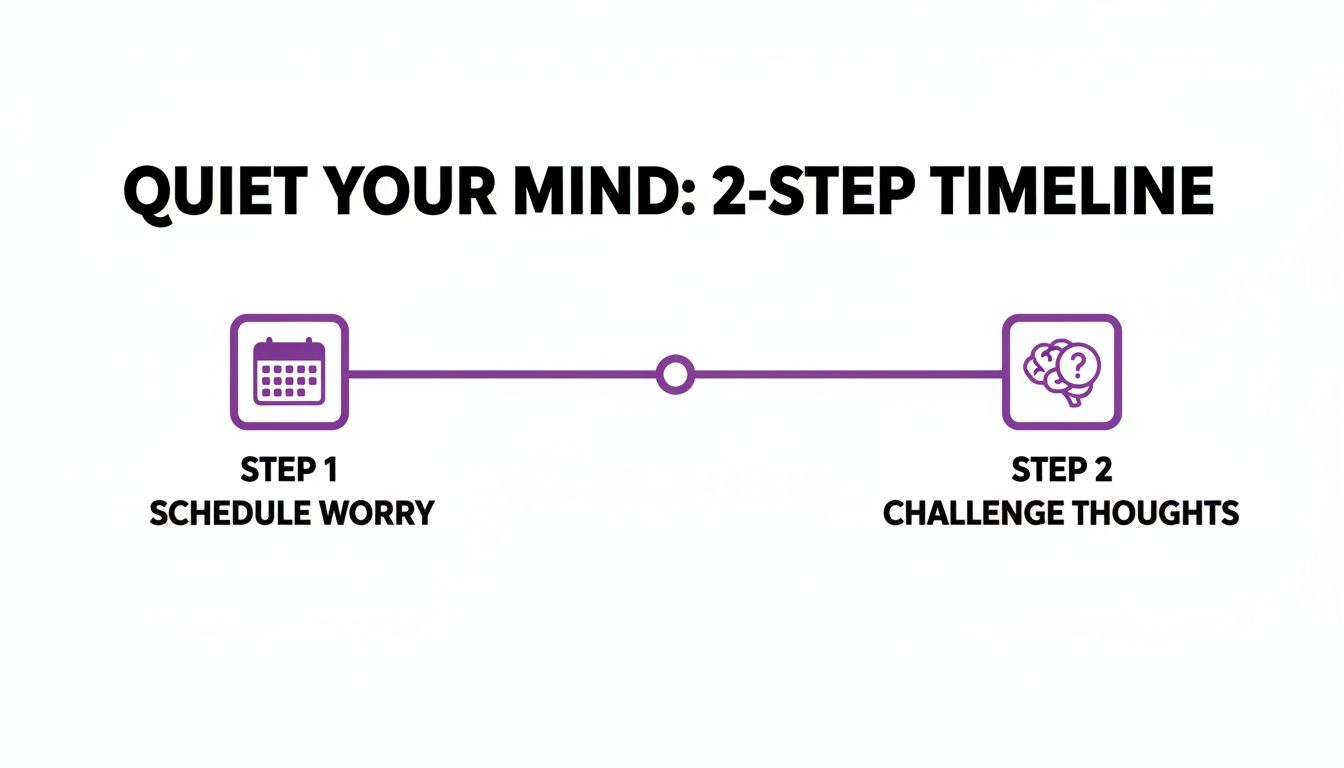
By dealing with these anxieties proactively, you stop them from ambushing you the second your head hits the pillow.
Mix and Match to Find Your Perfect Routine
Think of building your wind-down routine like creating a personal menu of calming activities. The goal is to design something you genuinely look forward to at the end of the day.
Here are a few proven ideas you can mix and match:
- Curate a Sleep Soundtrack: Create a playlist of calming ambient music, listen to a sleep story, or follow a guided meditation. Consistent audio cues can become a powerful signal to your brain that it's time for rest.
- Pick Up a Real Book: Choose a physical book (not an e-reader or tablet!) that’s interesting but not a nail-biting thriller. Fiction or light non-fiction works well; avoid anything related to work.
- Do Some Gentle Stretching: You’d be surprised how much physical tension you hold from a stressful day. A few minutes of slow, gentle stretching can release tightness in your shoulders, back, and hips, which has a direct calming effect on your mind.
Sample Nightly Wind-Down Routines
To give you a better idea, here are three different 60-minute routines you can adapt. See which one speaks to you and feel free to swap activities to create your perfect pre-sleep ritual.
| Time (Before Bed) | Routine A (For the Reader) | Routine B (For the Meditator) | Routine C (For the Creative) |
|---|---|---|---|
| 60 mins | Put phone away, make herbal tea | Dim lights, put on ambient music | Tidy up workspace, change clothes |
| 45 mins | Journaling / "Brain Dump" (15 mins) | Gentle stretching (10 mins) | Sketching or doodling (20 mins) |
| 30 mins | Read a physical book (30 mins) | Guided meditation (20 mins) | Listen to a calming podcast/music |
| 15 mins | Light tidying of bedroom | Breathing exercises (5 mins) | Journaling / Gratitude list (15 mins) |
| 0 mins | Lights out | Lights out | Lights out |
Remember, the best routine is the one you’ll actually stick with. These are just starting points.
Ultimately, quieting your mind at night is a core part of getting truly restorative rest. This practical guide to improving sleep quality has even more great tips for making sure you wake up feeling refreshed. A good night's sleep truly begins hours before you ever get into bed.
What to Do When Anxiety Wakes You Up at 2 AM

It’s one thing to have a solid wind-down routine, but it’s another entirely to jolt awake in the dead of night with a racing heart and a mind already spinning with dread. When you’re caught in that state, trying to reason with your brain is a losing battle.
This is where grounding techniques come in. These aren't complex mental exercises; they are simple, body-based tools designed to pull you out of the chaotic spiral of your thoughts. Think of them as an immediate off-ramp from the anxiety highway, anchoring you firmly in the present moment when you need it most.
The Power of Your Breath
When anxiety spikes, your breathing almost always becomes shallow and rapid, which just screams "danger!" to your nervous system. You can actually reverse this process by intentionally slowing your breath down, sending a message of safety right back to your brain.
One of the best methods I've found for this is the 4-7-8 breathing technique. It's incredibly simple, which is exactly what you need when you're groggy and overwhelmed.
- Breathe in quietly through your nose for a count of four.
- Hold that breath gently for a count of seven.
- Exhale slowly and completely through your mouth for a count of eight. It helps to make a soft "whoosh" sound.
Just repeat this cycle three or four times. The real magic is in that long exhale—it's what activates your parasympathetic nervous system, which is basically your body's built-in "rest and digest" mode.
Use Your Senses to Get Out of Your Head
Overthinking traps you inside your own head. The 5-4-3-2-1 sensory technique is a classic grounding exercise because it works—it forces your focus outward, reconnecting you with your physical surroundings and breaking the loop of rumination.
Lying there in bed, just silently tick these off in your mind:
- 5 things you can see: The shadow the lamp casts on the wall, the faint glow of your alarm clock, the outline of the bedroom door, maybe the moonlight filtering through the blinds.
- 4 things you can feel: The cool side of your pillow against your cheek, the weight of the comforter, the texture of your pajamas, the air on your skin.
- 3 things you can hear: The low hum of the refrigerator, the distant sound of traffic, your own breathing.
- 2 things you can smell: The clean scent of your sheets, maybe the lingering smell of the lotion you put on earlier.
- 1 thing you can taste: The faint, minty aftertaste of toothpaste, or just the neutral taste in your mouth.
This exercise gives your brain a job to do. It’s hard to entertain anxious thoughts when you’re busy noticing the specific details of the room around you.
Shifting your attention from internal worries to external sensations interrupts the momentum of a racing mind. It creates a small but crucial window of calm, which is often just enough to let sleep come back.
Let Go of Physical Tension
Anxiety isn't just a mental game; it gets stored in your body. Think about it—the clenched jaw, the tight shoulders, that knot in your stomach. It's all physical. Progressive muscle relaxation is a technique that tackles this head-on.
The idea is to systematically tense and then release different muscle groups, paying close attention to the difference between the two sensations.
- Start with your feet and toes. Squeeze them tightly for five seconds, then let all that tension go for ten seconds.
- Work your way up your body. Tense your calves and thighs, hold, and release.
- Continue with your stomach, chest, arms, and hands. Clench each group, then feel the relief as you let go.
- Finish with your shoulders, neck, and face. Scrunch everything up toward your ears, hold it, and then release it all completely.
This process doesn't just relieve physical tightness. It also deepens your awareness of your own body, giving you another powerful anchor to the present moment.
Knowing When to Get Professional Support
The self-help strategies we've covered are genuinely powerful, but sometimes overthinking at night points to something deeper than just the day's stress. If you've been putting these techniques into practice consistently and still feel like you're fighting a losing battle, it might be time to bring in a professional.
Realizing this isn't a sign of failure. In fact, it’s a smart, proactive step toward finding real and lasting peace of mind.
Deciding to seek help can feel like a huge step, but certain signs are pretty clear indicators that it's the right move. Ask yourself: how is this constant mental churn and lack of sleep really affecting my life? Is exhaustion tanking my performance at work? Am I becoming irritable and distant with the people I love?
When the answer is yes, it's a sign the problem has outgrown your ability to manage it alone.
When to Make the Call
It's time to reach out when your best efforts feel like they’re hitting a brick wall. Pay close attention if any of these sound familiar:
- Chronic Sleep Deprivation: You're regularly getting less than five or six hours of sleep because your mind won't shut off, and this has been going on for weeks.
- Daily Function is Impaired: The combination of exhaustion and anxiety is making it hard to focus at work, keep up with family life, or even enjoy the things you used to love.
- Anxiety Feels Uncontrollable: That feeling of dread isn't just a nighttime problem anymore. It's started creeping into your days, becoming a constant companion.
- Noticeable Mood Changes: You're dealing with a persistent sense of sadness, hopelessness, or irritability that just won't seem to lift.
The goal of therapy isn't just to get you through the night; it's to help you start thriving during the day again. If overthinking is stealing your energy and joy, professional guidance can provide the structure and support needed to reclaim your life.
What Does Therapy Look Like?
Therapy for nighttime overthinking is incredibly practical and focused. One of the most effective methods is Cognitive Behavioral Therapy for Insomnia (CBT-I), a specialized approach that directly targets the thoughts and behaviors sabotaging your sleep. A good therapist will help you pinpoint those unhelpful thought loops, challenge them, and build a new set of healthier sleep habits.
Sometimes, persistent overthinking can be a symptom of a larger issue. If your inability to rest is severe, you may want to explore strategies for alleviating various sleep disorders to see if something more is at play.
A professional can also help figure out if an underlying condition, like an anxiety disorder or depression, is fueling the fire. In some cases, a combination of therapy and medication management offers the most comprehensive relief. If that sounds intimidating, you can learn more about what happens during a psychiatric evaluation to see what the process actually involves.
This is where reVIBE Mental Health can step in. Our team of therapists and psychiatric professionals works together to provide expert care that fits your life. We make getting help straightforward with both in-person and telehealth appointments, and we accept most major insurance plans.
Find a reVIBE Location Near You!
We currently have five locations for your convenience. (480) 674-9220
reVIBE Mental Health – Chandler
3377 S Price Rd, Suite 105, Chandler, AZ
reVIBE Mental Health – Phoenix Deer Valley
2222 W Pinnacle Peak Rd, Suite 220, Phoenix, AZ
reVIBE Mental Health – Phoenix PV
4646 E Greenway Road, Suite 100, Phoenix, AZ
reVIBE Mental Health – Scottsdale
8700 E Via de Ventura, Suite 280, Scottsdale, AZ
reVIBE Mental Health – Tempe
3920 S Rural Rd, Suite 112, Tempe, AZ
Common Questions About Nighttime Overthinking
Even after trying a dozen different strategies, you might still wonder why it’s so hard to just turn your brain off. It's a frustratingly common problem. Let's tackle some of the most frequent questions I hear from people who are tired of their thoughts keeping them up at night.
Why Are My Thoughts So Much Worse at Night?
It’s not just you—worries absolutely feel bigger and more menacing in the dark. There’s a good reason for this. During the day, the logical, problem-solving part of your brain (the prefrontal cortex) is in the driver's seat. But as you get tired and start to wind down, its grip loosens.
This allows your brain’s emotional center, the amygdala, to get a lot louder. Suddenly, you're processing every little worry with raw emotion instead of logic. That's how a minor work issue can feel like a career-ending catastrophe at 2 AM. You're not going crazy; your brain is just shifting gears.
Is Overthinking a Sign of an Anxiety Disorder?
Not necessarily. Almost everyone has nights where their mind races, especially when life gets stressful. It’s a pretty normal human experience.
But if this is happening almost every night, and the overthinking feels completely out of your control and is wrecking your sleep and your days, it might be more than just stress. It could be a symptom of something like Generalized Anxiety Disorder (GAD). When it feels like you're fighting a losing battle every single night, getting a professional opinion is a really good idea.
What if I Wake Up and Can't Get Back to Sleep?
Waking up in the middle of the night is maddening. The worst thing you can do is lie there, fighting it, which just fuels more anxiety. The rule I tell my clients is simple: if you're still awake after 20 minutes, get out of bed.
Go to another room with dim lighting. Read a boring book, listen to some calm music—anything quiet and screen-free. The goal is to only go back to bed when you actually feel sleepy again. This reinforces the connection in your brain that your bed is for sleeping, not for tossing, turning, and worrying.
A simple phrase to repeat to yourself in these moments is, "This thought can wait." It acknowledges the worry without engaging it, giving you permission to postpone the problem-solving until morning when you're better equipped to handle it.
This little mental trick can be surprisingly powerful. It helps you reclaim control and create just enough space for sleep to find its way back.
If you’ve tried these strategies and still find yourself battling a racing mind night after night, you don’t have to struggle alone. The compassionate team at reVIBE Mental Health is here to provide the expert support you need to find lasting peace. Visit https://revibementalhealth.com to schedule an appointment at one of our convenient locations in Chandler, Phoenix, Scottsdale, or Tempe.