
You may have spent years blaming missed deadlines, forgotten appointments, or unfinished tasks on poor discipline. Maybe anxiety treatment helped with worry but didn't make it easier to organize your day. Psychiatry for ADHD can help clarify what's driving those difficulties and build a plan that's monitored over time, rather than treating a diagnosis as a one-time visit followed by a prescription.
ADHD care often works best as a partnership. A psychiatric clinician assesses symptoms and related conditions, discusses medication when appropriate, and checks whether treatment improves daily life. Therapy can build practical skills, while primary care can help monitor general health. The right mix depends on your needs, history, and goals.
What a Psychiatrist Does and How Care Divides
A psychiatrist diagnoses ADHD, considers conditions that can resemble or accompany it, and can prescribe and adjust medication. Psychiatry doesn't replace therapy or the practice of everyday skills. A CDC report on adult ADHD estimated that 15.5 million U.S. adults, or 6.0% of adults, reported a current ADHD diagnosis in 2023; 55.9% of diagnosed adults received their diagnosis at age 18 or older. For many people, the evaluation comes long after the difficulties first appeared.
| Role | Diagnoses ADHD | Prescribes Medication | Main Focus |
|---|---|---|---|
| Psychiatrist (MD or DO) | Yes, including adults and co-occurring conditions | Yes, including stimulants and nonstimulants | Diagnosis, medication plans, and dose changes |
| Psychiatric nurse practitioner (PMHNP) | Yes | Yes, within state rules | Medication management and monitoring |
| Primary care physician | Often screens and refers | Yes, often after stabilization | Ongoing prescribing once the patient is stable |
| Psychologist | Yes, through formal testing | Generally no | Testing, behavioral strategies, and coping skills |
| Therapist (LPC, LMFT, LCSW) | Generally no | No | Skills, emotional regulation, and family or work issues |
A clinician's role can be especially important when attention problems overlap with anxiety, depression, sleep difficulties, substance use, or other health concerns. These issues can affect how symptoms are understood and which treatments are suitable. Think of the psychiatrist as tuning the engine, while therapy helps you learn the road: medication may change symptoms, but it doesn't automatically teach planning, time management, or emotional regulation.
For children, the treatment approach also changes with age. The CDC recommends parent training in behavior management as the primary treatment for children younger than six; children six and older may benefit from a combination of medication and behavior therapy, according to its guidance on children's ADHD treatment.
An illustrative composite
Consider an adult who's been treated for anxiety for years and seeks a psychiatric evaluation after persistent problems with organization and follow-through. The psychiatrist evaluates whether ADHD fits and starts medication. A therapist works on time management and emotional regulation, while primary care tracks blood pressure and sleep.
Coordination matters. The therapist notices missed deadlines, but the psychiatrist doesn't hear about them. Primary care adds a prescription without having the psychiatrist's medication list. Neither problem means a particular provider has failed; both show why everyone involved needs a shared picture of the plan.
Make responsibilities visible
The psychiatrist should own the diagnostic assessment, medication selection, and dose changes. The therapist can work on skills and share observations with permission. Primary care can monitor general health and avoid duplicate prescribing by keeping an accurate medication list.
Three simple tools make that division easier: one current medication list, a signed release that allows providers to share relevant information, and a shared goal written in plain language, such as “finish work tasks by the agreed deadline.” If you mainly need help choosing or adjusting medication, prescribing expertise may be central. If you need practice with planning or emotional regulation, therapy may be central. Many adults benefit from both.
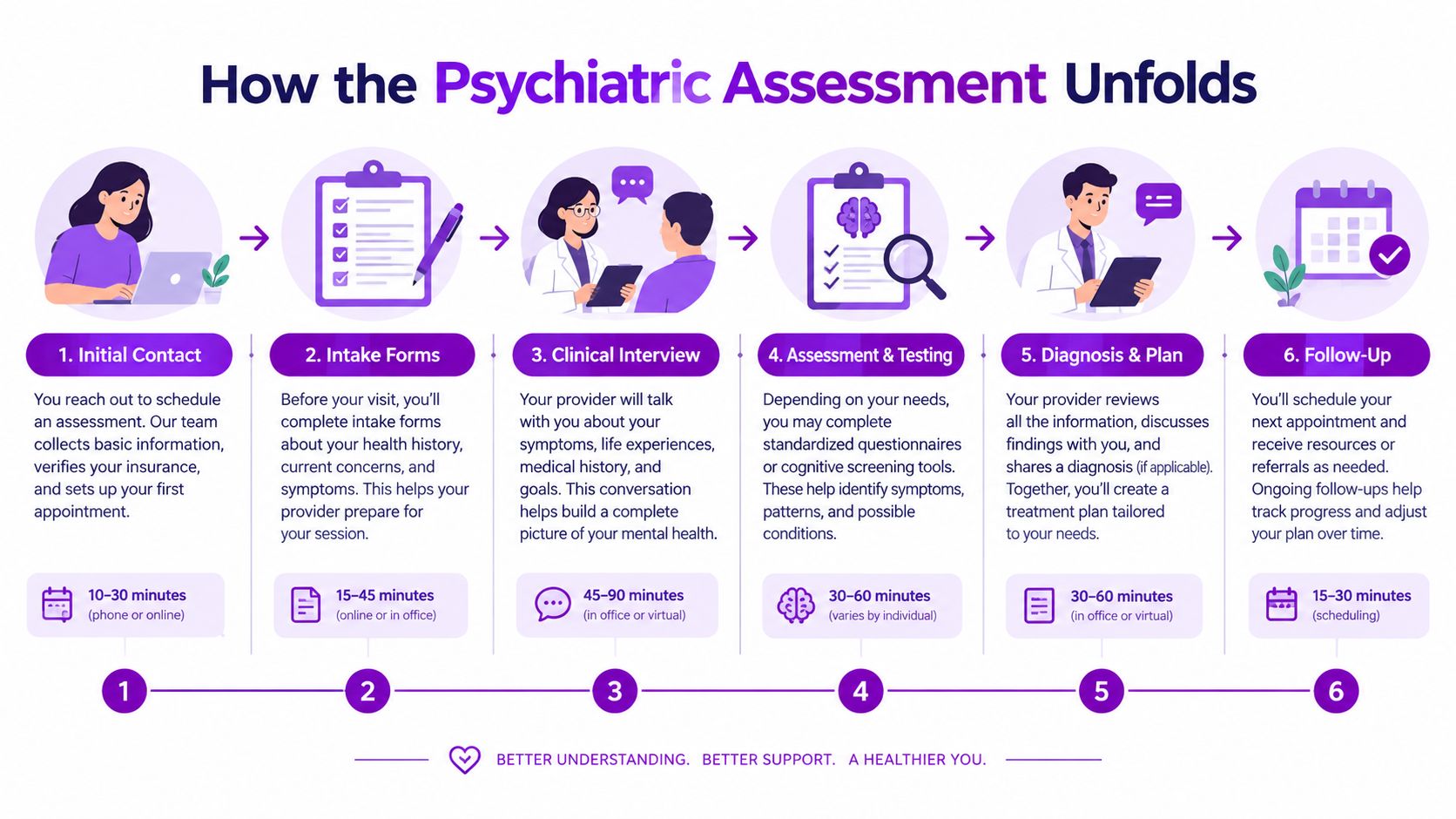
How the Psychiatric Assessment Unfolds
There's no blood test and no single decisive test that confirms ADHD. A good evaluation is a collaborative review of your history, functioning, and other possible explanations, not a verdict based on one questionnaire.
Start with your history. The clinician asks about attention, impulsivity, and everyday functioning over time, including whether difficulties have been present for at least six months and reach back into childhood. The pattern matters more than a few distracted days.
Look for childhood clues. Report cards, school feedback, or a parent's recollection can help establish what was happening early in life. Records may be unavailable, and their absence doesn't by itself rule out ADHD.
Use rating scales as supporting information. Tools such as the ASRS adult screener or Vanderbilt and Conners forms can organize observations. They're inputs to the evaluation, not a diagnosis on their own.
Check for other explanations and co-occurring conditions. Depression, anxiety, trauma, sleep apnea, bipolar disorder, thyroid problems, and substance use can cause symptoms that resemble ADHD or affect it. Tell the clinician what you've experienced and what treatments you've tried.
Consider another person's perspective. With your agreement, a partner, parent, or colleague may help describe how symptoms show up in daily life. Their observations add context, but the assessment remains collaborative.
Review the findings and decide together. At a feedback visit, the clinician explains the working diagnosis, the evidence behind it, and treatment options. The visit should end with a clear plan, even if more information is needed before reaching a conclusion.
The first evaluation often takes 60 to 90 minutes because the clinician needs to understand how symptoms affect more than one part of life. That time is particularly important if you've been high-achieving, worked hard to mask difficulties, or received treatment for anxiety or depression without an ADHD assessment. A U.S. Department of Health and Human Services review of barriers to adult ADHD diagnosis describes persistent sex, racial, and ethnic disparities in adult diagnosis and treatment, alongside continued underdiagnosis. It's reasonable to ask how the clinician will consider cultural context and distinguish ADHD from trauma, mood conditions, sleep problems, or other causes of executive-function difficulties.
For a plain-language overview of who may evaluate ADHD, see who can diagnose ADHD.
Medication Options Compared
The two main stimulant groups used in ADHD care are amphetamine-based medicines and methylphenidate-based medicines. They're commonly considered first, but one won't suit everyone. In 2023, 54.6% of U.S. health-center visits by adults with ADHD had a documented prescription for one of the selected ADHD medications; 41.7% included amphetamine and 8.8% included methylphenidate, according to the National Center for Health Statistics.
| Medication Class | Examples | Typical Onset | Best-Fit Situation | Main Cautions |
|---|---|---|---|---|
| Amphetamine-based stimulant | Adderall, Vyvanse (lisdexamfetamine) | Within about 1 hour; 4–6 hours for immediate release or 10–14 hours for extended release | Usual first-line choice in adults | Insomnia, appetite loss, raised heart rate and blood pressure, anxiety |
| Methylphenidate stimulant | Ritalin, Concerta | Within 30–60 minutes; 3–4 hours for immediate release or 8–12 hours for extended release | Alternative first-line choice | Similar to amphetamines, plus headache and irritability |
| Atomoxetine (nonstimulant) | Strattera | Gradual, over several weeks | Stimulant intolerance, misuse risk, or co-occurring anxiety | Nausea, fatigue, appetite loss; boxed warning for suicidal thoughts in young people |
| Viloxazine (nonstimulant) | Qelbree | Gradual, over several weeks | Option for children and adolescents when stimulants are unsuitable | Sleepiness, reduced appetite, suicidality warning |
| Guanfacine extended-release (alpha-2 agonist) | Intuniv | Gradual, over several weeks | Sleep difficulty, tics, or add-on to a stimulant | Drowsiness, dizziness, low blood pressure |
| Clonidine extended-release (alpha-2 agonist) | Kapvay | Gradual, over several weeks | Similar to guanfacine, often with tics or hyperactivity | Sedation, low blood pressure; don't stop abruptly |
| Bupropion (off-label antidepressant) | Wellbutrin | Several weeks | Depression that co-occurs with ADHD | Dry mouth, insomnia, seizure risk at high doses |
Stimulants may begin working within hours, while most nonstimulants take weeks to build their effect. That difference matters when you and your prescriber agree on how long to try a medication before judging whether it helps. A fast initial effect still needs careful monitoring; a slower onset doesn't mean a nonstimulant has failed before it's had time to work.
Nonstimulants may be considered when stimulants aren't effective, cause unacceptable side effects, or aren't a suitable choice. Some options may fit particular concerns, such as tics or co-occurring depression, but each brings its own cautions. No medication is universally best. The choice depends on your health and other conditions, side-effect history, and the demands of your daily routine.
Dose Adjustment and Monitoring Between Visits
Medication treatment is an ongoing adjustment process, not a one-time prescription. The basic rule is to change one medication or dose at a time. That makes it easier to tell whether a change improved focus, caused a side effect, or had no meaningful effect.
NICE recommends recording symptom severity, functional impairment, and adverse effects at baseline and after each dose change, then adjusting gradually toward meaningful improvement without unacceptable side effects. Its ADHD recommendations emphasize that response differs between individuals, so the effective dose can't be reliably predicted from body weight alone.
Set goals in your own terms. “Focus better” can be difficult to measure; “finish my work tasks before the end of the day” is clearer. You might also track missed appointments or whether driving feels safer. A simple daily log can rate focus, sleep, appetite, and mood from 0 to 10 and note progress on one or two goals.
| Check | What Is Measured or Reviewed | Typical Timing |
|---|---|---|
| Baseline visit | Symptom rating scale, functional goals, substance use, blood pressure, heart rate, weight | Before the first dose |
| Titration check | Symptom change and adverse-effect checklist | About 1–2 weeks after each dose change |
| Early stable-dose review | Functional targets, sleep, appetite, mood | Every 3 months during the first year |
| Ongoing review | Symptoms, functioning, co-occurring conditions, medication fit | At least once a year once stable |
| Cardiovascular check | Blood pressure and heart rate | At baseline, after dose changes, and periodically |
| Growth check for children | Height, weight, and appetite trends | At each visit |
NICE recommends slower titration and more frequent checks when ADHD occurs alongside anxiety, depression, bipolar disorder, PTSD, eating disorders, substance misuse, tic disorders, autism, epilepsy, or cardiovascular disease. Those conditions can change the balance of benefits and risks or affect how symptoms respond.
If a well-monitored trial doesn't improve daily functioning, the next step isn't automatically to increase the dose. Revisit the diagnosis, whether you're taking the medication as planned, sleep, substance use, co-occurring conditions, and whether another medication class makes more sense. Learn more about psychiatric medication management as an ongoing process of checking fit and safety.
Keeping Medication Going Through Refills and Shortages
A prescription that works is only useful if you can fill it. In 2023, 71.5% of U.S. adults taking stimulant medication reported difficulty filling their prescription because of limited availability, according to the CDC's adult ADHD information. Shortages are only part of the picture. Many adults with ADHD stop or interrupt their medication at some point, whether because of supply problems, cost, side effects, or losing track of the refill routine between appointments.
A refill log works like the symptom rating scales your prescriber uses: it turns a vague problem into something measurable. Knowing your exact run-out date, what the pharmacy told you, and how many doses you missed gives your prescriber real data to act on instead of guesswork. Keeping scheduled follow-ups matters too, because a prescription stays current only while your clinician keeps reviewing it.
Use a practical plan to reduce disruption:
Track your supply. Note the date your medication will run out and request a refill before then, allowing time to handle delays.
Check the exact product with the pharmacy. Ask whether your prescribed strength and formulation, such as immediate or extended release, are available. Don't change either without the prescriber's direction.
Start authorization paperwork early. If your insurer requires prior authorization, begin before the next refill is due.
Report any missed doses or gap. Tell the psychiatrist when it happened. Restarting after an interruption may require a different plan, and a gap can feel like the medicine stopped working.
Discuss a switch if supply remains limited. A prescriber can consider another appropriate option. Because many nonstimulants take several weeks to work, plan a change rather than treating it as an instant substitute.
Don't obtain medication from another person or an unverified source. Ask your prescriber for a safe plan.
A refill gap is a reason to review the treatment plan, not an automatic reason to increase the dose. When you report the gap accurately, your prescriber can tell the difference between medication that stopped helping and medication that never reached you.
Side Effects and Safety Warnings
Some effects are uncomfortable but can often be discussed at a routine follow-up. Stimulants may cause trouble falling asleep, reduced appetite, stomach upset, jaw tightness, or a mild rise in heart rate. Nonstimulants can cause sleepiness, fatigue, dizziness when standing, or dry mouth. Depending on the medication and the pattern of symptoms, your prescriber may discuss timing, dose, or a different option.
Contact your clinician the same day for chest pain, fainting, a racing or irregular heartbeat, hallucinations, severe agitation, new suicidal thoughts, or tics that worsen. If you feel in immediate danger, contact emergency services. Don't stop clonidine abruptly, because stopping it suddenly can lead to rebound high blood pressure.
Safety discussions are part of responsible prescribing. The U.S. Food and Drug Administration's stimulant medication guidance requires clinicians to assess the risk of misuse, abuse, and addiction before prescribing stimulants for ADHD and to monitor that risk during treatment. The guidance identifies unusually frequent refill requests, when they aren't explained by the prescribed dose, as a possible diversion signal.
Safety is a shared task: Store medication securely, dispose of unused medicine properly, and never share a prescription. Snorting or injecting stimulants can cause overdose and death.
These checks are meant to reduce harm, not to imply that a patient is misusing medication. Be open about changes in how you take a prescription, any supply problems, and concerns about your ability to store it safely.
Insurance, Telehealth and Phoenix Metro Access
Before scheduling, ask whether your insurance covers a psychiatric evaluation and ongoing medication management, whether the clinic is in network, whether you need a referral, and whether a medication might require prior authorization. The first evaluation usually involves a more detailed assessment than a follow-up, so ask how your plan treats each visit type. reVIBE accepts most major insurance plans and provides guidance on verifying your coverage before you commit to an appointment.
Telehealth can make follow-up easier, though some appointments or health checks may still call for an in-person visit. The rules for prescribing controlled medications through telehealth can change, so confirm the current process with the clinic before booking. reVIBE offers both in-person and secure online sessions, with appointments available seven days a week and licensed psychiatric support alongside therapists.
Access matters because ADHD care runs on steady follow-up. Choose an office you can reach consistently for monitoring visits, not just once for the intake. reVIBE serves Scottsdale, Tempe, Chandler, Phoenix, and Paradise Valley, and the reVIBE Mental Health website can help you find the office nearest you and confirm current contact details. If Scottsdale is the most convenient place for your follow-ups, see the psychiatrist near Scottsdale information.
Decide Whether to Book a Psychiatry Visit
Book an evaluation if attention or impulsivity problems have persisted since childhood and interfere with work, school, money, or relationships. It's also reasonable to seek an assessment if therapy alone hasn't improved focus, if anxiety, depression, sleep problems, or substance use make the picture unclear, if you're having medication side effects or a refill gap, or if your primary care clinician isn't sure what to do next. If you have a same-day warning sign such as chest pain, fainting, or new suicidal thoughts, call the clinic or emergency services now rather than waiting for a routine booking.
Bring a short timeline from childhood to the present, school or work feedback, your full medication and supplement list, notes about sleep and substance use, family history of ADHD or mood disorders, and any previous rating-scale results. A useful first visit should end with a clear working diagnosis or an explained next step, not necessarily a prescription.
For help with the practical hurdle of beginning a task, you can also find brain-friendly ways to start tasks. reVIBE supports people seeking care for ADHD and other concerns, including anxiety, depression, trauma, addiction, autism, and mood disorders, and offers personalized matching to help find a therapist or psychiatric care provider suited to your needs and preferences.
If you're ready to discuss assessment, medication support, or therapy, call (480) 674-9220 or choose the location where you can reliably attend follow-up visits.
reVIBE Mental Health offers licensed psychiatric medication support alongside therapy, in person or online, for people seeking a thoughtful approach to ADHD care. Visit reVIBE Mental Health to explore care options and find a provider who fits your needs.