A psychiatric evaluation fits when symptoms last about two weeks or longer and impair daily life, or sooner if safety concerns, psychosis, mania, or rapid worsening are present. The first visit assesses your options rather than requiring you to take medication.
You don't have to lose your job, stop parenting, or reach a crisis before getting help. The National Institute of Mental Health estimated that 15.4 million U.S. adults had serious mental illness in 2022, meaning a condition that substantially impaired or limited major life activities. That's a measure of serious illness, not an eligibility requirement for psychiatric care.
The useful question isn't whether you're struggling enough to deserve an appointment. It's whether a medical assessment could clarify what's happening and help you choose a workable next step.
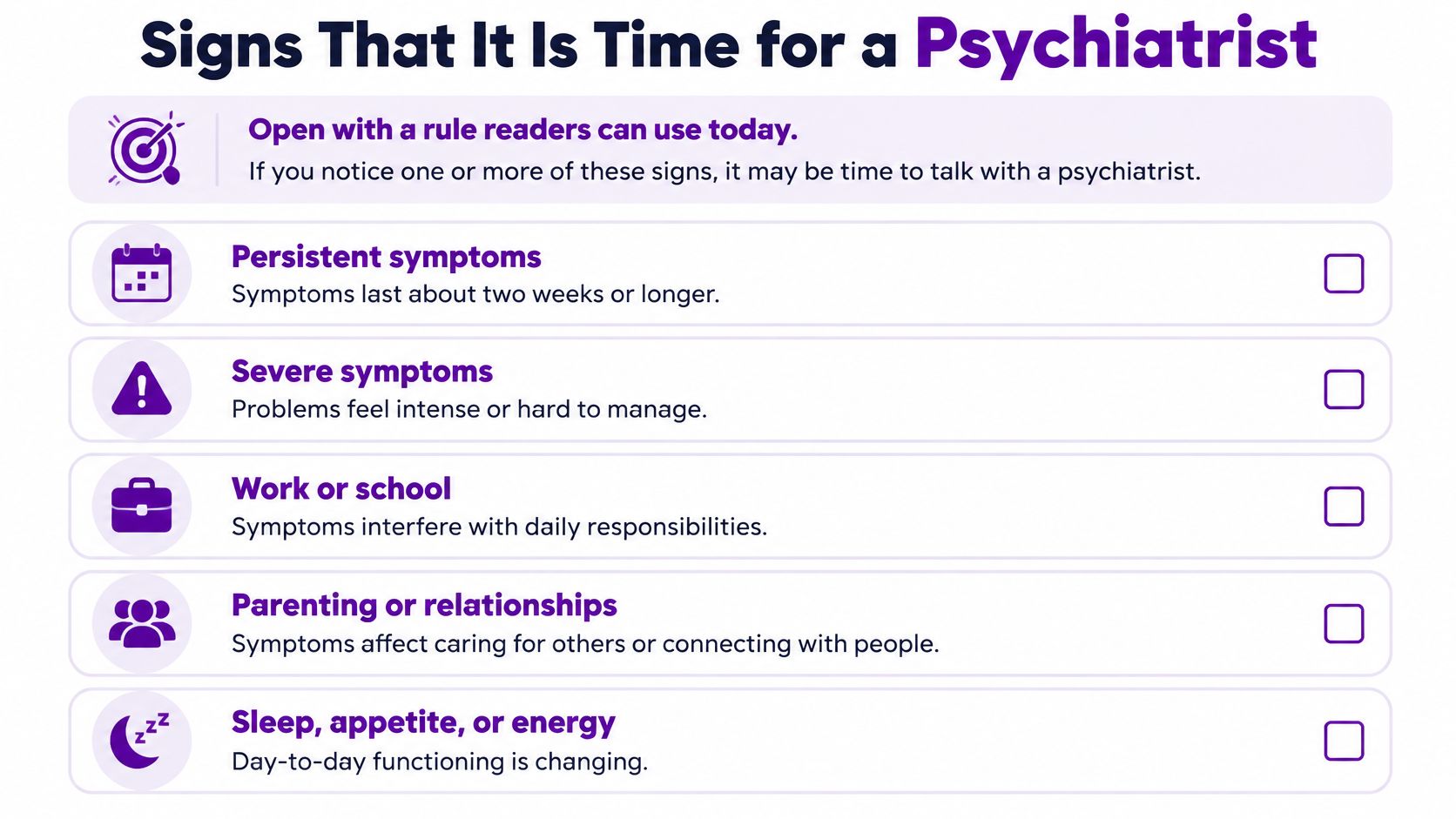
Signs That It Is Time for a Psychiatrist
Schedule an assessment when symptoms persist and interfere with ordinary life. The NIMH guide to caring for your mental health identifies severe or distressing symptoms lasting approximately two weeks or longer, including sleep disruption, appetite or weight changes, poor concentration, loss of interest, trouble getting out of bed, and difficulty completing usual tasks, as reasons to seek professional help.
That timeframe is a guide, not a waiting requirement or a diagnosis. Severe symptoms deserve earlier attention, and recurring problems can warrant evaluation even when you feel better between episodes.
Look at what symptoms cost you
Functioning means more than showing up. Say you're getting to work, but you spend every evening recovering from anxiety, stop answering friends, and struggle to prepare meals. You're still employed, but your symptoms are restricting your life.
Notice changes from your usual baseline:
- Responsibilities: You're missing deadlines, struggling with childcare, or avoiding essential errands.
- Relationships: Irritability, withdrawal, or mood swings are changing how you connect with people.
- Coping: You're using more alcohol or other substances to sleep, settle down, or get through the day.
- Thoughts and perception: Intrusive memories, unusual beliefs, or hearing things others don't hear are becoming difficult to manage.
Our guide to signs of depression in adults can help you describe changes that are easy to dismiss as tiredness or stress. You don't need to identify the diagnosis before making an appointment.
When a concern needs a psychiatrist
| Concern | Duration or intensity | Next step |
|---|---|---|
| Low mood, anxiety, or poor sleep while still functioning | Under about two weeks after a clear stressor | Watch, use supports, and consider therapy or primary care |
| Anxiety, depression, sleep loss, or concentration problems that disrupt work, school, parenting, or self-care | About two weeks or longer, or a recurring pattern | Schedule a psychiatric evaluation |
| Symptoms that have not improved with appropriate therapy | Several weeks of therapy without meaningful relief | Add psychiatry for diagnosis and a medication review |
| Unclear mood swings, possible bipolar pattern, ADHD questions, or medical or substance contributors | Pattern is confusing or keeps returning | Psychiatric evaluation for diagnostic clarification |
| New paranoia, hallucinations, disorganized thinking, or a sharp drop in function | New or escalating | Prompt psychiatric or crisis evaluation |
| Suicidal thoughts with a plan or means, recent self-harm, inability to stay safe, or severe self-neglect | Happening now | Call or text 988, or call 911 if danger is imminent |
These are starting points, not a self-diagnosis checklist. Therapy doesn't have a universal deadline for improvement, and lack of relief calls for a treatment review rather than an assumption that therapy has failed.
Practical rule: Judge the change in your life, not how well you can hide it.
Mild stress that eases after a clear event may be manageable with support, therapy, or primary care. Symptoms that return, worsen, or remain difficult despite treatment justify another look. A primary-care clinician can help arrange that assessment.
Urgent, Prompt, or Routine Care Decisions
Choose among emergency help, prompt clinical contact, and routine evaluation based on what's happening now. An appointment opening isn't a measure of how safely someone can wait.
In 2023, 5.0% of U.S. adults, approximately 12.8 million people, reported serious thoughts of suicide, according to SAMHSA's National Survey on Drug Use and Health. Suicidal thoughts deserve immediate support, even when someone isn't sure whether they would act on them.
Emergency help when safety cannot wait
Say someone has taken an overdose or has an immediate suicide plan and access to the means. That person needs emergency help, not a voicemail requesting a new-patient appointment. The NIMH guidance on getting mental-health help directs people with suicidal thoughts to immediate assistance; in the United States, call or text 988 for crisis support, and call 911 for an attempt in progress, an immediate plan with means available, suspected overdose, or physical danger.
Chest pain or shortness of breath shouldn't automatically be dismissed as panic. Emergency assessment can determine whether a medical problem is involved. Severe confusion, loss of contact with reality, inability to remain safe, or dangerous self-neglect also require emergency evaluation.
At reVIBE Mental Health, we ask people who are in a crisis or in danger to themselves or others to call 911. A routine scheduling call isn't a substitute for crisis care.
Prompt contact for a rapidly changing situation
Consider someone who has barely slept for several nights but feels unusually energized, talks much faster, and starts making risky purchases. That's different from being exhausted after ordinary insomnia. Possible mania needs immediate clinical assessment, with emergency care if judgment, reality testing, or safety is compromised.
Other reasons to contact a clinician the same day, or seek guidance about assessment within a day or two, include:
- Rapid deterioration: Depression, agitation, or hopelessness is getting noticeably worse.
- New perception changes: Paranoia, hallucination-like experiences, or disorganized thinking have appeared.
- Medication concerns: A frightening side effect or marked behavioral change follows a prescription change.
- Increasing substance use: Alcohol or drug use is escalating alongside worsening symptoms.
Suicidal thoughts without immediate intent still call for immediate crisis support and prompt clinical assessment. Don't wait to see whether they become more specific.

Routine care and a plan while waiting
Someone with persistent anxiety who can remain safe and manage basic needs may reasonably book a routine evaluation. But worsening symptoms should trigger reassessment of that route, not silent acceptance of a distant appointment.
The HRSA 2025 Behavioral Health Workforce Brief reports an average 48-day wait for behavioral-health services. That isn't a prediction of any particular practice's availability. If access is difficult, ask about telepsychiatry, cancellation openings, community services, and a primary-care appointment to bridge the gap.
A safety plan is a set of actions you can use when thinking clearly becomes harder. It isn't a promise to manage a crisis alone.
Write down personal warning signs, coping actions you can try independently, two or three trusted contacts, crisis numbers, and ways to limit access to lethal means. Ask a clinician or crisis counselor to help make the plan practical. Don't stop or change prescribed medication abruptly without clinical guidance.
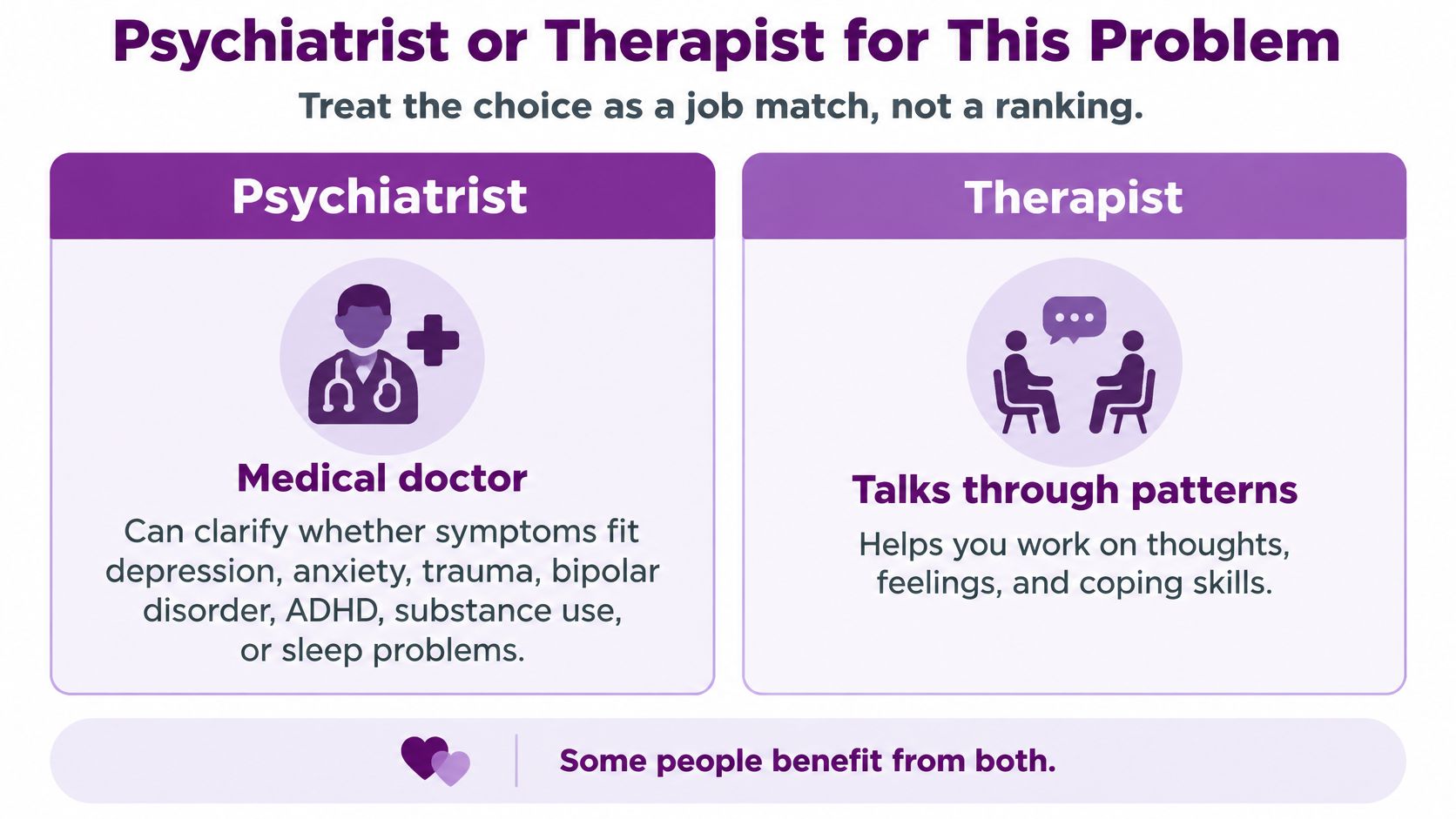
Psychiatrist or Therapist for This Problem
Psychiatrist, therapist, and primary care compared
| Clinician | Main job | Best fit | Medication |
|---|---|---|---|
| Psychiatrist | Diagnose, assess medical contributors, and manage medication | Unclear diagnosis, treatment-resistant symptoms, safety concerns, or possible medication | Yes |
| Therapist or psychologist | Talk therapy, skills, and trauma or relationship work | Mild to moderate distress, skills practice, trauma processing | Generally no, except limited prescribing authority in some places |
| Primary care | General health and a first look at common mental-health symptoms | Short-lived or mild symptoms and referrals | Can start common medicines and refer |
| Integrated therapy plus psychiatry | Coordinated talk therapy and medication management | When you may need therapy, medication, or both | Yes, with the psychiatric clinician |
Treat the choice as a job match, not a ranking. A psychiatrist is a medical doctor who can investigate whether symptoms reflect depression, anxiety, trauma, bipolar disorder, ADHD, substance use, sleep problems, medication effects, or another medical condition. If anyone's safety is in question, the routing question is already answered: urgent or emergency care comes before choosing between office visits.
A therapist helps you work with thoughts, feelings, behavior, and relationships. Many therapists can also diagnose mental-health conditions; our explanation of whether a therapist can diagnose clarifies that prescribing and diagnosing aren't the same authority.
Match the clinician to the question
For grief, relationship patterns, or coping skills without medical or safety concerns, therapy may be a sensible starting point. For confusing mood episodes, medication questions, or symptoms that haven't improved with appropriate psychotherapy, psychiatric input can add something different.
Primary care fits when you need an accessible first assessment, especially if physical symptoms are involved. Combined care fits when you need both ongoing therapeutic work and medical monitoring.
The difference works like a house inspection. Therapy helps you change how you live in the house, while psychiatry checks the wiring and the medical systems underneath. The analogy isn't a strict boundary. Psychiatrists consider life circumstances, and therapists weigh how physical health shapes emotional well-being.
Being productive doesn't settle the question
The World Health Organization's 2025 global findings indicate that fewer than 10% of people with mental-health conditions in low-income countries receive care, compared with more than 50% in higher-income countries. Treatment access is uneven; whether someone has already obtained care doesn't tell you how much they need it.
Employment or parenting doesn't rule out a useful evaluation either. The relevant question is whether diagnostic clarification or coordinated treatment could reduce the effort and distress behind that functioning. If your doubts center on workplace performance rather than symptoms, a resource that can compare executive coaching and clinical care helps separate the two: coaching supports professional goals, while an evaluation assesses persistent mental-health symptoms.
What the Evaluation and Medication Visit Covers
The evaluation is a structured conversation, not a verdict on your character. You can bring notes, ask for a pause, and tell the clinician when a question is difficult to answer.
Medication and therapy are both established routes, but neither is automatic: the Centers for Disease Control and Prevention reports that in 2024, 19.3% of U.S. adults took medication for their mental health and 14.0% received counseling or therapy from a mental-health professional during the previous twelve months. Those figures describe use, not which treatment you personally need.
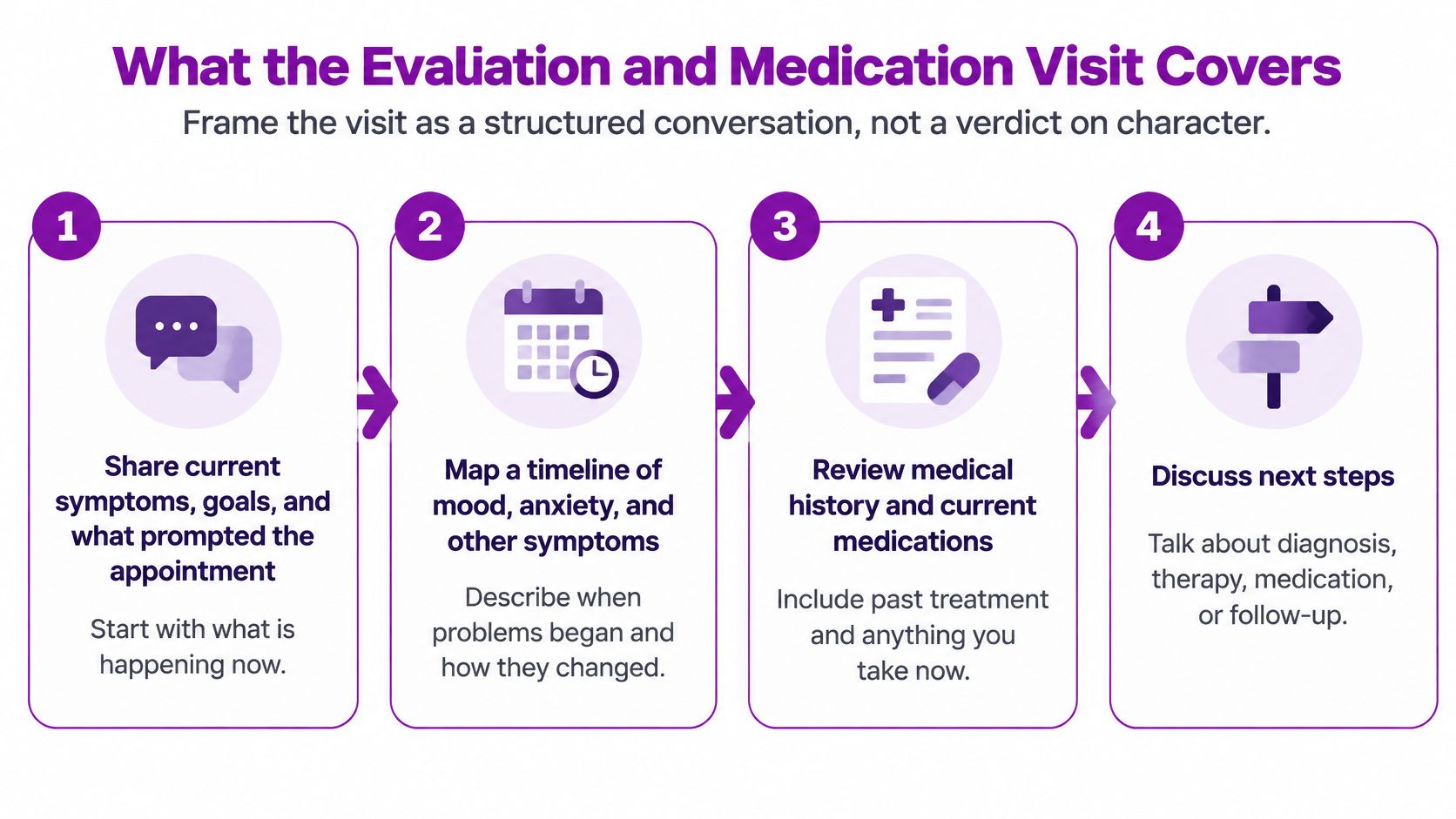
How the conversation usually unfolds
- Start with your goal. Explain what prompted the appointment and what you want to change, such as sleeping reliably or returning to activities you've stopped.
- Build a timeline. Describe mood, anxiety, sleep, appetite, concentration, trauma symptoms, and prior treatment. Distinguishing a long-standing pattern from a recent change helps guide diagnosis.
- Review health and substances. Bring every prescription, over-the-counter medicine, and supplement, along with an honest account of alcohol, cannabis, and other substance use.
- Answer safety questions directly. The clinician may ask about suicidal thoughts, plans, past attempts, impulsivity, and access to means. These questions help determine what level of support is safe.
- Discuss the working impression. Ask which diagnoses seem likely and what remains uncertain. Sometimes the clinician needs records, testing, or more observation.
- Compare next steps. Options may include therapy alone, medication, combined treatment, lab work, or a medical referral.
- Clarify any prescription plan. Leave knowing the dose instructions, expected timing of benefit, side effects to report, and follow-up date.
A questionnaire may help establish a starting point, but a score isn't the entire assessment. If you want to understand what these forms measure, MicroTrack's resource lets you compare standardized mood assessment tools.
A complete visit may end without medication
A clear working diagnosis, a therapy plan, or an appropriate referral can be a useful outcome. Our medication management overview explains what ongoing review involves when medication is part of the plan.
Before you leave: Make sure you can explain the next step in your own words, including who to contact if something changes.
At reVIBE Mental Health, our therapy sessions are generally confidential. Information isn't disclosed without your consent except when you're at risk of harming yourself or others, or when child or elder abuse is suspected. Your therapist explains these limits during the first session, and you can ask how they apply to your situation.
How to Choose a Psychiatrist Near You
Choose based on clinical fit and practical access rather than the first name in a directory. A nearby office helps only when the provider can address the question you bring, and asking for an evaluation is a way to get answers before anyone decides whether medication belongs in the plan.
Make the appointment workable
- Name your concern. Use plain language such as recurring panic, depression, trauma symptoms, mood swings, or uncertainty about medication. You do not need a confirmed diagnosis.
- Describe what “better” would change. More sleep, fewer episodes, steadier mood, or a clearer explanation gives the matching conversation a target.
- Choose a format. Weigh travel from home or work, privacy, childcare, and a quiet place for online appointments. Our therapists can explain whether telehealth is offered and discuss technical requirements during your inquiry.
- Check the match. We offer personalized matching to help you find a therapist or psychiatric care provider whose specialties and approach fit your needs and preferences.
- Verify coverage before booking. We require clients to call and verify insurance eligibility before scheduling. Confirm the clinician's credentials and appointment type so you know which benefits apply.
- Remove travel barriers. Choose the closest suitable office, or ask whether secure online care would make attendance easier. Plan for follow-up travel as well as the first visit.
If you specifically want a psychiatrist, say so when calling. Psychiatric care providers can have different professional credentials, and it is reasonable to ask who will conduct your evaluation and how therapy and medication decisions are coordinated.
Use location to narrow choices
reVIBE Mental Health serves Scottsdale, Tempe, Chandler, Phoenix, and Paradise Valley, Arizona, and the team can confirm the closest office when you contact the practice. With appointments available seven days a week and in-person or secure online sessions, pick the option you can attend consistently.
A good match includes being able to speak openly and understand the clinician's explanations. Mention language, communication style, or condition-specific experience if it would make the matching conversation more useful.
Book the Evaluation This Week
If danger is immediate, use emergency services first; for suicidal thoughts or a mental-health crisis, contact crisis support rather than waiting for scheduling. Otherwise, turn the decision into a short preparation task and a phone call.
Prepare the information that changes the plan
Write a one-page note covering when symptoms began, sleep changes, substance use, current medicines and supplements, and what you've already tried. Add the main outcome you want, such as fewer panic episodes or a clearer explanation for mood changes.
Our certified psychiatric providers offer ongoing support to keep prescribed medications effective and safe alongside therapy. We also offer a free guide titled “5 Ways to Know You've Found a Good Match with Your Therapist” if you're weighing therapeutic fit.
Settle the logistics before hanging up
- Explain the appointment you want: Say whether you're seeking psychiatry, therapy, or help deciding between them.
- Confirm the cost: Our service costs depend on insurance coverage, provider licensure, and private-pay options. Verify eligibility and your expected payment before booking.
- Check cancellation terms: We require 24-hour advance notice to cancel or reschedule.
- Secure the next step: Confirm the format, date, and time. If availability is limited, ask about a waitlist, cancellation opening, or telehealth option while keeping your safety plan active.
Call (480) 674-9220, keep your notes beside you, and record the appointment date before you end the call.
Questions to Bring to Your First Appointment
Bring your symptom note and a list of every medicine and supplement you take. Write down the answers, especially when the clinician explains uncertainty or offers more than one reasonable option.
- What diagnosis are you considering, and what is still uncertain?
- Do you recommend therapy, medication, or both, and why?
- If we start a medicine, when should it help, and which side effects mean I should call?
- How will we know treatment is working?
- What should I do if I feel worse between visits?
- How will you coordinate with my therapist or primary-care clinician?
Judge the explanation, not just the recommendation
A good sign is that the clinician explains their reasoning in plain language, invites questions, and connects treatment to goals you recognize. Progress might mean getting through a workday without avoidance, sleeping more consistently, or reconnecting with family.
Pressure to commit to medication before the assessment is finished is a reason to ask for clarification. You should understand the expected benefit, important risks, alternatives, and what happens if you prefer another approach.
Leave with a follow-up date and a clear answer about whether medication is recommended now, optional, or not indicated. If the answer remains uncertain, ask what information will help resolve it.
reVIBE Mental Health offers therapy, psychiatric evaluations, and medication management, with in-person and secure online options. If you're deciding when to see a psychiatrist, visit reVIBE Mental Health to explore care and find a provider who fits your concerns and preferences.