
Psychiatrists are medical doctors who can prescribe medication. Therapists deliver psychotherapy and, in most U.S. states, can't prescribe. But the popular advice to “start with therapy and try medication only if that fails” isn't right for everyone. Severe symptoms, possible medical causes, or an existing medication problem can make psychiatric evaluation the better first step.
The useful question isn't psychiatrist vs therapist alone. It's who should you see first, what should that visit accomplish, and when should you add the other provider? A good starting appointment should leave you with a plan you can evaluate, not an open-ended commitment to treatment without clear goals.
Psychiatrist vs Therapist at a Glance
Psychiatrists and therapists often treat the same conditions, but they have different tools and responsibilities. This comparison describes roles, not quality. A medical degree doesn't automatically make someone the best clinician for relationship work, and advanced therapy training doesn't authorize medication management.
Psychiatrist and therapist roles compared
| Factor | Psychiatrist | Therapist |
|---|---|---|
| Core degree | MD or DO | Master's for LPCs, LCSWs, and LMFTs; doctorate such as PhD or PsyD for clinical psychologists |
| Training after the degree | Approximately three to four years of specialized psychiatry residency, according to the American Psychological Association's guide to psychotherapy professionals, which also describes clinical psychologists' one to two years of supervised clinical training | Supervised clinical hours; clinical psychologists add the supervised training described alongside |
| Can prescribe medication | Yes | Generally no; a limited number of jurisdictions allow specially trained psychologists |
| Main work | Diagnosis, medication management, medical evaluation | Psychotherapy, psychological assessment, behavior change |
| Typical first stop for | Medication questions, severe or complex symptoms, possible medical causes | Anxiety, depression, trauma, relationship or behavior concerns needing talk therapy |
What Medical Training Adds
A psychiatrist can prescribe medication, adjust doses, order appropriate physical tests, and assess whether another health problem contributes to psychiatric symptoms. That medical review matters when anxiety, low mood, agitation, or poor concentration could involve thyroid disease, medication interactions, substance use, or a sleep disorder.
The evaluation shouldn't assume every symptom has a psychological cause. Nor should it assume every symptom needs medication. Testing should answer a clinical question, rather than becoming a routine battery without a reason.
Psychiatrists also provide psychotherapy when their practice includes it. If you want both services from the same physician, confirm whether appointments include ongoing psychotherapy or primarily medication management. Those are different visit types, even when the clinician is qualified to deliver both.
A therapist's license defines what they may do, while a psychiatrist's medical training defines what they must check.
What Therapy Training Adds
A therapist assesses emotional and behavioral concerns and, within their license, may diagnose mental health conditions. Treatment should involve more than an opportunity to vent: the clinician identifies patterns, chooses an approach, and helps you practice changes that serve your goals.
Licensed professional counselors, clinical social workers, and marriage and family therapists practice under state law with different education and supervision requirements. Clinical psychologists hold doctorates and may also offer specialized psychological assessment. The umbrella term therapist doesn't tell you someone's specialty, preferred methods, or experience with your concern.
For a plain-language companion to provider profiles, DeTalks explains the differences between therapy and psychiatric care. Use that distinction to interpret credentials, not to rank clinicians by title alone.
How the Roles Can Fit Together
In 2024, 19.3% of U.S. adults took prescription medication for their mental health, while 14.0% received counseling or therapy from a mental-health professional during the previous 12 months, according to the Centers for Disease Control and Prevention. These are separate measures, not mutually exclusive groups; they don't tell us how many people received both.
Say someone has panic attacks and a history of thyroid problems. A psychiatrist can review the medical history and decide whether testing or medication is appropriate, while a therapist provides panic-focused treatment to reduce avoidance and fear of bodily sensations. Neither task replaces the other.
Before choosing any provider, ask a scope question: Which actions can you take on your own, and which would require a referral? A clear answer helps prevent delays when your needs extend beyond that clinician's role.
Appointment Types and What to Expect
Appointment types, length and cadence
| Appointment | Usually run by | What happens | Typical cadence |
|---|---|---|---|
| Psychiatric intake evaluation | Psychiatrist or psychiatric prescriber | History, symptoms, medical review, medication decision; usually about an hour | Once, then follow-up visits |
| Medication follow-up | Psychiatrist or psychiatric prescriber | Response, side effects, dose changes, safety check; often 15 to 30 minutes | Every few weeks to a few months, set by the prescriber |
| Individual therapy session | Therapist | Skills practice, emotional processing, goal review; usually 45 to 50 minutes | Weekly or every other week |
| Couples therapy session | Therapist trained in Gottman Method or EFT | Communication patterns, conflict cycles, repair work; confirm the scheduled length | Weekly, sometimes every other week |
| Child or family play therapy | Therapist trained in play therapy | Play-based expression and caregiver guidance; confirm how the session is divided | Weekly |
| Group therapy session | Therapist leading the group | Shared skills work with people facing similar challenges; length follows the group's format | Weekly |
These lengths are scheduling expectations, not guarantees about an individual appointment. Confirm the booked duration, especially for couples, family, and group work.
Why a Medication Visit Can Be Shorter
A psychiatric intake needs room for symptom history, previous treatment, physical health, substance use, and diagnostic questions. Our explanation of what happens during a psychiatric evaluation can help you prepare without assuming that attending means agreeing to medication.
Follow-ups focus on narrower decisions: Is treatment helping? Are there side effects? Does the dose or diagnosis need reconsideration? A short medication appointment isn't designed to substitute for a full therapy session.
Therapy reserves time for examining patterns and practicing a different response. Regular attendance helps the clinician connect what happens between visits with the work you do together.
What the First Session Should Clarify
During the first session, our therapist explains the limits of confidentiality, including circumstances in which information must be disclosed. Ask how records, caregiver involvement, and communication with other clinicians will work. Couples and family appointments also need clear expectations about whose treatment is being provided and how private disclosures are handled.
We offer therapy in person or online. During your inquiry, the provider can explain whether telehealth is offered and what technology you'll need, including a private space and a reliable connection.
The first appointment can be triage rather than a commitment to a long course of treatment. For example, a parent might arrange play therapy for a child's emotional difficulties and a separate psychiatric visit for sleep and focus concerns. The clinicians should clarify what each will assess and what the next visit will measure.
Bring a symptom history, current medications and supplements, and recent medical tests. Previous diagnoses, medication reactions, and your main functional goal are also useful.
Treatments Each Provider Usually Delivers
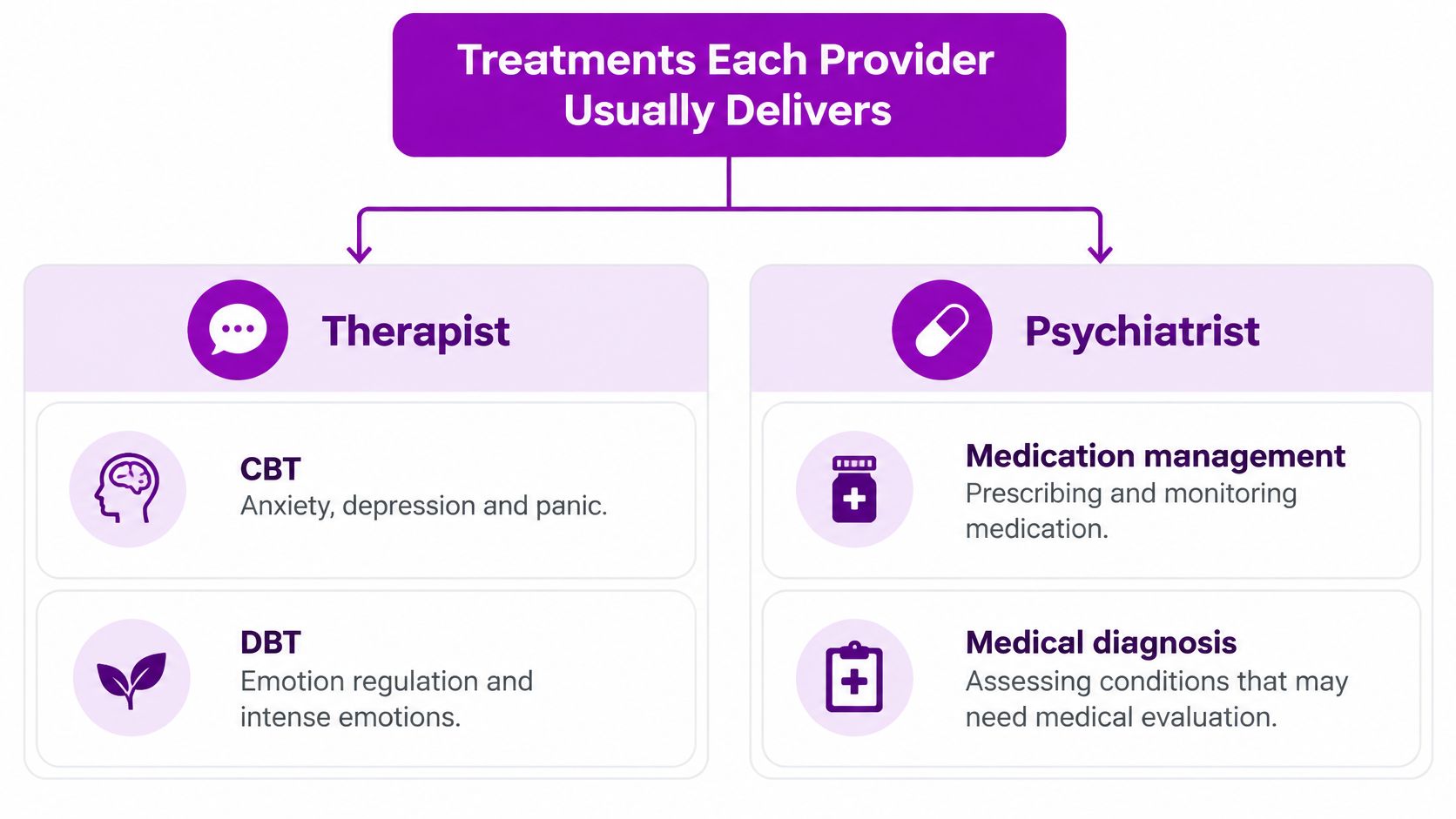
Therapists usually deliver structured psychological treatment. Psychiatrists usually lead medical diagnosis and medication decisions. The practical difference is what you do during treatment: rehearse a response, process a memory, change an avoidance pattern, or evaluate a medication's benefits and harms.
Treatments by usual provider and target
| Treatment | Usually delivered by | Common targets |
|---|---|---|
| Cognitive behavioral therapy (CBT) | Therapist | Anxiety, depression, panic, OCD |
| Dialectical behavior therapy (DBT) | Therapist | Emotion regulation, intense emotions, self-harm urges |
| Acceptance and commitment therapy (ACT) | Therapist | Avoidance, anxiety, values-based change |
| EMDR | Therapist | PTSD, trauma memories, anxiety, phobias |
| Internal Family Systems (IFS) | Therapist | Internal conflict, self-criticism, trauma |
| Gottman Method or Emotionally Focused Therapy | Therapist | Couples conflict and attachment |
| Play therapy | Therapist | Child anxiety, trauma, behavior, emotional regulation |
| SSRIs and SNRIs | Psychiatrist or prescriber | Depression and anxiety disorders |
| Mood stabilizers and antipsychotics | Psychiatrist | Bipolar-spectrum and psychotic symptoms |
| Ketamine or SPRAVATO management | Psychiatrist-led care | Treatment-resistant depression |
What Therapy Looks Like in Practice
CBT connects thoughts, behavior, and symptoms, then uses practice to change unhelpful cycles. For OCD, ask specifically about exposure and response prevention rather than assuming general CBT includes it. DBT emphasizes skills for managing intense emotions and responding safely to urges.
ACT helps people act according to their values even when uncomfortable thoughts or feelings remain. IFS explores internal conflict and self-criticism. These approaches aren't interchangeable just because they all involve conversation.
EMDR helps individuals heal from trauma by reprocessing distressing memories while using bilateral stimulation such as eye movements, taps, or sounds. It requires assessment and preparation, not just beginning eye movements at the first meeting. Our therapists are also trained in the Gottman Method and Emotionally Focused Therapy (EFT) for couples.
Children may communicate more effectively through play than through direct questioning. Parents can explore play therapy for children through Children Psych to understand the therapist's role and how caregiver guidance fits into treatment.
What Medication Management Requires
SSRIs and SNRIs are options for depression and anxiety disorders; mood stabilizers and antipsychotics address different clinical needs, including bipolar-spectrum or psychotic symptoms. Choosing among them requires attention to diagnosis, medical history, interactions, prior response, and tolerability. Ketamine or SPRAVATO® management requires a separate assessment of suitability and monitoring needs.
We offer Mental Health Therapy, EMDR Therapy, Psychiatry & Medication Management, and Ketamine/SPRAVATO® Management. Our guide to what a psychiatrist does explains the medical responsibilities behind those decisions.
The table shows typical pairings, not exclusive rules. Therapists may integrate techniques, and psychiatrists may offer brief psychotherapy. Ask whether the clinician is trained in the approach you want and how they'll use it for your specific goal.
Costs, Insurance and Access Differences
Price depends on the visit type, not the job title. At reVIBE Mental Health, costs vary with insurance coverage, provider licensure, and private-pay options, so the useful comparison is your expected cost for a psychiatric evaluation, a medication follow-up, and a therapy session. Assumptions that therapy is always cheaper or psychiatry always better covered fail on individual plans.
Questions That Establish Your Real Cost
Get concrete answers before accepting an appointment:
- Network status: Is this specific clinician in network with your exact plan, rather than just accepting the insurer?
- Visit benefits: Do psychiatric evaluations, medication follow-ups, and therapy sessions carry different copays, deductibles, or coinsurance?
- Plan requirements: Does your coverage require a referral, prior authorization, or a particular telehealth arrangement?
- Private-pay costs: What will you owe for the intake and recurring appointments if insurance doesn't apply?
- Sliding scale: During the initial consultation, ask the therapist whether a sliding scale fee is available.
Our guide on how to verify insurance coverage walks through that conversation step by step. Ask for the expected patient responsibility before the appointment; the insurer makes the final coverage determination.
Cost per visit is only half the math. A psychiatric evaluation plus periodic medication follow-ups concentrates spending early, while recurring therapy spreads it across months. The lowest charge for a single visit does not necessarily produce the most affordable workable plan.
When Access Changes the Starting Point
National workforce projections anticipate a continuing shortage of psychiatrists, and psychiatric appointments can be harder to secure than therapy intakes. Ask about the next available evaluation when you call, not just whether the practice is accepting new patients.
If symptoms are stable and therapy is appropriate, starting it while a psychiatric appointment is pending may be useful. A triage visit can establish whether waiting is reasonable. Urgent symptoms shouldn't be managed by merely accepting the next routine opening.
Access rule: Choose a plan you can attend consistently, but don't let convenience substitute for the level of care your symptoms require.
Distance, transportation, work hours, and privacy at home all shape what is realistic. Online care removes the commute; it does nothing if you can't speak privately. reVIBE schedules appointments seven days a week, in person or through secure online sessions, which widens the scheduling options worth comparing.
A Tempe resident who works late might look for weeknight online therapy and an in-person psychiatric appointment near work during a lunch break. That arrangement only works after confirming appointment availability, visit length, and enough time to return without rushing.
Whatever you book first, set a four-to-eight-week checkpoint to judge whether the plan is working or needs a second provider added. Cost and convenience determine what you can start; that checkpoint determines whether what you started is enough.
Which Provider Fits Your Concern
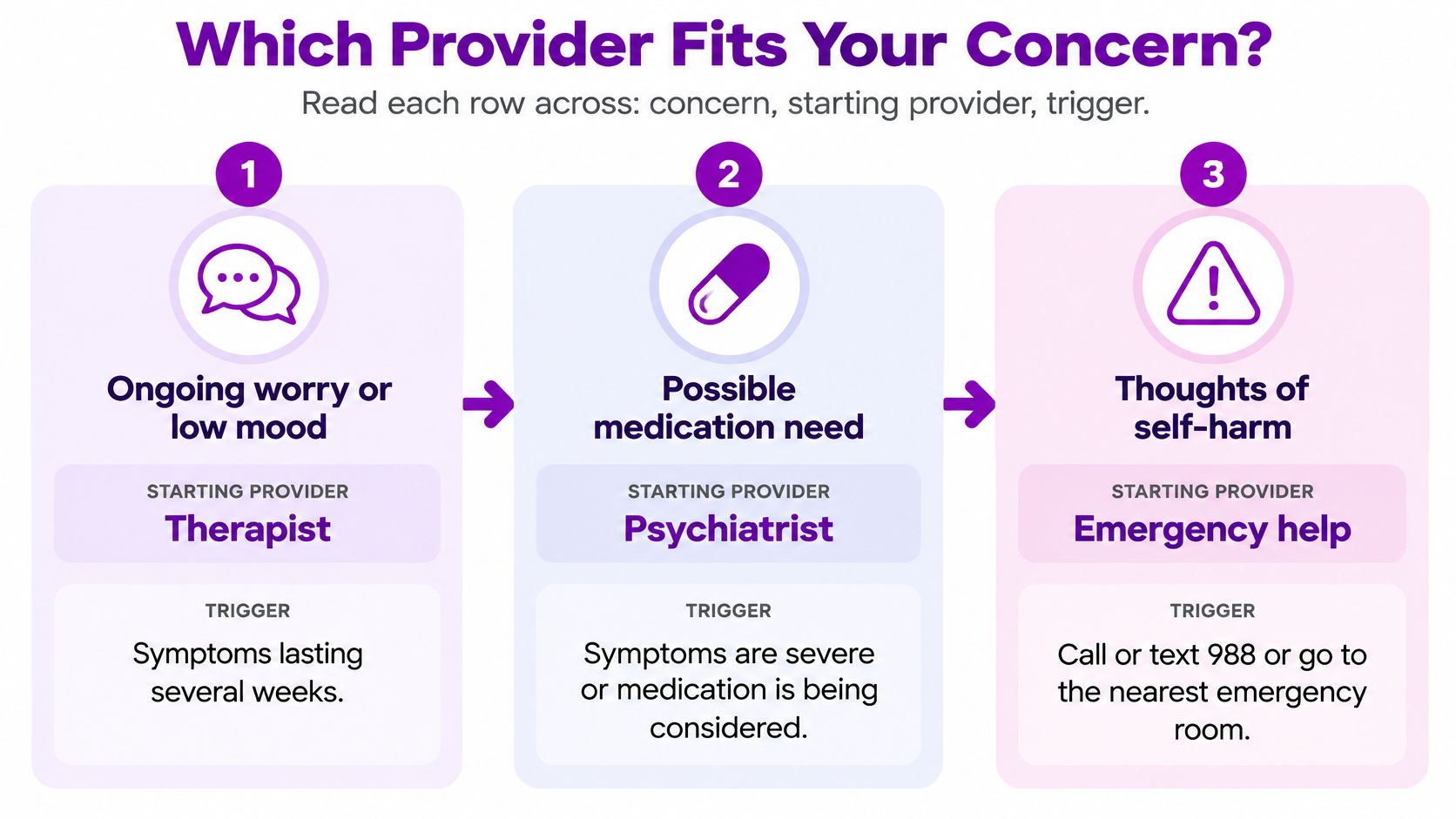
Depression severity changes the starting decision. The National Institute of Mental Health's depression guide explains that people with milder depression often try psychotherapy first, adding medication if therapy doesn't produce a good response, while people with moderate or severe depression are usually prescribed medication as part of the initial treatment plan.
The concern alone isn't enough to choose. Sleep, functioning, safety, previous episodes, and your preferences should shape the recommendation.
Which provider to start with, by situation
| Situation | Start with | Add the other when |
|---|---|---|
| Mild anxiety or stress | Therapist | Symptoms persist after 8-12 weeks of skills work |
| Mild depression | Therapist, since psychotherapy is often tried first | Little improvement after a good-faith trial of therapy |
| Moderate to severe depression | Psychiatric evaluation, with therapy alongside | Medication is usually part of the initial plan |
| Trauma or PTSD | Therapist trained in EMDR or trauma-focused CBT | Nightmares, severe sleep loss or dissociation need a medication review |
| Relationship or family conflict | Couples or family therapist | One partner shows persistent mood symptoms that need evaluation |
| Child or teen behavior and emotions | Therapist, often play-based | Developmental, medical or severe mood questions need a psychiatric evaluation |
| Medication questions, side effects or dose changes | Psychiatrist or prescriber | Therapy goals stall and need added skills work |
| Suicidal thoughts, psychosis or mania | Prompt psychiatric assessment; emergency help for immediate danger | Ongoing therapy added after stabilization |
The anxiety timeline is a planning guide, not a requirement to wait through worsening symptoms. Likewise, severe sleep loss or dissociation needs clinical assessment; it doesn't automatically mean medication is the answer.
Match the Next Action to the Problem
For anxiety, ask whether avoidance is shrinking your life and whether you're able to practice skills between sessions. For trauma, choose a clinician trained in trauma treatment rather than relying on a general promise to discuss the past. Relationship and family work needs attention to interaction patterns, while an individual's persistent mood symptoms may warrant separate evaluation.
For children and teens, caregiver observations, school functioning, and developmental history help clarify the next step. For medication side effects or dose questions, contact the prescriber rather than changing treatment yourself.
Suicidal thoughts, psychotic symptoms, or mania need prompt psychiatric assessment. If anyone is in immediate danger, call 911 in the United States; dial or text 988 for suicide and crisis support. Don't wait for a routine appointment when someone can't stay safe.
Set a Checkpoint Rather Than Guessing Indefinitely
A first visit can recommend a single provider, both roles, or a sequence. Our therapists and licensed psychiatric professionals collaborate, allowing referrals within the same practice when appropriate.
Start where the main problem lives, then review whether the treatment is changing daily life, not just whether you've attended appointments.
Set a four-to-eight-week checkpoint to review symptom direction, functioning, attendance, treatment practice, and tolerability. This isn't a deadline for recovery or proof that treatment has failed. It's a scheduled decision about whether to continue, refine the approach, or add the other provider sooner.
If you're uncertain about the relationship itself, we offer the free guide “5 Ways to Know You've Found a Good Match with Your Therapist.” Feeling comfortable matters, but so do shared goals and a clear explanation of the treatment.
Confirm Your Starting Point Before You Book
A booking plan needs four pieces of information, and none of them require you to diagnose yourself. Intake teams route appointments based on what you describe, so clarity about the problem matters more than a label for it.
- Name your main concern and how long it has lasted. Include its effect on sleep, work, relationships, and everyday tasks. Duration and impairment are what separate a therapy-first concern from one that may warrant a psychiatric evaluation up front.
- Screen for urgency before scheduling anything routine. Safety symptoms change the pathway entirely; urgent assessment replaces standard booking rather than preceding it.
- Confirm what the visits will cost. Verify insurance benefits before booking, and ask about sliding scale fee options during the initial consultation so the plan you choose is one you can actually attend.
- Book the first appointment and set the review date. Choose therapy, a psychiatric evaluation, or a combined intake if one is offered. I recommend calendaring the review date the same day you book, so the follow-up decision has an owner and doesn't drift.

Find a reVIBE Location Near You!
reVIBE serves Scottsdale, Tempe, Chandler, Phoenix, and Paradise Valley, Arizona. Visit revibementalhealth.com for current location and contact details.
Fit matters more than the credential after a provider's name. Personalized matching pairs you with a therapist or psychiatric care provider who specializes in your concern and suits your preferences, and care can include talk therapy, medication, or both within the same practice. Appointments run in person or online, so confirm availability and telehealth options when booking, including whether the provider works with your age group and treatment goals.
The outcome is concrete: a named first provider, a booked date, and a checkpoint for review. A scheduled appointment with a review date beats another week of weighing options.
reVIBE Mental Health offers therapy, psychiatric care, and medication management with personalized provider matching for your needs and preferences. Visit reVIBE Mental Health to discuss whether therapy, a psychiatric evaluation, or coordinated care is the right starting appointment for you.