
You may be in this spot right now: your child can't stay on task at school, or you're an adult who keeps missing deadlines, losing focus in meetings, and wondering why everyday tasks feel harder than they should. You type who can diagnose ADHD into a search bar and get a confusing mix of answers. One site says psychiatrist. Another says psychologist. A friend says start with your family doctor. Someone on social media says a quiz told them everything they needed to know.
That confusion makes sense. ADHD diagnosis is not limited to one type of professional, and it's also not something that should be decided by a quick checklist alone. A real diagnosis depends on patterns over time, symptoms that fit formal criteria, and clear evidence that those symptoms affect life in more than one setting.
For a child, that might mean home and school. For an adult, it might mean work and relationships. Either way, the clinician has to look beyond “I feel distracted” and ask a more careful question: Is this ADHD, or could something else be causing similar problems?
That's why the right starting point depends on your age, how complicated the picture is, whether medication may be part of treatment, and how quickly you need access. In Phoenix, that practical decision matters just as much as the diagnosis itself.
Introduction Who Really Can Diagnose ADHD
A Phoenix parent calls a pediatrician after another week of school notes about unfinished work and constant blurting. Across town, an adult opens a clinic directory after missing one more deadline and wonders whether to book with a psychologist, a psychiatrist, or a primary care doctor. They are asking the same practical question: Who really can diagnose ADHD, and who is the best first call for my situation?
More than one type of licensed clinician may be able to diagnose ADHD. According to the CDC, that can include mental health professionals such as psychologists or psychiatrists, and primary care providers such as pediatricians, as long as the evaluation is done properly through the CDC overview of ADHD diagnosis.
That broad answer helps, but it also causes confusion.
A provider's title tells you only part of the story. What people usually need to know is what that provider can do. Can they diagnose? Can they do formal testing? Can they prescribe medication? Can they refer you somewhere else if the picture is more complicated? Those are different jobs, and ADHD care often involves more than one of them.
A good way to picture it is a care map. Some clinicians are strong first-stop evaluators. Some are better for detailed testing. Some mainly help with medication. Some do one part well and then hand off the next step. In Phoenix, where wait times, insurance rules, and specialist access can shape your options, choosing the right first appointment can save weeks of frustration.
Practical rule: Start with the clinician who fits your age group and level of complexity, not just the clinician with the most impressive-sounding title.
By the end of this article, you should be able to sort providers into four clear roles:
- Who can diagnose ADHD: including which licensed professionals commonly make the diagnosis.
- Who can test more deeply: such as when learning problems, autism concerns, or diagnostic uncertainty call for formal psychological or neuropsychological testing.
- Who can prescribe medication: which matters if treatment may include stimulants or non-stimulant medication.
- Who is best as your first Phoenix appointment: based on whether the patient is a child, teen, or adult, and whether the case seems straightforward or layered with anxiety, depression, sleep problems, trauma, or school concerns.
That distinction matters. A straightforward child case may start well with a pediatrician. An adult who wants both diagnosis and medication planning may choose a psychiatrist first. A child struggling in school with possible learning differences may need a psychologist for testing even if a pediatrician stays involved. The right starting point is less about prestige and more about fit.
Understanding How ADHD Diagnosis Actually Works
A Phoenix parent notices one pattern at home, the teacher reports another, and the child looks fairly calm in the exam room. Or an adult says, “I can focus on things I like, so maybe this isn't ADHD,” while bills, deadlines, and missed appointments keep piling up. That is why ADHD diagnosis is a clinical evaluation, not a quick yes-or-no test.
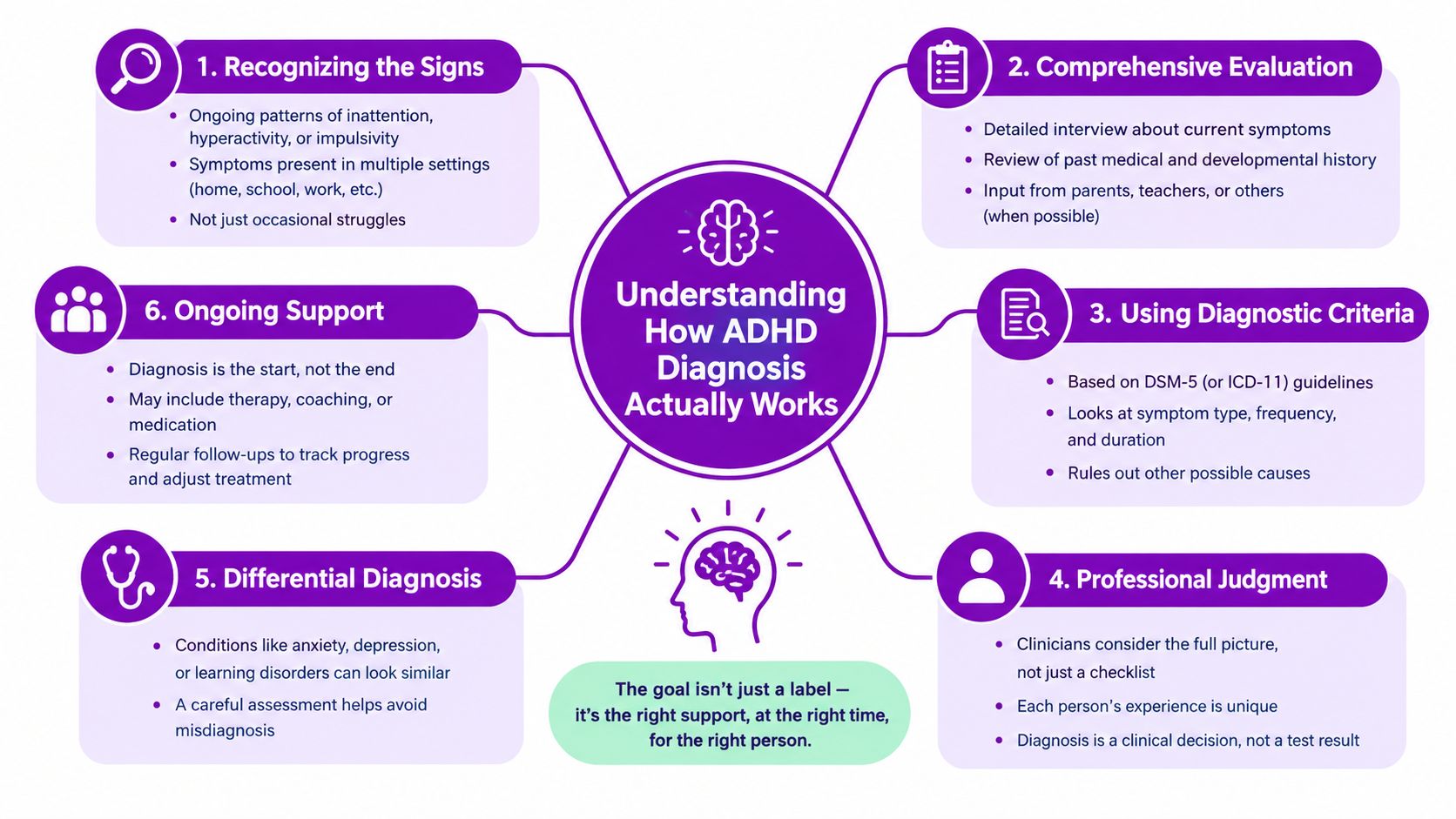
A good evaluator is doing two jobs at once. First, they check whether the pattern fits ADHD. Second, they check whether something else explains the same symptoms better.
That process works a lot like putting together a case file. One clue rarely settles it. The clinician looks for a consistent pattern across time, settings, and daily functioning.
The diagnosis has to fit formal criteria
ADHD is diagnosed against DSM-5 criteria. For children and teens, symptoms need to be present long enough, show up in more than one setting, and cause real impairment. For older teens and adults, the symptom count threshold is lower than it is for younger children, but the same big idea applies. The pattern has to be persistent, broad enough to affect more than one area of life, and strong enough to interfere with functioning. The CDC summarizes these diagnostic standards in its overview of ADHD diagnosis in children and teens.
That distinction helps with a common point of confusion. Getting distracted during stress, boredom, grief, poor sleep, or a hectic season of life can look similar on the surface. ADHD refers to an ongoing developmental pattern, not a rough month.
Why clinicians ask for information from other people
ADHD rarely shows up the same way in every room. A child may hold it together for a short office visit and still struggle through six hours of school. An adult may explain inattention clearly, but a spouse, parent, or roommate may describe the missed details, impulsive spending, or chronic lateness that rounds out the picture.
So clinicians often gather outside observations, especially for children. Rating scales, school reports, partner input, and prior records help answer a practical question: is this a repeated pattern across daily life, or a problem tied to one setting?
Outside input is helpful because ADHD is diagnosed by pattern, not by a single impressive symptom.
Why “these symptoms sound familiar” still is not enough
Many conditions can blur attention, memory, energy, and impulse control. Anxiety can make the mind jump. Depression can slow focus and motivation. Sleep loss can look like inattention. Trauma, substance use, learning disorders, and some medical problems can create a similar picture.
A careful clinician sorts through those possibilities instead of stopping at symptom overlap.
Here is the simplest way to understand the logic:
- Are ADHD-like symptoms present?
- Have they been present long enough to fit the disorder, rather than a brief stressful period?
- Do they appear in more than one setting, such as school and home, or work and relationships?
- Do they impair daily functioning in a meaningful way?
- Does the history suggest an early developmental pattern, even if no one recognized it at the time?
- Could another condition, or several conditions together, explain the symptoms better?
That sixth question matters more than many people expect. It often shapes the best first appointment in Phoenix. A straightforward school-age case may fit well in primary care. An adult with anxiety, insomnia, or substance use concerns may need a psychiatrist first. A child with attention problems plus reading struggles may need formal testing with a psychologist, even if another clinician makes the diagnosis.
Why provider type changes the process, but not the standard
Different clinicians gather evidence in different ways. A pediatrician may rely heavily on history, rating scales, and school input. A psychologist may add cognitive or academic testing when the picture is unclear. A psychiatrist may spend more time sorting ADHD from mood, sleep, or substance-related conditions while also considering medication.
The tools may differ. The core question stays the same. Does the full pattern fit ADHD, and is this the right explanation?
That is the part that makes the provider choice less mysterious. The right clinician is not just someone allowed to diagnose ADHD. It is someone whose scope matches what you need most right now: diagnosis, testing, prescribing, or referral.
Who Can Diagnose ADHD and How Their Roles Differ
A parent in Phoenix might start with a pediatrician because school reports mention focus problems. An adult might book with a psychiatrist after years of missed deadlines, poor sleep, and anxiety. Both are reasonable starting points. The better question is not which title sounds most authoritative. It is which clinician can do the part you need: diagnose, test, prescribe, or refer.
That distinction makes the process much easier to sort out.
The main provider types
ADHD evaluation works a bit like building a case file. One clinician may gather the history and make the diagnosis. Another may add testing. Another may handle medication. Sometimes one person does all three. Often, especially in Phoenix clinics with long wait lists, the work is split across providers.
Psychiatrists are medical doctors who diagnose ADHD, look for overlapping psychiatric conditions, and prescribe medication when appropriate. They are often the best first stop if the picture is crowded by anxiety, depression, bipolar symptoms, insomnia, trauma, or substance use. In adults, that sorting step matters because several conditions can look like poor attention from the outside.
Clinical psychologists can also diagnose ADHD. Their role often becomes especially useful when the picture is blurry. They may use interviews, rating scales, and cognitive or academic testing to sort out whether the problem is ADHD, a learning disorder, anxiety, or a mix of several issues. In most settings, they do not prescribe medication.
Pediatricians and family physicians often diagnose ADHD in straightforward cases, especially when the history is clear and input from home and school lines up. They can also prescribe within their scope. If the pattern is unusual or there are signs of learning problems, autism, sleep disorders, tics, severe mood symptoms, or substance use, they often refer to a psychologist, psychiatrist, or developmental specialist.
Psychiatric nurse practitioners may diagnose ADHD and prescribe medication within their licensure and clinic model. In many outpatient practices, they are a practical option for evaluation and follow-up care, especially when access to psychiatrists is limited.
Physician assistants may also participate in ADHD assessment and medication management, depending on state rules, supervision structure, and the practice setting. Their role varies more from clinic to clinic, so it helps to ask what evaluations they perform directly and when a supervising psychiatrist becomes involved.
School psychologists play a different role. They can document classroom concerns, review learning patterns, and perform school-based testing related to academic support. That information can be very helpful for a child's overall picture. Still, families usually need a medical or licensed mental health clinician for diagnosis and treatment outside the school system.
If you want a plain-language comparison of these roles, this psychiatry vs psychology overview can help clarify where each profession fits.
Which provider can do what
| Provider Type | Can Diagnose | Can Prescribe | Can Test | Can Refer | Best First Fit |
|---|---|---|---|---|---|
| Psychiatrist | Yes | Yes | Sometimes limited formal testing | Yes | Adults or teens with ADHD plus mood, sleep, trauma, or substance concerns |
| Clinical Psychologist | Yes | No | Yes, often in more detail | Yes | Unclear cases, learning concerns, need for diagnostic clarification |
| Pediatrician or Family Physician | Yes, often in straightforward cases | Yes, within scope | Usually limited formal testing | Yes | Children, teens, or adults with a clear history and fewer complicating factors |
| Psychiatric Nurse Practitioner | Yes, within scope | Yes, within scope | Usually limited formal testing | Yes | Faster access for evaluation and medication follow-up |
| Physician Assistant | Sometimes, based on setting and supervision | Sometimes, within scope | Usually limited formal testing | Yes | Team-based psychiatric or primary care practices |
| School Psychologist | School-based assessment, sometimes not a medical diagnosis for treatment purposes | No | Yes, school and academic testing | Yes | Children with classroom struggles or possible learning issues |
A Phoenix-friendly way to choose your first appointment
Phoenix families and adults often run into the same practical problem. The best specialist on paper may not be the best first appointment if the wait is four months and you need a clear starting point now.
Use this simple path:
- Child with attention concerns mainly showing up at school: start with a pediatrician if access is fastest, especially if teacher and parent concerns are consistent. Add a psychologist if reading, math, or learning concerns are also present.
- Adult with lifelong attention problems and no major mental health overlap: primary care, a psychiatrist, or a psychiatric nurse practitioner can all be reasonable first appointments.
- Child or adult with a more tangled picture: start with a psychiatrist or psychologist if symptoms overlap with anxiety, depression, sleep problems, trauma, autism, substance use, or past treatment failure.
- Need medication soon and the diagnosis already seems fairly clear: a psychiatrist, psychiatric nurse practitioner, or primary care clinician may be the most direct route.
- Need documentation, testing, or help separating ADHD from learning problems: book with a psychologist first, even if another clinician later manages medication.
If you want an outside summary of how these specialists compare, the DeTalks guide to ADHD diagnosis offers a useful overview.
The right first appointment is the one that matches the job in front of you. For some people, that job is diagnosis. For others, it is testing, prescribing, or getting referred to the next person on the care team.
What to Expect During an ADHD Evaluation
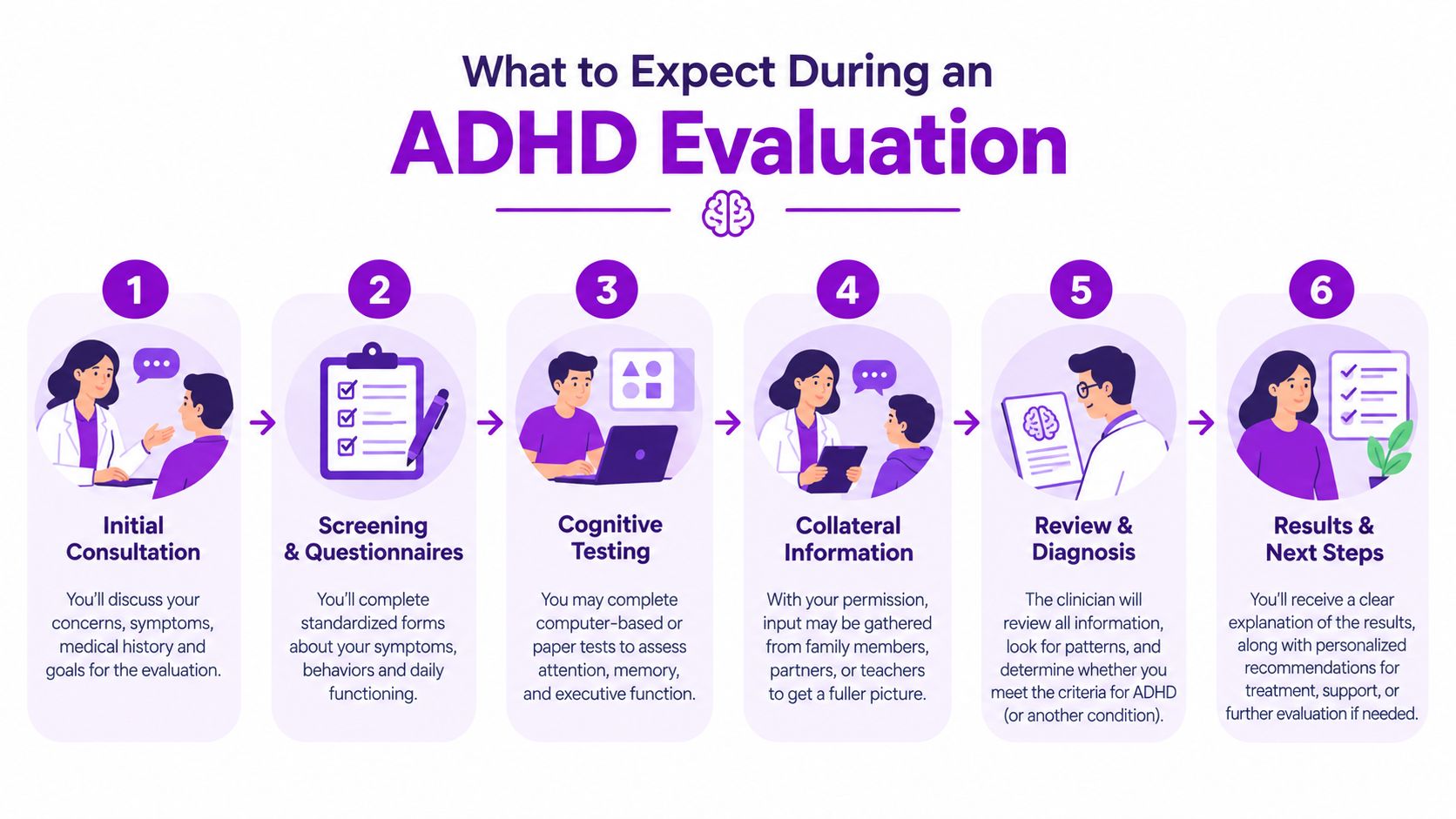
You book an appointment because staying on task has felt harder for years. You might expect a quick checklist and a yes-or-no answer. A good ADHD evaluation works more like assembling a clear timeline. The clinician is trying to see whether your symptoms fit a consistent pattern, where that pattern shows up, and whether ADHD is the best explanation.
For adults, strong practice standards describe an assessment that includes a clinical interview, a structured or semi-structured interview, outside input when available, a review of day-to-day impairment, and a check for other causes, as outlined in the VA ADHD quick reference guide.
It usually starts with history
The first part of the visit is often a detailed conversation. The clinician asks what led you to seek help, when the difficulties began, where they happen, and how they affect school, work, home life, routines, finances, relationships, and daily follow-through.
For a child, that may include pregnancy history, developmental milestones, classroom behavior, homework patterns, and family observations. For an adult, the discussion often covers work habits, organization, missed deadlines, driving, emotional control, and whether similar struggles were present earlier in life.
The goal is pattern recognition.
Symptom checklists help, but they do not decide the diagnosis alone
Many clinicians use rating scales or structured interview tools. Those tools are useful in the same way a blood pressure cuff is useful. They measure part of the picture, but they do not replace clinical judgment.
As noted earlier, ADHD criteria use a lower symptom threshold for people 17 and older than for younger children. The clinician also looks at duration, impact, and whether the symptoms fit ADHD rather than another condition.
The evaluator looks for the same pattern in more than one setting
This part often clears up a common misunderstanding. Someone with ADHD may focus very well on a favorite activity and still have ADHD. The problem is not a total lack of attention. It is uneven attention control that repeatedly causes problems.
So the clinician asks for real-life examples from different places. A child may lose materials at school and melt down over homework at home. An adult may miss deadlines at work, forget bills, and struggle to keep track of chores or messages.
Part of the visit is checking for other explanations
Sleep problems, anxiety, depression, trauma, substance use, thyroid issues, medication side effects, and learning disorders can all affect attention. Asking about those topics is not a detour. It is part of making the diagnosis carefully.
If you want a broader preview of how a first appointment is structured, this guide to getting a mental health evaluation can help set expectations.
Bring examples, not just impressions. “I lose track of tasks” is a start. “I missed two deadlines last month, forgot a parent meeting, and left three forms unfinished” gives the clinician something concrete to assess.
What to bring, and how that changes by provider type
The most helpful records are the ones that show a pattern over time:
- School records: report cards, teacher comments, past testing, IEPs, or 504 plans
- Work examples: performance feedback, repeated concerns about lateness, detail errors, or follow-through
- Medication list: current prescriptions, supplements, and any past psychiatric medications
- Outside observations: a parent, partner, teacher, or another person who sees your daily functioning
What happens next often depends on who is doing the evaluation. A psychologist may add formal testing if the picture is unclear or if learning problems are part of the question. A psychiatrist, psychiatric nurse practitioner, or primary care clinician may focus on diagnosis and treatment planning, especially when medication is likely to be part of care. In Phoenix, that difference matters. If your main need is school documentation or separating ADHD from a learning disorder, testing is often the better first step. If the diagnosis already seems fairly clear and access is the bigger issue, an evaluating prescriber may be the more direct first appointment.
Some evaluations happen in one long visit. Others are split across two or more appointments. What matters is not the number of visits. What matters is whether the clinician gathered enough information to diagnose, refer, or prescribe with confidence.
How Child and Adult Evaluations Differ and Why Comorbidities Matter
A 9-year-old who cannot stay seated in class and a 34-year-old who misses deadlines may both have ADHD. The evaluation still starts in two different places. For a child, the clinician is gathering a pattern from the adults around them. For an adult, the clinician is often reconstructing a pattern across many years.

What matters more in child evaluations
Child evaluations rely heavily on outside observation because children do not always notice or describe their own symptoms clearly. A clinician usually needs to know how the child functions at home, at school, and in other structured settings. That is why parent reports, teacher rating scales, school feedback, and developmental history carry so much weight.
For Phoenix families, that also helps clarify who should be the first appointment. If the main concern is classroom behavior and attention, a pediatrician, child psychiatrist, or psychiatric nurse practitioner may be able to diagnose and treat. If the bigger question is whether ADHD is separate from a learning disorder, language issue, or autism-related concern, a psychologist is often the better first stop because testing may be needed.
Children also require more careful sorting of normal development from true impairment. A very active 6-year-old is not automatically a child with ADHD. The clinician has to ask whether the behavior is stronger, more persistent, and more disruptive than expected for that child's age.
What changes in adult evaluations
Adult evaluations often work like timeline building. The clinician is not only asking, "What is happening now?" They are also asking, "Does this pattern reach back to childhood?" ADHD does not usually begin for the first time in adulthood, so earlier school struggles, family observations, old report cards, or long-standing work habits can help fill in the picture.
Adults also present with more life layers. Work demands, parenting, sleep loss, relationship stress, and burnout can all affect attention. That is one reason adult evaluations can look less like a school-based checklist and more like a careful review of daily functioning across work, home, finances, driving, and routines.
In Phoenix, the best first appointment often depends on complexity and access. An adult with a fairly clear history who mainly wants diagnosis and medication discussion may start with a psychiatrist, psychiatric nurse practitioner, or a primary care clinician who is comfortable assessing ADHD. An adult with a murkier history, possible learning problems, or questions about whether anxiety, trauma, or another condition explains the symptoms may get a clearer answer from a psychologist first.
Why comorbidities change who should evaluate you
Comorbidities are overlapping conditions that can either resemble ADHD or sit beside it. A helpful analogy is blurry vision. Sometimes the problem is the lens. Sometimes it is the lighting. Sometimes both are true. Attention problems work the same way.
Anxiety can make a person restless, distracted, and mentally overloaded. Depression can slow thinking and reduce follow-through. Sleep apnea can cause brain fog and irritability. Substance use can cloud concentration. Learning disorders can make school or paperwork look like an attention problem when the core issue is reading, writing, or processing.
That is why provider roles matter so much here:
- Psychologists can help sort apart ADHD from learning disorders, autism traits, and other diagnostic look-alikes through interviews and testing.
- Psychiatrists can diagnose ADHD, evaluate overlapping mental health conditions, prescribe medication, and decide which problem should be treated first.
- Psychiatric nurse practitioners can often diagnose and prescribe, and they may refer out for testing if the picture is unclear.
- Primary care clinicians may diagnose and prescribe in straightforward cases, but often refer children or adults with more diagnostic uncertainty.
- Neurologists are usually not the first stop for routine ADHD concerns, but may be helpful if seizures, head injury, or another neurological issue is part of the story.
A few common examples make this easier to apply:
- Sleep problems: poor sleep can worsen focus, emotional control, and memory. Adults trying to improve routines while waiting for an appointment may find these ADHD-friendly sleep strategies useful.
- Mood or anxiety symptoms: panic, chronic worry, low motivation, or racing thoughts may need parallel assessment so the clinician can tell what is driving the attention problem.
- Learning concerns: repeated trouble with reading, writing, math, or processing speed often points toward a psychologist for fuller testing.
A referral in a complicated case is not a detour. It is closer to getting the right specialist for the right part of the problem.
Navigating Telehealth Referrals Insurance and Wait Times
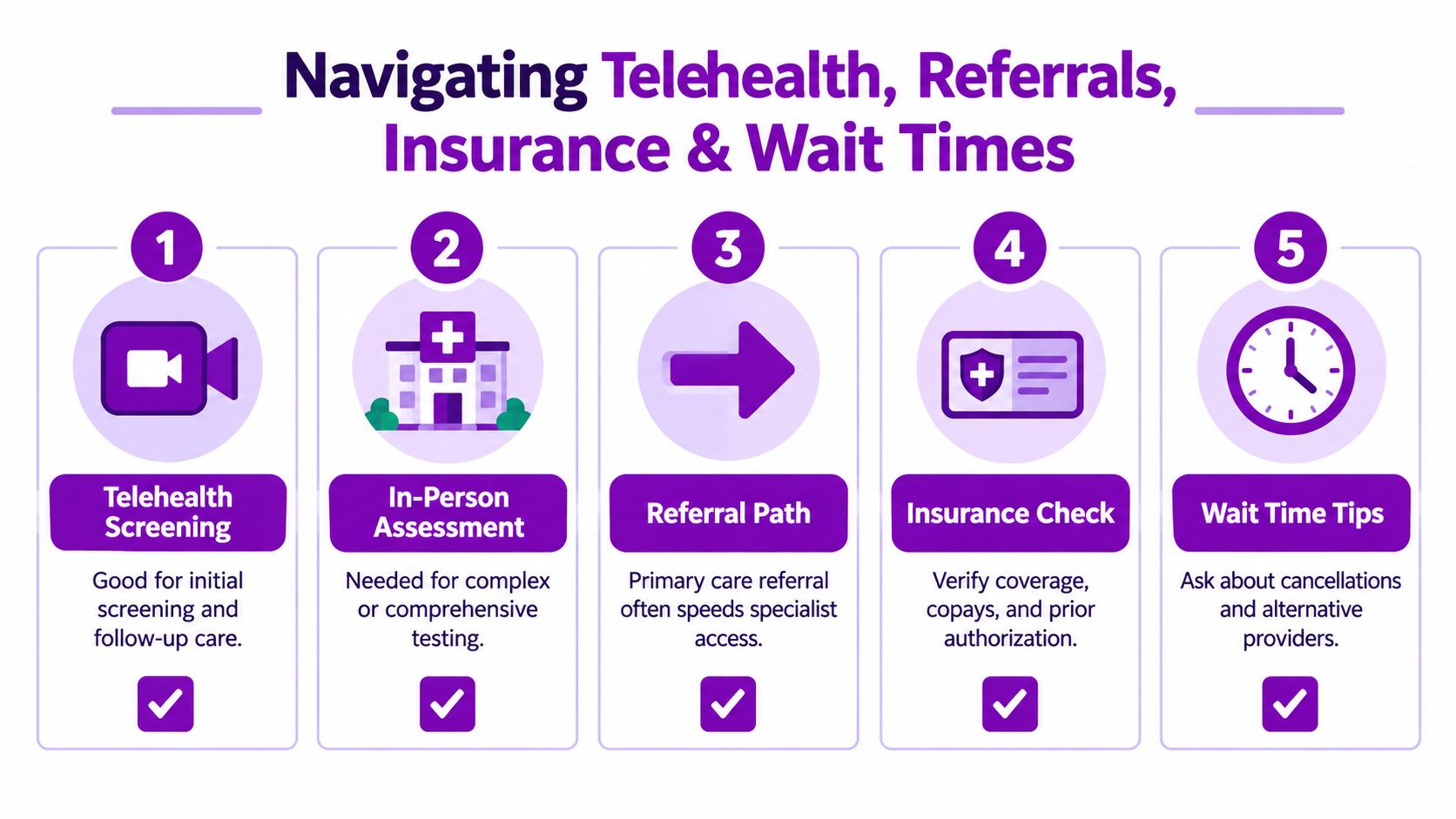
Access shapes real-life ADHD care more than most articles admit. You may know which clinician you want, but if the earliest opening is months away, the better question becomes: what's the smartest first move now?
That's where telehealth, referrals, and insurance details start to matter.
When telehealth helps and when it may not
Telehealth can work well for initial screening, history-taking, follow-up visits, and medication management in appropriate cases. It can be especially helpful if you already have records, school feedback, or outside forms ready to review.
In-person care may be a better fit when the picture is more complicated, when a child needs fuller behavioral observation, or when testing and broader diagnostic clarification are likely to be part of the process.
Referrals can shorten the path
A referral doesn't always mean your case is severe. Sometimes it means your primary care clinician sees that a psychologist or psychiatrist is better positioned to sort out a complicated picture.
That matters in systems with long queues. Independent UK reporting in 2025 said at least 196,000 adults were waiting for NHS ADHD assessments, according to Healthwatch reporting on ADHD wait times. The same report noted that in New Zealand, policy changes from February 2026 are set to allow specially trained GPs and nurse practitioners to diagnose adults and start stimulant treatment, which reflects a broader effort to expand access rather than rely only on specialist-only models.
Insurance questions to ask before you book
Before the first appointment, ask:
- Is this clinician in-network: and if not, what's the out-of-network process?
- Does the evaluation require prior authorization: especially if testing may be involved?
- Will follow-up visits be separate from diagnostic visits: and are they billed differently?
- If medication is discussed later: will that happen with the same clinician or by referral?
A practical strategy is to start with the fastest qualified clinician who can evaluate your level of complexity. If the case is straightforward, that may save time. If it isn't, you still get the referral process moving instead of waiting in limbo.
Next Steps for Getting Diagnosed in the Phoenix Area
If you're in the Phoenix metro area, the best next step is usually simpler than people expect. Match the first appointment to the person being evaluated and the complexity of the case.
A school-age child with behavior and focus concerns may do well starting with a pediatric or child-focused mental health evaluation. An adult with longstanding inattentive symptoms and no major overlap may start with primary care or psychiatry. If anxiety, depression, sleep problems, or substance use are part of the picture, it usually makes sense to start with a clinician who can sort through overlapping causes carefully.
What to gather before the first visit
Come prepared with real-life examples. Clinicians make better decisions when they can see patterns, not just hear general impressions.
- Symptom examples across settings: home, school, work, relationships, driving, finances, or daily routines.
- Records that show impact: report cards, teacher notes, prior testing, workplace feedback, or accommodation paperwork.
- Your medication and health history: include prescriptions, supplements, past psychiatric treatment, and relevant medical conditions.
- Names of people who know the pattern well: a parent, spouse, partner, teacher, or another person who can provide context if needed.
Questions worth asking when you schedule
Ask the office what kind of evaluation they provide. Some clinics focus on screening and medication management. Others offer broader diagnostic workups or therapy coordination too.
You can also ask:
- Who will conduct the evaluation: psychiatrist, psychologist, NP, PA, or therapist with referral support?
- Will this visit include diagnosis only, or treatment planning too?
- If ADHD is confirmed, who handles medication and follow-up?
- If ADHD isn't the right diagnosis, will they still help with next steps?
For people comparing local options, this Phoenix-area psychiatrist search page can help you think through in-person access.
Find a reVIBE Location Near You
We currently have five locations for your convenience. Call (480) 674-9220.
reVIBE Mental Health – Chandler
3377 S Price Rd, Suite 105, Chandler, AZreVIBE Mental Health – Phoenix Deer Valley
2222 W Pinnacle Peak Rd, Suite 220, Phoenix, AZreVIBE Mental Health – Phoenix PV
4646 E Greenway Road, Suite 100, Phoenix, AZreVIBE Mental Health – Scottsdale
8700 E Via de Ventura, Suite 280, Scottsdale, AZreVIBE Mental Health – Tempe
3920 S Rural Rd, Suite 112, Tempe, AZ
One practical local option is reVIBE Mental Health, which offers psychiatry, therapy, in-person visits, and secure online sessions across the Phoenix area. For someone trying to sort out ADHD symptoms while also considering anxiety, depression, trauma, or family stress, that kind of integrated setup can make referrals and follow-up more straightforward.
If you're ready to move, don't wait until you've organized every detail perfectly. Bring what you have, describe what's been hard, and let the evaluation process do its job.
If you're looking for help figuring out who can diagnose ADHD and what kind of appointment makes sense, reVIBE Mental Health offers psychiatry, therapy, medication management, and both in-person and secure online care across the Phoenix area. Their team can help you start with the right type of clinician, clarify whether ADHD fits, and map out practical next steps for treatment and follow-up.