

You've finally booked a therapy appointment, but now the intake form is asking about experiences you've never put into words. Your cursor stops over the question. You wonder whether you'll have to tell the entire story immediately, whether the therapist will understand, or whether starting care will leave you feeling more exposed than supported.
Trauma informed counseling is designed for that moment. It gives clinicians a framework for recognizing how overwhelming experiences can affect a person's mind, body, relationships, and sense of safety, without reducing the client to a diagnosis or a list of symptoms. The approach matters whether someone has a clear trauma history or just notices anxiety, numbness, irritability, distrust, or emotional reactions that seem difficult to explain.
The term can sound specialized, but the central question is practical: How can counseling help without making a person feel trapped, pressured, or re-traumatized? The answer begins with the therapist's behavior, continues through the clinical methods they use, and includes the design of the entire care experience.
What Trauma Informed Counseling Actually Means
Trauma informed counseling is a way of organizing care around the possibility that a client's current reactions may be connected to unresolved stress responses. Instead of asking only, “What symptom should we reduce?” a clinician also considers, “What might this person's nervous system be protecting them from, and what would help them feel safe enough to participate in treatment?”
That doesn't mean the therapist assumes what happened. It means they avoid treating a client's behavior as defiance, weakness, or lack of motivation before understanding its context. A missed appointment, difficulty making eye contact, emotional shutdown, or reluctance to answer a question can have several explanations. A trauma informed clinician responds with curiosity and flexibility rather than punishment or pressure.
The approach grew out of a broader trauma-informed care movement that became more visible after the landmark CDC–Kaiser Permanente ACE Study in the mid-1990s. The study followed more than 17,000 adults, found that almost two-thirds had experienced at least one adverse childhood experience, and reported that more than 1 in 5 had experienced three or more (Counseling Today's overview of trauma-informed care). Those findings helped establish that trauma exposure is common, not exceptional.
What the term does and doesn't mean
Trauma informed counseling is not one therapy technique, a diagnosis, or a promise that every client needs to discuss traumatic memories. It also isn't limited to veterans, first responders, or people with severe post-traumatic stress disorder. A person may seek this kind of care after abuse, medical treatment, neglect, a frightening accident, loss, instability, or another experience that changed how safe the world feels.
It's also different from trauma-focused therapy. Trauma-focused methods directly address trauma memories or trauma-related beliefs. Trauma informed care is the wider framework that shapes consent, communication, pacing, referrals, and treatment planning. A provider may practice EMDR or TF-CBT within a trauma informed framework, but using one of those modalities alone doesn't automatically describe the whole care environment.
The practical details matter. The therapist explains why they're asking a sensitive question, accepts “not today,” notices signs of overwhelm, and includes the client in deciding what happens next. This explanation of trauma-informed care can help readers compare the philosophy with what they experience in an actual counseling relationship.
The rest of this guide focuses on four connected layers: the principles behind the approach, the clinical methods that may be used, what an initial appointment can feel like, and how to evaluate whether a provider practices what the label promises.
The Five Core Principles in Plain Language
A useful way to understand the five principles is to imagine a clinician preparing a guest room for someone returning to a clinic after a difficult medical experience. The room needs more than attractive furniture. The guest needs to know the door locks, the host will keep their word, and they can decide how much contact feels manageable.
Safety is the lock on the door. In counseling, it includes privacy, respectful language, emotional steadiness, and attention to physical surroundings. A therapist might explain confidentiality limits before asking personal questions, offer a pause, or notice when the client is becoming overwhelmed. Safety doesn't mean discomfort never occurs. It means discomfort is handled with care and choice.
Trustworthiness and transparency are consistent follow-through. The clinician explains what a session will involve, keeps agreements, and says when they don't know something. If a referral is needed, the therapist describes why and includes the client in that process rather than making an unexplained decision.
What the principles look like in the room
Choice is like allowing the guest to control the lighting and music. The client may choose whether to answer a question, decide which concern comes first, or request a different way of discussing a topic. A provider can offer options before asking for trauma details, such as focusing on sleep, panic, relationships, or coping skills first.
Collaboration means asking where the guest would like to sit instead of placing them wherever there's an empty chair. In a session, that can look like shared agenda-setting, joint treatment goals, and regular check-ins about whether the plan still fits. The therapist brings expertise, but the client brings knowledge of their own life.
Agency means handing over the remote. The therapist helps the client notice strengths, build skills, and make informed decisions instead of presenting themselves as the only source of answers. The client should leave with a clearer sense of what they can influence, even when the work is difficult.
These principles aren't merely statements for a clinic website. A 2021 systematic review identified 10 operational components of trauma-informed services. Seven were system-level elements, including staff training, physical and psychological safety, leadership, client choice, cultural and gender sensitivity, participation, and collaboration. Three were clinical elements: trauma screening or assessment, psychoeducation, and trauma-specific interventions (the systematic review of trauma-informed components).
That finding has an important implication. A therapist's warm manner matters, but it isn't the entire model. Intake procedures, referral pathways, documentation, supervision, and opportunities for client feedback all influence whether care feels predictable and safe.
Common Therapy Approaches Used in Trauma Informed Work
EMDR and TF-CBT are often mentioned together, but they aren't interchangeable. Both can be delivered within a trauma informed framework, yet they differ in age range, structure, clinical emphasis, and the way clients participate between sessions.
EMDR, or Eye Movement Desensitization and Reprocessing, uses a structured process in which the client briefly focuses on a disturbing memory, belief, emotion, body sensation, or related material while engaging in bilateral stimulation directed by the therapist. The model is associated with adaptive information processing, the idea that distressing memories can remain insufficiently processed and continue to trigger present-day reactions.
TF-CBT, or Trauma-Focused Cognitive Behavioral Therapy, is a shorter-term, component-based model originally developed for children and adolescents. It combines trauma education, coping and emotional regulation skills, cognitive work, trauma narrative development, and caregiver involvement when appropriate. Homework may include practicing coping skills, tracking thoughts, or completing agreed-upon exercises with support from a parent or caregiver.
| Dimension | EMDR | TF-CBT |
|---|---|---|
| Primary target | Distress linked to traumatic memories, beliefs, emotions, and body responses | Trauma-related thoughts, feelings, behaviors, coping skills, and family support |
| Typical structure | Phase-based and highly structured, with preparation before memory processing | Component-based, with skills, gradual trauma narrative work, cognitive strategies, and caregiver participation |
| Common age range | Used with adults and also adapted for younger clients by appropriately trained clinicians | Originally developed for children and adolescents, with caregiver participation built into the model |
| Session experience | The client focuses briefly on selected material while following the therapist's bilateral stimulation protocol | The client learns skills, discusses trauma-related meaning, develops a narrative gradually, and practices between sessions |
| Homework | May involve noticing triggers, practicing regulation, or using agreed-upon grounding strategies | Often includes coping practice, thought exercises, emotional regulation work, or caregiver-supported activities |
| Best fit considerations | May suit clients seeking structured processing of specific traumatic material after adequate preparation | May suit younger clients and families who need a coordinated skills and narrative-based approach |
Neither approach should begin with forced disclosure. Preparation, stabilization, informed consent, and the client's ability to pause remain central. The choice depends on the person's goals, symptoms, developmental needs, safety, preferences, and the clinician's actual training.
A 2021 systematic review found a mixed but measurable signal across trauma-informed interventions. PTSD symptoms improved in 11 of 23 studies, depression improved in 9 of 16, and anxiety improved in 5 of 10 (the review of trauma-informed interventions). Those findings don't establish that the overall framework works equally well for everyone. A 2025 NIH-hosted systematic review found the broader evidence insufficient to determine effectiveness because studies were small, heterogeneous, and often at high risk of bias.
That distinction protects clients from overselling. Ask how the provider measures progress and which validated trauma-specific methods they use. A trauma-focused therapy resource for adults can help clarify why trauma-focused treatment and trauma informed care belong together without being the same thing. Somatic approaches, parts-work therapies, and other evidence-informed methods may also fit, provided the clinician can explain the model and its limits.
What a Trauma Informed First Session Looks Like
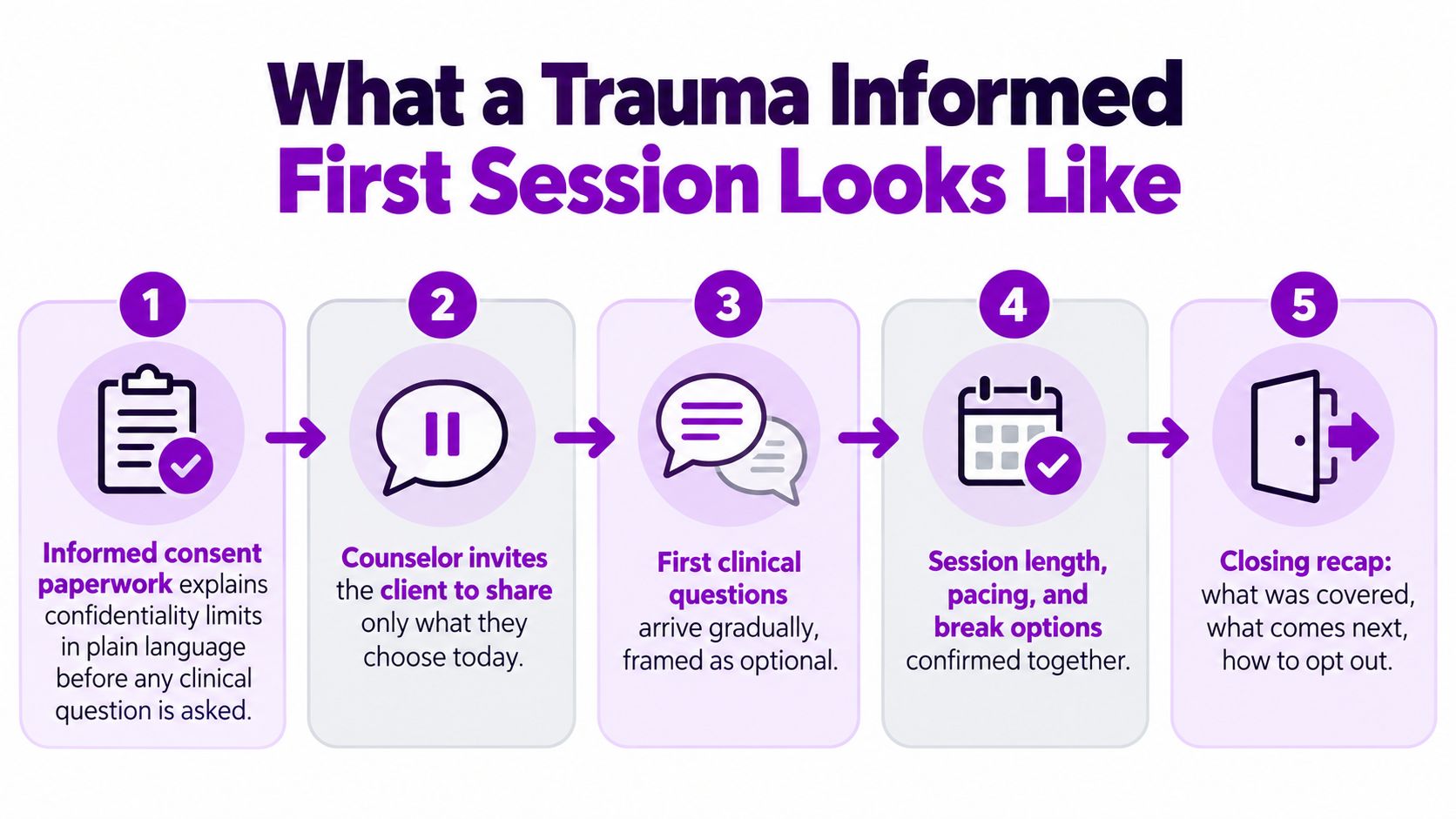
A representative first session often starts with informed consent, not a demand for the most painful memory. The paperwork should explain confidentiality and its limits in plain language before the clinician asks detailed clinical questions. You should have an opportunity to ask what happens if safety concerns arise, how records are handled, and what communication outside sessions looks like.
The therapist may ask, “What brought you in now?” or “What would you like to be different?” before asking about trauma history. A client might say, “I'm having panic attacks and I can't sleep,” while choosing not to explain the event connected to those symptoms. The clinician can begin with goals, current functioning, and coping, then ask whether discussing relevant history feels manageable.
Pacing is part of the treatment
A trauma informed therapist checks comfort without turning the session into a constant interrogation. They might ask whether the client wants to continue, take a break, change topics, or leave a subject for another appointment. The client doesn't need to provide every detail to prove that their distress is real.
Therapists often avoid intensive memory processing in session one because the client and clinician still need to assess stability, current safety, coping capacity, and treatment fit. Early work may include grounding, breathing, emotional regulation, psychoeducation about trauma responses, and a written safety or coping plan. These steps aren't a delay in “real” therapy. They help create the conditions for later work to remain tolerable and collaborative.
A second session may review what the client noticed after intake, refine goals, discuss screening results, and decide whether to continue stabilization or begin a trauma-specific protocol. Fit becomes visible through small interactions: Does the therapist answer questions directly? Do they remember agreements? Can they explain why a method is being recommended?
A productive first session doesn't require complete disclosure. It should leave you better informed about your options and more able to decide what happens next.
How to Tell If a Provider Is Truly Trauma Informed
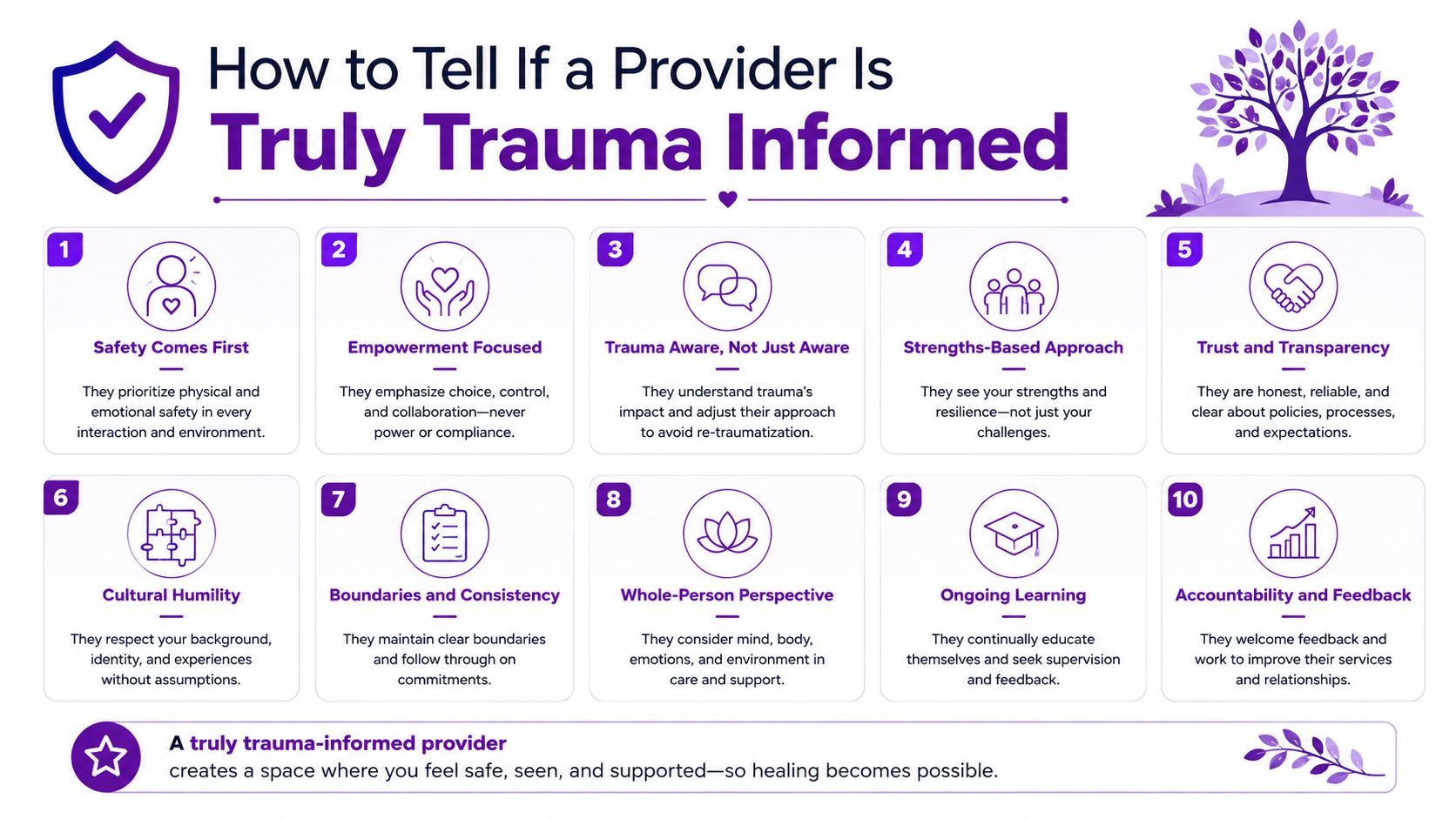
A phrase on a provider's website doesn't guarantee that the practice will feel safe in the room. “Trauma informed” can describe a careful, well-supervised approach, but it can also appear as a broad marketing label with no explanation of training, methods, or limits.
Start by asking what the clinician means by the term. A specific answer might include the modalities they practice, how they handle screening, how they prepare clients for trauma processing, and how they respond when someone becomes overwhelmed. A vague answer such as “I help people heal from trauma” is a reason to ask a follow-up question, not necessarily a reason to end the conversation.
Questions for a consultation call
Use a brief call to evaluate both competence and fit:
- Training: What formal training have you completed in trauma-specific approaches?
- Modality: Do you use EMDR, TF-CBT, or another defined treatment model? What does that model involve?
- Supervision: Do you receive clinical supervision, especially if you're working toward independent licensure?
- Experience: Have you worked with the type of trauma or concern I'm bringing to therapy?
- Pacing: How do you respond if I don't want to answer a question or need to pause?
- Coordination: Are you willing to coordinate care with a physician, psychiatrist, school, or another provider when I authorize it?
- Measurement: How will we know whether treatment is helping?
A capable clinician won't pressure you to disclose your history during a scheduling call. They should be able to explain consent, confidentiality, safety planning, and the difference between stabilization and trauma processing.
Lived experience can support empathy, and a certification can show relevant education, but neither one alone proves clinical competency. Look for clear training, appropriate supervision, ethical boundaries, and a willingness to discuss uncertainty. The guide to what to look for in a therapist offers another way to organize these questions before contacting providers.
Equity requires additional questions. A 2025 scoping review of trauma-informed care in transgender and gender-diverse health care found mixed results, no randomized trials, and no definitive conclusions about effectiveness. The review also called for a unified framework because implementation remains inconsistent (the editorial discussion of trauma-informed care evidence). Ask how the provider adapts language, safety planning, family involvement, and referrals to your identity and circumstances. Respectful care should be specific, not assumed.
Finding Trauma Informed Counseling Near You
Begin with more than a location search. A primary care clinician, Employee Assistance Program, community mental health center, trusted support organization, or another therapist may provide referrals. These sources can help you find clinicians who work with your concern, insurance, schedule, and preferred format.
Directories are useful when you filter by modality and clinical concern, not only by ZIP code. Search for EMDR, TF-CBT, trauma-focused CBT, PTSD treatment, medical trauma, complex trauma, grief, or the specific issue you want addressed. Then read the profile for details about training, populations served, session format, and whether the provider offers a consultation.
A practical screening process
Use this sequence:
- Write your priority. Decide whether you're seeking help with panic, sleep, relationships, intrusive memories, emotional regulation, or another concern.
- Shortlist several providers. Compare training, modalities, availability, location, telehealth options, and insurance information.
- Book a brief consultation. Ask how the clinician starts treatment and whether early disclosure is optional.
- Test the explanation. Ask what happens if you become overwhelmed and how progress is tracked.
- Notice your response. You don't need instant trust, but you should feel respected, informed, and free to make a decision.
For people in the Phoenix metro area, reVIBE Mental Health is one regional option. The practice serves Scottsdale, Tempe, Chandler, Phoenix, and Paradise Valley, with therapy, EMDR, psychiatry, and medication management. Its listed locations include Chandler, Phoenix Deer Valley, Phoenix PV, Scottsdale, and Tempe, and prospective clients can request a consultation to discuss fit, goals, insurance, and whether in-person or secure online care is appropriate.
A useful test: Ask the same pacing question to every provider you contact. Their answer will tell you more than a general statement about compassion.
The practice lists care for concerns including anxiety, depression, trauma, grief, burnout, relationship and family issues, eating disorders, and other mental health needs. Because service details and availability can change, confirm current clinicians, modalities, locations, insurance participation, and scheduling directly before committing.
Your Next Step Toward Getting Started
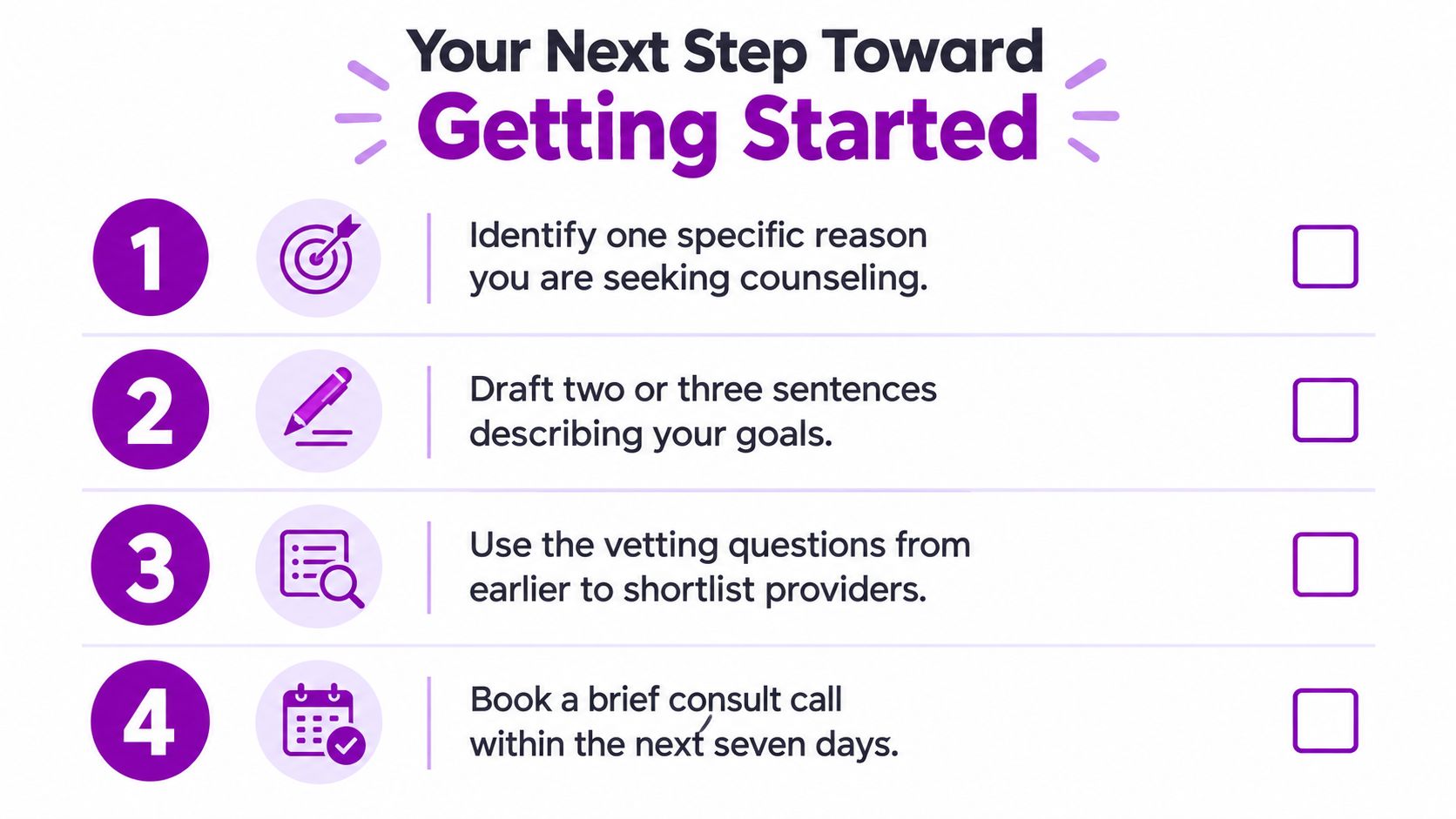
You don't need a complete treatment plan before making the first call. You need enough clarity to begin a conversation and enough permission to change direction if the fit isn't right.
Start with one specific reason you're seeking counseling. “I feel bad” is honest, but “I'm avoiding sleep because of recurring nightmares” gives a provider a clearer starting point. Then draft two or three sentences about what you want to change, what you're worried about, and what would make counseling feel manageable.
Use the vetting questions above when you contact providers. Ask about trauma-specific training, pacing, supervision, coordination, and how the clinician measures progress. Schedule one consultation call before agreeing to ongoing work.
Remove the barriers that stop follow-through
Cost uncertainty often leads people to postpone care. Ask whether the provider accepts your insurance, what verification involves, whether payment options exist, and whether a sliding scale is available. You can ask these questions without sharing your trauma history.
Scheduling creates another predictable obstacle. If weekly care seems difficult, ask about recurring appointment times, secure online sessions, or other available formats. A realistic appointment plan is more useful than a perfect plan you can't maintain.
Fear of retelling the story is also common. Tell the provider directly that you want to control the pace and ask whether the first appointment can focus on goals and stabilization. A trauma informed clinician should be able to explain how you can pause, decline a question, or revisit a subject later.
The evidence for broad trauma-informed care remains limited, and that honesty matters. A 2025 review concluded that the available studies were too variable and often too methodologically weak to determine effects for any outcome (the American Academy of Family Physicians editorial on the evidence gap). Trauma informed counseling is a process, not a single-session result. Your first conversation is also useful information about whether the provider listens, explains, collaborates, and respects your boundaries.
If you're in the Phoenix metro area, you can contact reVIBE Mental Health to ask about therapy, EMDR, psychiatry, medication management, locations, insurance, and secure online appointments. Visit reVIBE Mental Health to review the current care options and request a consultation, while keeping the same questions in hand for any provider you're considering.