

A trauma reminder can arrive without warning. Your heart may race, your body may tense, or you may feel numb and disconnected from the room around you. In that moment, you need a way to return to the present, not an exercise that forces painful memories open before you're ready.
Grounding and stabilization can often be practiced independently, especially when you're learning to notice early signs of distress. EMDR, Cognitive Processing Therapy, Somatic Experiencing, and Prolonged Exposure involve trauma processing and should be completed with an appropriately trained professional. These trauma therapy exercises can support care, but they aren't a substitute for assessment or treatment.
This guide organizes five approaches by what you may need: immediate stabilization, body-based regulation, cognitive processing, memory processing, or structured exposure. If distress becomes unmanageable, pause, look around the room, name where you are, contact someone you trust, or seek urgent help. You can also find trauma support in Coral Gables. In Arizona, reVIBE Mental Health offers therapy, EMDR, psychiatry, medication management, in-person and secure online sessions, and appointments seven days a week in Chandler, Phoenix Deer Valley, Phoenix PV, Scottsdale, and Tempe.
1. Eye Movement Desensitization and Reprocessing
EMDR is a therapist-led approach for processing distressing memories while maintaining awareness of the present. Its distinctive feature is bilateral stimulation, which may involve guided eye movements, alternating taps, or alternating sounds. The client focuses on selected elements of a traumatic memory while also following the therapist's structured prompts and monitoring changes in thoughts, emotions, body sensations, and distress.
EMDR follows an eight-stage process. Preparation matters because the therapist first helps establish safety, orientation, and coping skills before asking you to focus closely on traumatic material. A session may include identifying a painful image, a belief connected to it, a preferred adaptive belief, and the physical sensations that arise. The therapist then guides the processing while checking that you can return to the present and close the session safely.
EMDR has a substantial research base. It's supported by more than 30 published randomized controlled trials in adults and children, and a 2025 clinical and cost-effectiveness review reported a population effect size of SMD 1.86, with a 95% credible interval of 1.18 to 2.58 for trauma-focused therapy exercises delivered through structured protocols. Those findings support EMDR as a serious clinical treatment, not a self-guided eye movement exercise. (Review of EMDR evidence)

What a safe starting point looks like
A trained therapist may begin by helping you identify a calming image, orienting phrase, or grounding action. You can ask whether the session will use eye movements, tapping, or sound, and you can speak up if a particular method feels uncomfortable. You don't have to prove readiness by tolerating overwhelming activation.
Practical rule: If an exercise causes you to lose contact with the room, feel increasingly detached, or become unable to settle afterward, tell your therapist and stop the processing sequence.
EMDR may help people working through combat-related trauma, accidents, disasters, childhood abuse, or occupational trauma exposure. It can also be adapted to the person's pace and current stability. Learn more about how EMDR therapy is done and consider EMDR therapy for trauma when comparing professional options.
2. Cognitive Processing Therapy
Cognitive Processing Therapy, or CPT, gives language to the beliefs that trauma can leave behind. After an assault, accident, combat experience, or childhood trauma, someone may conclude, “I should have prevented it,” “I can't trust anyone,” or “the world is completely unsafe.” CPT doesn't dismiss the experience. It helps you examine whether trauma-related conclusions are accurate, useful, and consistent with the full context.
The therapist and client identify stuck points, meaning thoughts that keep fear, guilt, shame, anger, or avoidance active. You may write about the event, track the connection between a situation and your interpretation, and look for evidence that supports or challenges the belief. The work is structured, but it isn't about replacing painful thoughts with forced positivity. It's about developing a more balanced understanding that makes room for responsibility, safety, control, trust, and self-worth.
A simple thought record can show the process:
- Event: A friend doesn't respond to a message.
- Automatic thought: “Everyone eventually abandons me.”
- Emotion and body response: Fear, tight chest, urge to withdraw.
- Questions: What evidence supports this thought? What evidence doesn't? Is there another explanation?
- Balanced perspective: “The delayed response is uncomfortable, but it doesn't prove that I'm being abandoned.”
Why the written work matters
CPT often includes practice between sessions. Writing down stuck points can reveal patterns that are difficult to notice during a conversation, especially when shame or fear makes the thought feel like a fact. You can bring unfinished worksheets, confusion, resistance, or anger to the therapist. Those reactions are useful clinical information, not signs that you're failing.
CPT may fit someone who wants a clear framework for examining guilt after sexual assault, safety beliefs after combat, catastrophic thinking after an accident, or negative beliefs shaped by childhood trauma. It may feel demanding because it asks you to engage directly with interpretations rather than relying only on calming skills.
“A thought can feel certain without being complete.”
CPT is not a self-help instruction to challenge every upsetting thought while you're in crisis. If you're highly activated, dissociated, or at risk of harming yourself, stabilization and professional support come first. A qualified clinician can decide whether CPT fits your needs and how quickly to introduce trauma-focused writing.
3. Somatic Experiencing
Some people understand what happened but still feel trapped in body reactions. A sudden sound may create intense tension, a crowded room may trigger scanning and vigilance, or a reminder may produce numbness, shaking, stomach discomfort, or an urge to escape. Somatic Experiencing, often called SE, uses careful attention to body sensations as part of trauma-focused psychotherapy.
During a session, the therapist may ask you to notice one sensation without trying to intensify it. You might identify pressure in your shoulders, warmth in your face, a clenched jaw, a change in breathing, or an impulse to turn away. The therapist then helps you move between a difficult sensation and a more neutral or comfortable one. This gradual process is intended to support awareness, choice, and regulation rather than dramatic emotional release.
SE can be especially relevant when talk therapy alone hasn't captured the full problem. A combat veteran may notice persistent tension related to hypervigilance. An accident survivor may become aware of a freezing response. Someone with childhood trauma may need help recognizing what physical safety feels like before discussing memories in detail.
Gentle attention instead of forced release
SE is not a contest to produce shaking, catharsis, or a powerful bodily reaction. Independent shaking or TRE-style exercises may feel activating for some people, and the evidence around trauma-releasing exercises remains limited enough that researchers have called for stronger study designs and validated measurement tools. (Recent review of trauma-releasing exercises)
Try a modest self-guided version only when you feel oriented and reasonably steady:
- Place both feet on the floor and look at several objects in the room.
- Notice one neutral sensation, such as the chair supporting your back.
- Briefly observe a mild sensation, without searching for a traumatic memory.
- Return your attention to the neutral sensation.
- Stop if your distress rises, your awareness narrows, or you feel disconnected.
A therapist can adapt the pace, movement, and level of body focus. Read about somatic healing exercises and ask a clinician about whether SE is appropriate if you experience dissociation, severe hyperarousal, unexplained physical symptoms, or difficulty staying present.
4. Prolonged Exposure Therapy
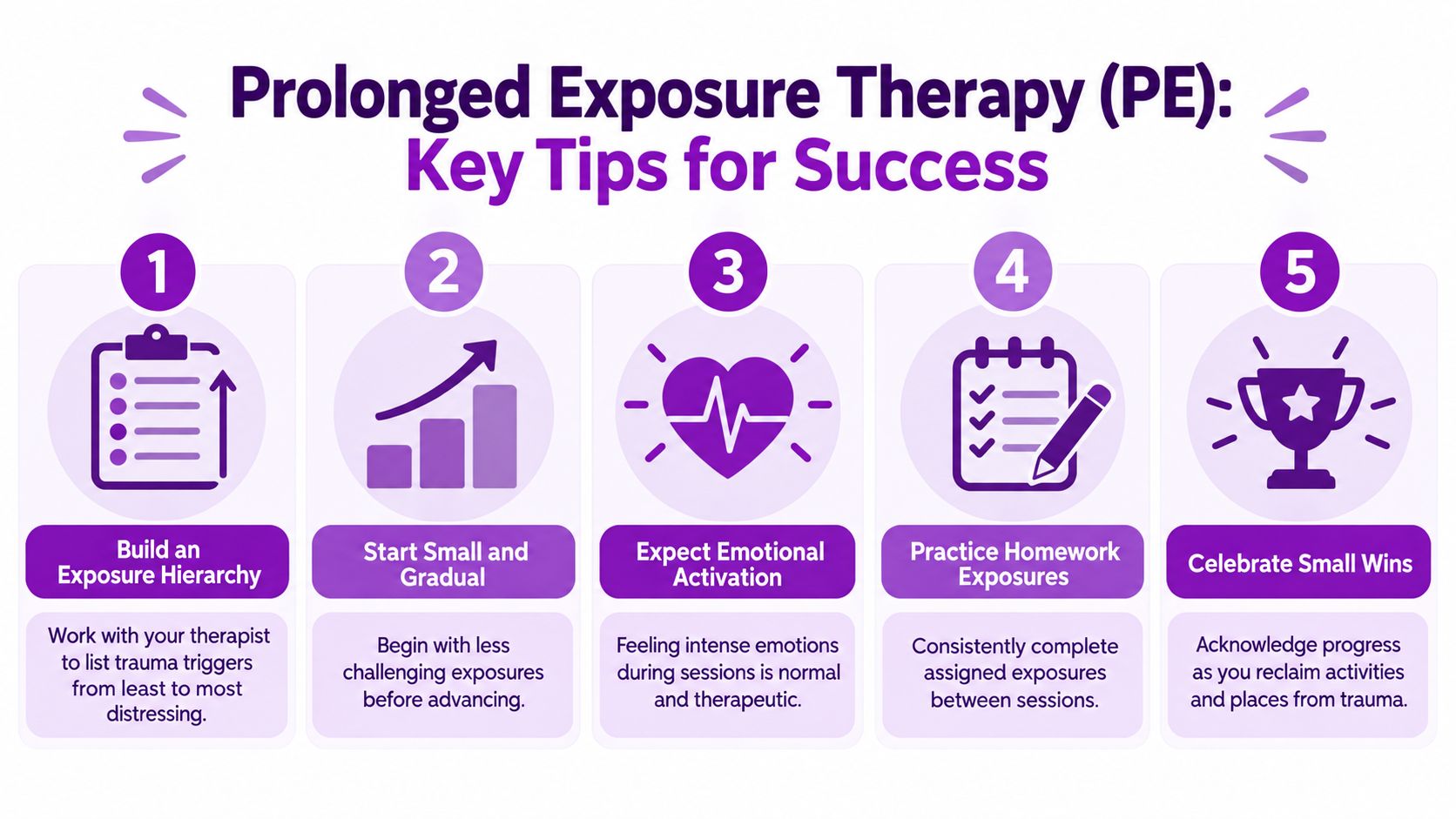
Prolonged Exposure Therapy, or PE, addresses the avoidance that can keep trauma reminders powerful. Avoiding driving after a crash, refusing crowded places after an assault, or staying away from public spaces after combat may provide short-term relief. Over time, however, avoidance can narrow daily life and prevent new learning about what is safe now.
PE uses two main forms of exposure. Imaginal exposure involves describing or revisiting the traumatic memory in a controlled therapeutic setting. In vivo exposure involves gradually approaching real-world situations, places, activities, or objects that trigger fear. The therapist and client create a hierarchy, beginning with manageable steps rather than jumping immediately to the most distressing situation.
For example, a motor vehicle accident survivor might first sit in a parked car, then ride as a passenger on a quiet road, and later work toward driving. A first responder may process an occupational memory while gradually returning to activities that have become associated with danger. An assault survivor may approach a feared setting through carefully chosen steps, with attention to personal safety and consent throughout.
Exposure requires a plan
PE is not the same as forcing yourself into a trigger, replaying a memory alone, or remaining in danger. The therapist explains the rationale, teaches coping and orientation skills, reviews reactions, and adjusts the hierarchy when a step is too difficult. Emotional activation can happen during treatment, but escalating panic, dissociation, or unsafe behavior requires immediate discussion with the clinician.
Exposure should expand choice, not remove it.
Consistency with agreed homework can support progress, but the activity must remain appropriate and safe. Don't create an exposure hierarchy from an online list and begin trauma memory work without professional guidance. PE is structured trauma treatment, and a trained therapist can distinguish therapeutic activation from destabilization.
5. Grounding and Mindfulness-Based Trauma Exercises
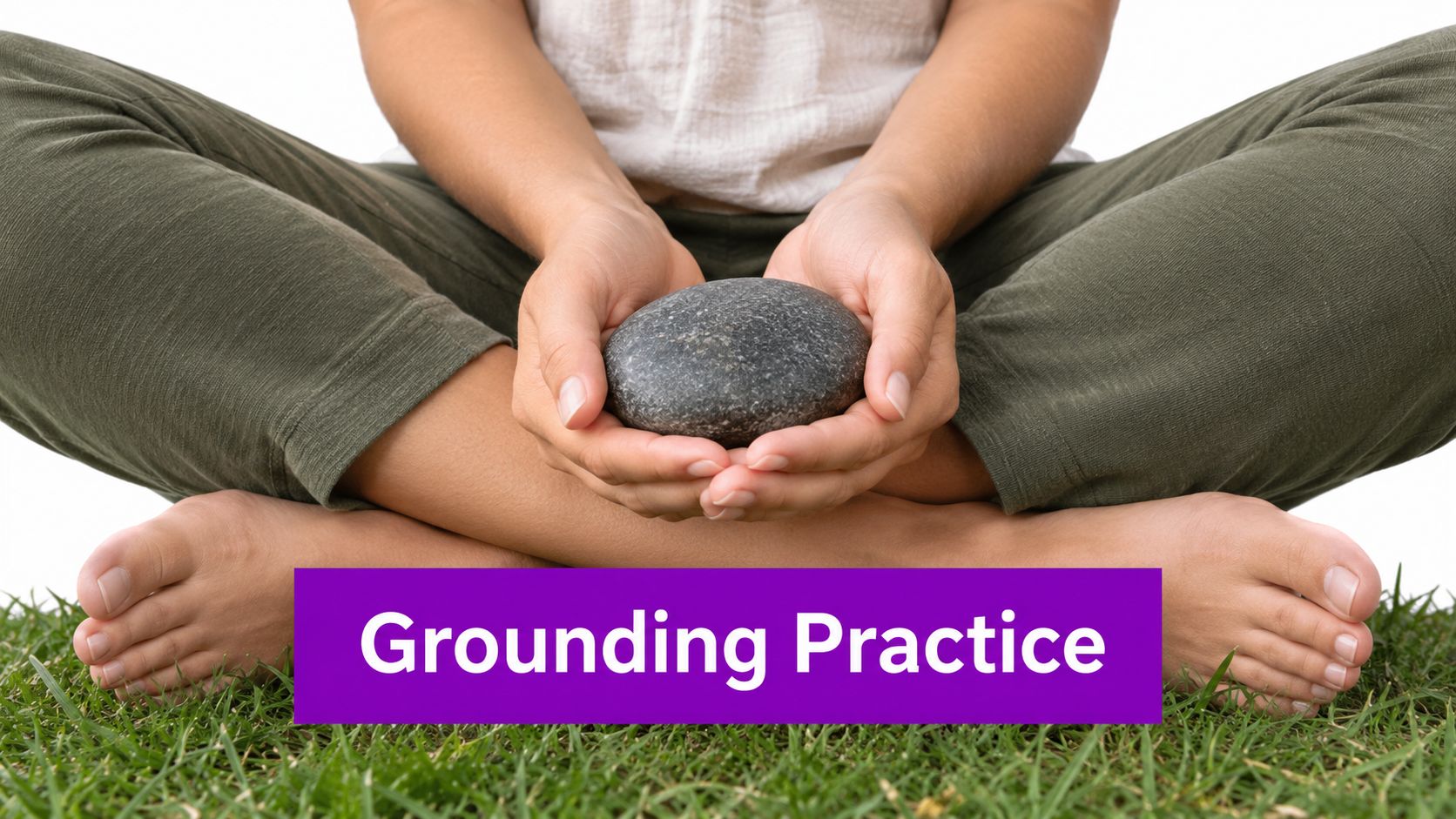
Grounding is often the right first category when you're panicking, numb, having a flashback, or struggling to stay connected to the present. These exercises don't process the traumatic memory. They help you notice where and when you are now, using sensory information, physical contact, breathing, movement, or attention.
The 5-4-3-2-1 method is one example. Name five things you can see, four things you can feel, three things you can hear, two things you can smell, and one thing you can taste. You can modify the sequence if counting feels stressful. Pressing your feet into the floor, holding a cool object, walking slowly while naming landmarks, or placing a hand on a stable surface can also provide present-moment information.
Mindfulness adds a nonjudgmental way to observe thoughts and sensations. A body scan might involve noticing the forehead, jaw, shoulders, chest, abdomen, hands, and legs without trying to force relaxation. Mindful walking can bring attention to the movement of your feet, the support of the ground, and the details of your surroundings.
Build a personal grounding menu
Practice when you're calm so the steps feel familiar during distress. A breathing pattern may soothe one person but increase panic in another, especially when attention to breathing feels threatening. Holding ice may help someone reconnect with the present, while intense cold can be uncomfortable or medically unsuitable for someone else.
Keep your menu simple:
- Sensory orientation: Name objects, colors, sounds, and surfaces in the room.
- Physical anchoring: Feel both feet on the floor or the support of a chair.
- Gentle movement: Walk, stretch, or press your hands together without forcing intensity.
- Connection: Text or call a trusted person and say that you need help staying present.
- Mindful attention: Notice one neutral sensation and return to it when your mind moves toward a flashback.
Use grounding techniques for anxiety as a starting point, then ask your therapist to adapt them to your triggers, preferences, and medical needs. In trauma-support apps, 53.1% included a trauma-informed section and 45.7% included content useful for trauma-related symptoms, while EMDR appeared as a therapeutic background in 8.6% of products, according to a 2023 review. (Review of trauma-support apps) Digital tools can supplement care, but they don't replace individualized safety planning.
5 Trauma Therapy Approaches Compared
| Therapy | Implementation complexity 🔄 | Resource requirements ⚡ | Expected outcomes ⭐📊 | Ideal use cases 💡 | Key advantages |
|---|---|---|---|---|---|
| Eye Movement Desensitization and Reprocessing (EMDR) | Structured 8‑phase protocol; requires certified clinician 🔄 | Certified EMDR therapist; multiple sessions; in‑person or secure online ⚡ | Often rapid PTSD symptom reduction; strong evidence ⭐⭐⭐ 📊 | PTSD, single‑incident & complex trauma; clients who struggle with verbal processing | Fast symptom relief; memory reprocessing; well‑researched |
| Cognitive Processing Therapy (CPT) | Manualized, time‑limited (≈12 sessions); moderate complexity 🔄 | Trained CBT clinician; regular homework and worksheets ⚡ | Measurable cognitive change; reduces PTSD, guilt/shame and comorbid depression ⭐⭐⭐ 📊 | PTSD with “stuck points” (blame, shame); clients willing to do homework | Structured, measurable, skill‑building; efficient time frame |
| Somatic Experiencing (SE) | Body‑focused, experiential approach; requires somatic training 🔄 | Somatic‑trained therapist; gradual pacing; session variability ⚡ | Improved nervous‑system regulation; reduced somatic symptoms; subtle/gradual gains ⭐⭐ 📊 | Clients with chronic physical symptoms, dissociation, or who prefer body‑based work | Addresses trauma in the body; gentle; reduces re‑traumatization risk |
| Prolonged Exposure Therapy (PE) | Highly structured exposure hierarchy; emotionally intense; high complexity 🔄 | Experienced PE clinician; homework in vivo/imaginal exposures; 8–15 sessions ⚡ | Robust, durable reduction in PTSD symptoms; extensive empirical support ⭐⭐⭐ 📊 | PTSD with avoidance patterns; clients ready to confront memories/situations | Directly targets avoidance; strong long‑term outcomes; evidence‑based |
| Grounding & Mindfulness‑Based Exercises | Low complexity; teachable in short sessions; scalable 🔄 | Minimal resources; self‑practice or brief clinician guidance; portable ⚡ | Immediate reduction in acute distress/hyperarousal; supports broader treatment ⭐ 📊 | Acute distress, flashbacks, panic, dissociation; adjunct to formal therapy | Readily accessible, empowering, enhances emotion regulation and engagement |
Choose Support That Matches Your Pace
The best trauma therapy exercise isn't necessarily the most intense one. It's the practice that matches your current level of safety, your symptoms, your goals, and the support available to you. If you're overwhelmed by a flashback or feel disconnected from your surroundings, start with grounding and mindfulness. These tools help you orient to the present without asking you to revisit the traumatic event.
If body sensations dominate, discuss somatic work with a qualified therapist. SE may offer a way to explore tension, numbness, impulses, and physical patterns gradually, but body-focused exercises can also feel activating. Move slowly, avoid chasing a dramatic release, and treat increased dissociation, panic, or agitation as a reason to pause and reassess.
EMDR, CPT, and Prolonged Exposure are different forms of structured trauma processing. EMDR uses bilateral stimulation while the client attends to selected memory material. CPT examines trauma-related beliefs and stuck points. PE approaches memories and avoided situations through a planned hierarchy. None should be improvised as an intense self-guided exercise.
Your response is information. If a practice leaves you more oriented and able to choose what happens next, it may be useful. If it intensifies flashbacks, dissociation, panic, or urges to self-harm, stop and tell a qualified professional.
Start with one manageable practice rather than collecting a long list. Track what increases distress, what decreases it, how long the effect lasts, and what conditions were present. Bring those observations to therapy so your clinician can refine your plan. Research on exercise-based trauma interventions also suggests that movement may be a useful adjunct to trauma care, while results vary across approaches and studies. A 2022 review reported an exercise effect size of ES = 0.46, with a 95% confidence interval from 0.18 to 0.74, for PTSD symptom severity compared with non-active treatment. (Review of exercise-based trauma interventions)
If you may act on thoughts of self-harm, can't stay safe, or are losing contact with reality, seek immediate crisis or emergency support rather than trying another exercise alone. Arizona readers can contact reVIBE Mental Health at (480) 674-9220 to ask about therapy, EMDR, psychiatry, and medication management. The practice offers in-person and secure online sessions, appointments seven days a week, and locations in Chandler, Phoenix Deer Valley, Phoenix PV, Scottsdale, and Tempe.
reVIBE Mental Health locations
- reVIBE Mental Health, Chandler: 3377 S Price Rd, Suite 105, Chandler, AZ
- reVIBE Mental Health, Phoenix Deer Valley: 2222 W Pinnacle Peak Rd, Suite 220, Phoenix, AZ
- reVIBE Mental Health, Phoenix PV: 4646 E Greenway Road, Suite 100, Phoenix, AZ
- reVIBE Mental Health, Scottsdale: 8700 E Via de Ventura, Suite 280, Scottsdale, AZ
- reVIBE Mental Health, Tempe: 3920 S Rural Rd, Suite 112, Tempe, AZ
You can also find a mental health support group if connection with others would make the next step feel more manageable. You don't have to decide on a lifetime treatment plan today. You only need a safe next step and support that respects your pace.
reVIBE Mental Health offers trauma-focused therapy, EMDR, grounding and mindfulness support, psychiatry, and medication management through in-person and secure online sessions. Visit reVIBE Mental Health or call (480) 674-9220 to discuss your goals and find care in Chandler, Phoenix Deer Valley, Phoenix PV, Scottsdale, or Tempe.